Beyond the Soil Triangle: Why Texture Alone Cannot Explain Crop Health
The Soil Triangle remains a foundational teaching tool, but modern soil science reveals that texture is only the beginning — microbial activity, organic matter, and root-soil relationships determine whether a crop thrives or struggles.

Expert insights
Meghana bhardwaj Kaul · Plant Microbiologist, Bengaluru
Meghana Bhardwaj Kaul is a Bengaluru-based plant microbiologist with over 15 years of experience in plant-microbe interactions, biofertilizers, biopesticides, and scalable agri-biotech solutions.
The short answer
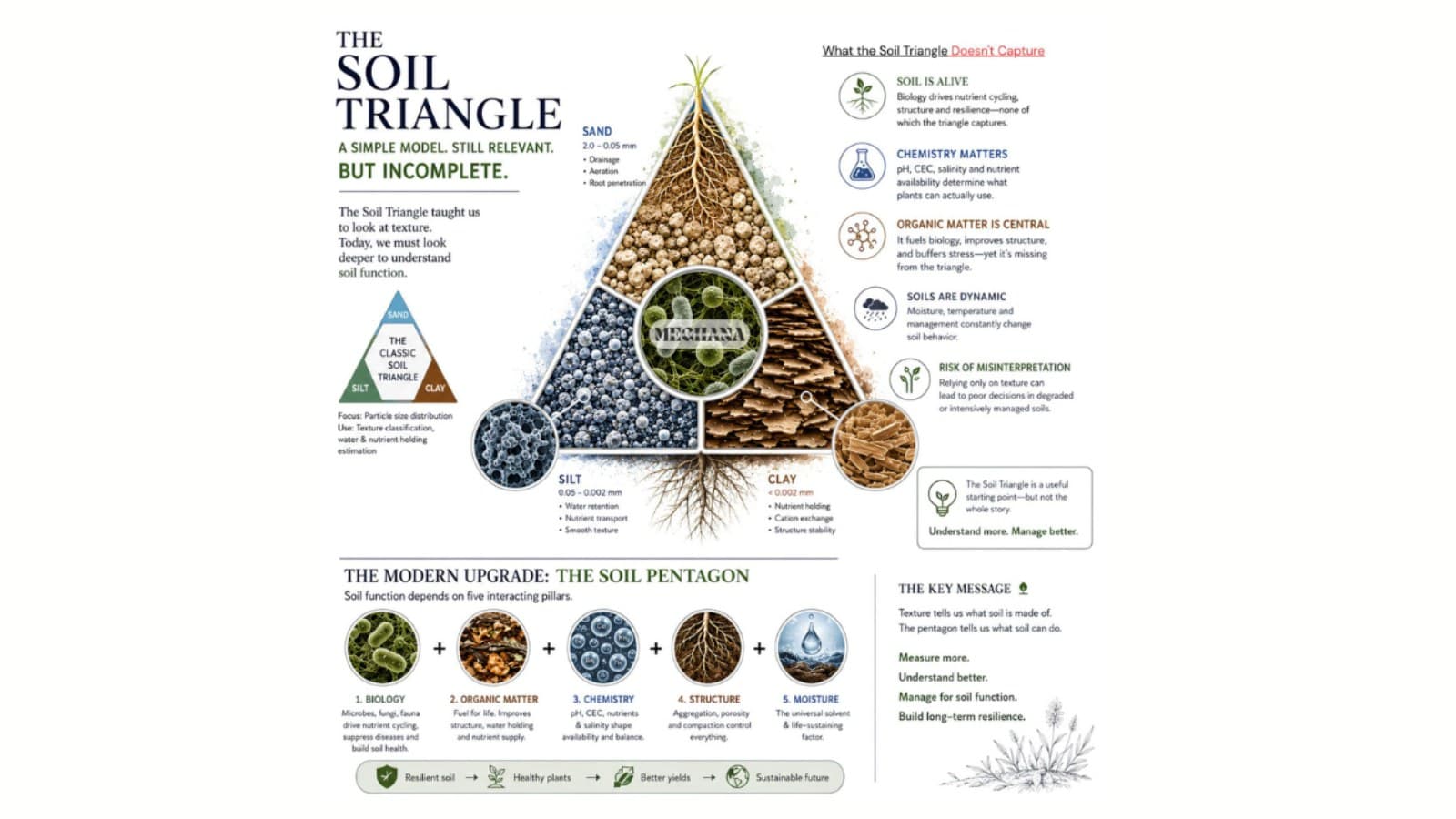
Two fields with nearly identical soil texture reports can produce completely different crop outcomes — one thriving, one struggling — because the Soil Triangle describes what soil is made of, not how it functions. Modern soil science has shifted decisively toward understanding biological, chemical, and structural relationships within the soil ecosystem. The future of productive agriculture lies not in discarding the Soil Triangle, but in layering it with the dimensions of biology, organic matter, structure, and chemistry.
The core problem
Same Triangle, Completely Different Fields
The Soil Triangle — the classic framework organising soils by their proportions of sand, silt, and clay — has guided generations of farmers and agronomists in assessing drainage, water retention, and workability. It remains a legitimate and valuable teaching tool. Yet the framework reveals its limits starkly in a scenario familiar to many practitioners: two fields returning nearly identical texture reports, yet producing sharply divergent crop outcomes. One crop flourishes; the other fails to establish. The triangle, in such cases, is not wrong — it simply was not designed to answer the question being asked. Texture describes the mineral skeleton of soil. It says nothing about whether the living community within that soil is active and functional.
The real debate
Both Sides of the Soil Argument Are Correct
A legitimate tension runs through soil science today. One school of thought holds that texture-first frameworks are outdated and that biology, organic matter, chemistry, structure, and moisture are far more consequential drivers of crop performance. A second school argues that without a baseline understanding of texture, every subsequent measurement becomes harder to interpret accurately. Both positions hold weight. The error is not in using the Soil Triangle — it is in treating it as a complete diagnosis rather than a first filter. Texture establishes the physical envelope within which biological and chemical processes operate. It cannot, however, reveal whether nutrients are locked in unavailable forms, whether roots have adequate aeration, or whether the soil retains the resilience to recover after drought, waterlogging, or tillage stress.
What soil science now says
From Description to Function: A Fundamental Shift
Contemporary soil science has moved its central question from what is this soil made of to how does this soil function. The distinction matters enormously at the field level. The healthiest, most productive soils are characterised not by hitting an ideal sand-silt-clay ratio but by the quality of relationships operating within them — between minerals and microbes, between roots and fungi, between organic matter and water, and between chemical and biological processes. As one analogy makes the point plainly: no physician would diagnose a patient on the basis of height and weight alone. Expecting a single textural triangle to fully explain a complex, living ecosystem is an equivalent limitation. The move toward multi-dimensional soil health assessment is not a rejection of existing knowledge — it is an expansion of it.
The path forward
Connecting Old Knowledge With Everything Learned Since
The practical question for farmers, input companies, and soil-health scheme designers is which additional dimension to prioritise when moving beyond texture. The candidates each carry weight:
- Biology — microbial community activity drives nutrient cycling and disease suppression
- Organic matter — feeds biology, improves water retention, and buffers chemical extremes
- Structure — determines root penetration, aeration, and erosion resistance
- Chemistry — governs nutrient availability, pH balance, and toxicity thresholds
- Moisture dynamics — integrates texture, structure, and organic matter into real-time plant-available water
The future of productive, sustainable agriculture is unlikely to rest on any single new framework replacing the Soil Triangle. It rests on using texture as one input among many — a foundation to build on, not a ceiling to stop at.
Why it matters
For Indian farmers and agronomists making decisions about inputs, amendments, and crop selection, this perspective is a practical caution: a texture report from a soil lab is a starting point, not a diagnosis. As agri-biotech solutions — biofertilizers, mycorrhiza, and microbial inoculants — become more widely available, soil health assessments that go beyond texture will become essential to achieving consistent productivity gains. Policymakers designing soil health schemes should consider whether current frameworks adequately capture biological soil function alongside physical texture.
Frequently asked
What does the Soil Triangle actually measure?
The Soil Triangle classifies soil by the proportions of three mineral fractions — sand, silt, and clay — and helps explain physical properties such as drainage, water-holding capacity, and workability. It does not measure biological activity, organic matter content, or nutrient availability.
Why can two fields with the same soil texture produce different crop results?
Because texture describes only the mineral skeleton of soil. Differences in microbial activity, organic matter, soil structure, chemistry, and moisture dynamics — none of which the Soil Triangle captures — can produce entirely different crop outcomes even when the sand-silt-clay ratio is identical.
Is the Soil Triangle still useful for farmers?
Yes. The Soil Triangle remains a valuable baseline tool and teaching framework. The recommendation is not to abandon it but to treat it as a starting point — layering texture data with assessments of biology, organic matter, structure, and chemistry for a complete picture of soil health.
What dimensions should be added to soil assessment beyond texture?
Soil science points to five key dimensions that complement texture: biological activity (microbial communities), organic matter, physical structure, chemical balance (including pH and nutrient availability), and moisture dynamics. Each reveals aspects of soil function that texture alone cannot explain.
This is an original IndianAgri report. The analysis and India context are IndianAgri's own.