The Cucumber Grew Fine. The Price Is What Decided the Profit.
Sixty quintals off half an acre, ₹40,000 of sales, ₹5,000 left over. Working back through the twelve picks shows the crop was never the weak link — the price on the day the crate reached the market was.

Field notes
Siddhant Patel · B.Sc Agriculture, Mahatma Gandhi Chitrakoot Gramodaya Vishwavidyalaya (MGCGV)
Agriculture student at MGCGV working on agribusiness, rural development and agri-finance, who ran a half-acre cucumber crop from sowing to sale and kept the books.
The short answer
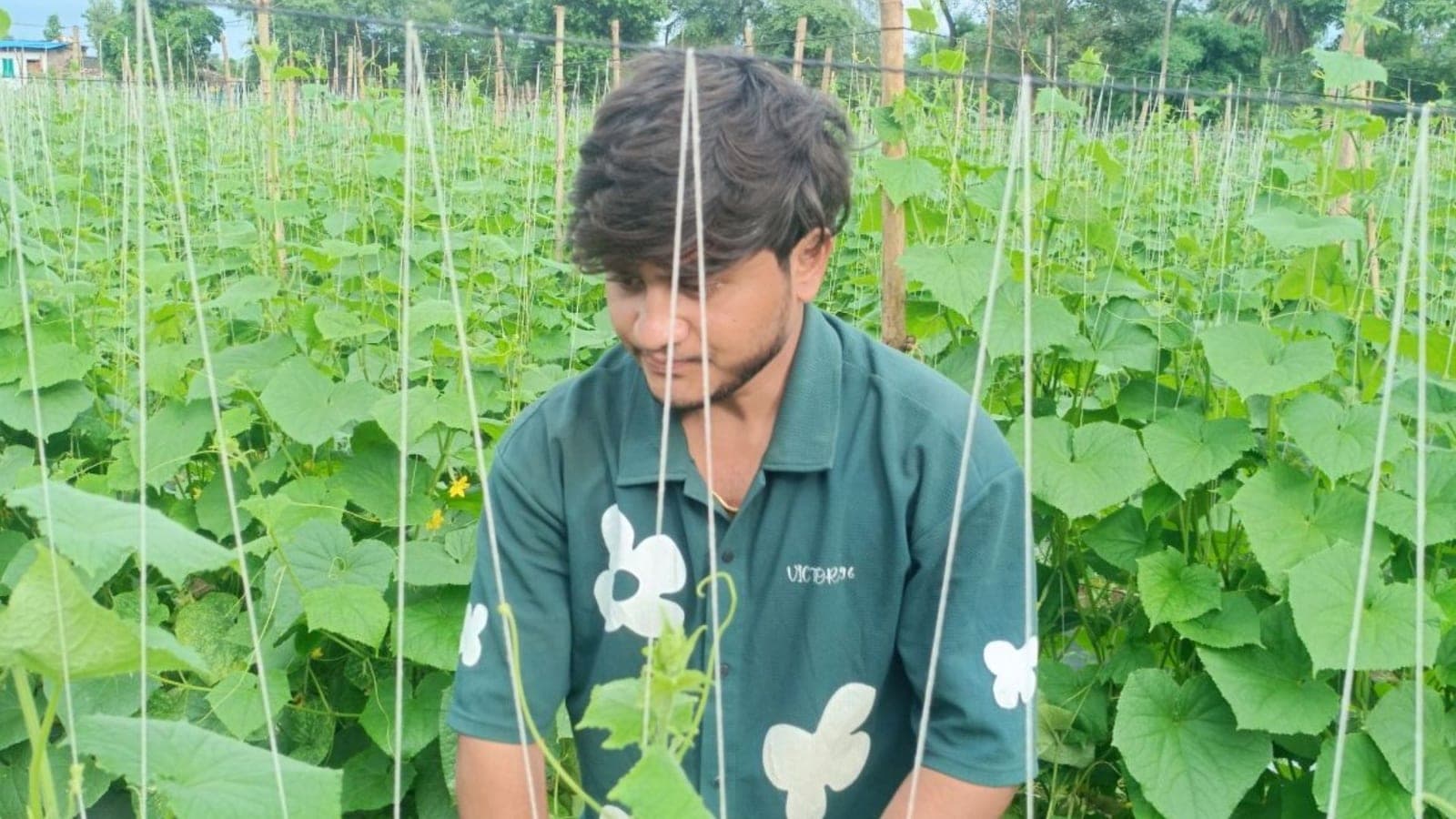
Half an acre of open-field cucumber, sown 20 June with drip and mulch, produced 60 quintals over twelve picks and sold for ₹40,000 against ₹35,000 of costs — ₹5,000 clear, a 14.3% return in 70 days. Each kilo carried ₹5.83 of cost, so the two heaviest picks, better than a third of the crop, sold below what they cost to grow. The final and smallest pick fetched twice their price.
The twelfth pick
The last pick paid twice what the biggest ones did
The final harvest off this half-acre plot was among the smallest of the season — five quintals, the twelfth time the vines were gone over. It fetched ₹11 a kilo, the best price of the whole 70 days. Six weeks earlier the third and fourth picks had come in fat: nine quintals, then twelve and a half. Between them they were more than a third of everything the plot ever produced. They sold at ₹5.50.
Same field, same vines, same season, and the price had doubled by the time the crop was nearly finished — except that by then there was very little left to sell. Sown on 20 June, the plot was picked twelve times between roughly 14 July and the end of August, about once every four days.
Sixty quintals came off half an acre, which is 120 quintals to the acre. The agronomy held up: drip irrigation and mulching on open ground did what they were supposed to do, and this is a perfectly respectable horticultural crop. What the season turned on was not how much came off the vines. It was what day each crate went to market.
The line under everything
₹5.83 a kilo is the number to write on the shed wall
₹35,000 went into the plot and 6,000 kg came out of it. Divide one by the other and every single kilo was carrying ₹5.83 of cost before it left the field. That one number sorts the whole season's picks into two piles.
| Pick | Quintals | ₹/kg | Realised |
|---|---|---|---|
| 1st (24 days after sowing) | 1.5 | 7.00 | ₹1,050 |
| 3rd | 9.0 | 5.50 | ₹4,950 |
| 4th | 12.5 | 5.50 | ₹6,875 |
| 12th and last | 5.0 | 11.00 | ₹5,500 |
| The other eight picks | 32.0 | 6.76 | ₹21,625 |
| Season | 60.0 | 6.67 | ₹40,000 |
Sold below the ₹5.83 it cost to grow. The eight unpriced picks are the residual — total sales less the four picks whose price was recorded.
The first pick at ₹7 cleared cost. The last at ₹11 cleared it comfortably. The two peak picks at ₹5.50 did not: 2,150 kg, better than a third of the crop, went out of the gate for less than it cost to put there. Across the whole season ₹40,000 over 6,000 kg averages ₹6.67 a kilo — eighty-four paise above cost, and that thin margin, multiplied by six thousand, is the ₹5,000.
Notice the shape of it. The money was made on the thin picks and given back on the heavy ones. A grower watching quintals pile up in week five would have felt the season going very well indeed.
…a farm becomes successful when that production is managed profitably.
Same sixty quintals
The identical crop could have been a ₹2,000 loss or a ₹31,000 profit
Hold the yield still and move only the price. Sold entirely at the season's low of ₹5.50, these 60 quintals would have taken ₹33,000 against ₹35,000 spent — a ₹2,000 loss on a crop that grew perfectly well. Sold entirely at the ₹11 the last pick fetched, the same crates would have taken ₹66,000 and left ₹31,000, six times what was actually earned.
The real outcome, ₹5,000, sits near the bottom of that range. Nothing about the growing separates those three numbers: same sowing date, same drip line, same 60 quintals in the crate. The entire spread is the price on the day.
Which is why how many quintals per acre is close to the least useful question you can ask about a vegetable crop, and why a yield figure quoted without a price realisation tells you almost nothing about whether the season paid.
If you are sowing this
Four things this changes about planning a cucumber crop
- Work out the break-even before sowing, not after. Budget divided by the kilos you realistically expect. On this plot it was ₹5.83. That number tells you, on any given morning, whether picking today is worth the labour of picking today.
- Stagger the sowing. The trouble here was that the two heaviest picks landed together in the cheapest week of the season. Two or three sowings a fortnight apart spread the peak across more price points instead of betting the crop on one of them.
- Treat a pick as a pricing decision. Quantity and price have to be managed together — a heavy pick into a soft market converts the best part of your crop at your worst rate, and cucumber will not wait on the vine while you think about it.
- Cost is the half you control. You cannot set the market price. You can set what the kilo costs to produce, and every rupee off that figure widens the band of prices at which the season still pays.
Field notes
Siddhant Patel
This was not a trial plot run by somebody else and written up afterwards. Patel sowed the half acre, laid the drip, picked it twelve times over seventy days, sold it and kept the books — a complete production cycle carried out as practical work. What follows is what the season taught him that the syllabus had not.
- Yield is not profit, and the gap between them is where farms fail. Sixty quintals is a result any grower would be pleased to report. It still only just cleared its own costs, because production and profitability are two separate problems and only the first one is taught properly.
- The market moves more than the crop does. Over one seventy-day season the price of the same cucumber ran from ₹5.50 to ₹11. Nothing the grower did — no input, no practice, no decision in the field — moved the outcome by anything close to that much.
- When you pick is a price decision, not a chore. Quantity and price realisation have to be handled as one thing. Getting the heaviest pick of the season into the weakest market of the season is a scheduling failure, and it is invisible until the accounts are added up.
- Cost control is where the margin actually lives. Input and operating costs are the part of the equation that answers to the grower. On a crop whose selling price can halve inside a fortnight, the cost per kilo is the only line you can defend.
- Selling is part of growing, not something that happens afterwards. A crop is not finished when it comes off the vine. Market linkage — knowing who buys, at what price, on which day — completes the cycle, and treating it as an afterthought is how a good harvest turns into a poor season.
His own summing up, after seventy days of it: a crop is produced successfully when it grows well, but a farm is only successful when that growing is managed into a profit.
Editorial note — how firm these figures are
- One plot, one season, self-reported. These are one grower's records of half an acre, published on LinkedIn, not a replicated trial. No district or mandi is named, so the ₹5.50–₹11 band cannot be checked against a published price series.
- Four of the twelve picks carry a stated price. The 1st, 3rd, 4th and 12th are sourced. The remaining eight — 32 quintals, ₹21,625, ₹6.76 a kilo — are IndianAgri's residual: total sales less the four known picks. If any single unpriced pick is misremembered, that average moves.
- The break-even, the average realisation and the per-acre figures are our arithmetic from the published totals of 60 quintals, ₹35,000 and ₹40,000. The ₹5,000 profit and the 14.3% return are the grower's own.
Why it matters
Vegetable growers are routinely advised in yield terms — quintals per acre, tonnes per hectare — and judged by them at every field day and training programme. This plot is a small, clean demonstration that on a short-duration crop with a volatile price, the same 60 quintals can be a loss or a comfortable profit depending on nothing but the week it is sold. For anyone advising smallholders on horticulture, break-even price per kilo and a staggered harvest calendar are worth more than another quintal of yield. For the grower, the number to know before sowing is not the expected yield. It is the price below which picking stops being worth doing.
Frequently asked
How much profit can you make from cucumber farming on half an acre?
On this plot, ₹5,000 — ₹40,000 of sales against ₹35,000 of costs over a 70-day crop, a return of about 14.3% on the money spent. Scaled up, that is roughly ₹10,000 an acre for the season, though it moves sharply with the price at which the crop is sold.
What is the break-even price for cucumber per kg?
₹5.83 a kilo on this half-acre plot, being ₹35,000 of cost spread over the 6,000 kg produced. Any pick sold below that price loses money no matter how many quintals it runs to, which is what happened to the two heaviest picks of the season at ₹5.50.
How many days does cucumber take from sowing to harvest?
About 70 days for the full cycle here. Sown on 20 June, the first pick came 24 days after sowing and the twelfth and final pick closed the crop at the end of August — roughly one pick every four days through the harvest window.
How many quintals of cucumber can you get per acre?
This plot produced 60 quintals on half an acre, which works out at 120 quintals — 12 tonnes — an acre, grown in the open field with drip irrigation and mulching.
About the author
Siddhant Patel
B.Sc Agriculture, Mahatma Gandhi Chitrakoot Gramodaya Vishwavidyalaya (MGCGV)
Agriculture student at MGCGV working on agribusiness, rural development and agri-finance, who ran a half-acre cucumber crop from sowing to sale and kept the books.
Field notes
Ran a plot, a trial or a survey? We would like to publish it.
IndianAgri publishes field work by agriculture students and researchers — a crop you took from sowing to sale, a trial you ran, a village you surveyed. What we need is not a polished article. It is your records: the dates, the yields, the costs, the prices you actually got. We do the writing, check the arithmetic, and publish it under your name with your institution.
A season that lost money is as worth reading as one that paid — often more, because nobody publishes those.
Or write to info@agri.net.in with your dates, yields, costs and the prices you got.