Biochar: How Pyrolysis Can Turn India's Crop Residues into Soil Health and Farmer Income
India's vast agricultural residue burden could become a climate and income opportunity — through biochar, a pyrolysis-derived soil amendment aligned with PM-PRANAM, JI-VAN Yojana, and India's Net Zero 2070 goal.

Expert insights
Vimal Kumar Upadhyay · Executive Agronomist, Absolute
Vimal Kumar Upadhyay is an Executive Agronomist at Absolute, holding an M.Sc. in Soil Science, specialising in nutrient management, crop advisory, and precision farming.
The short answer
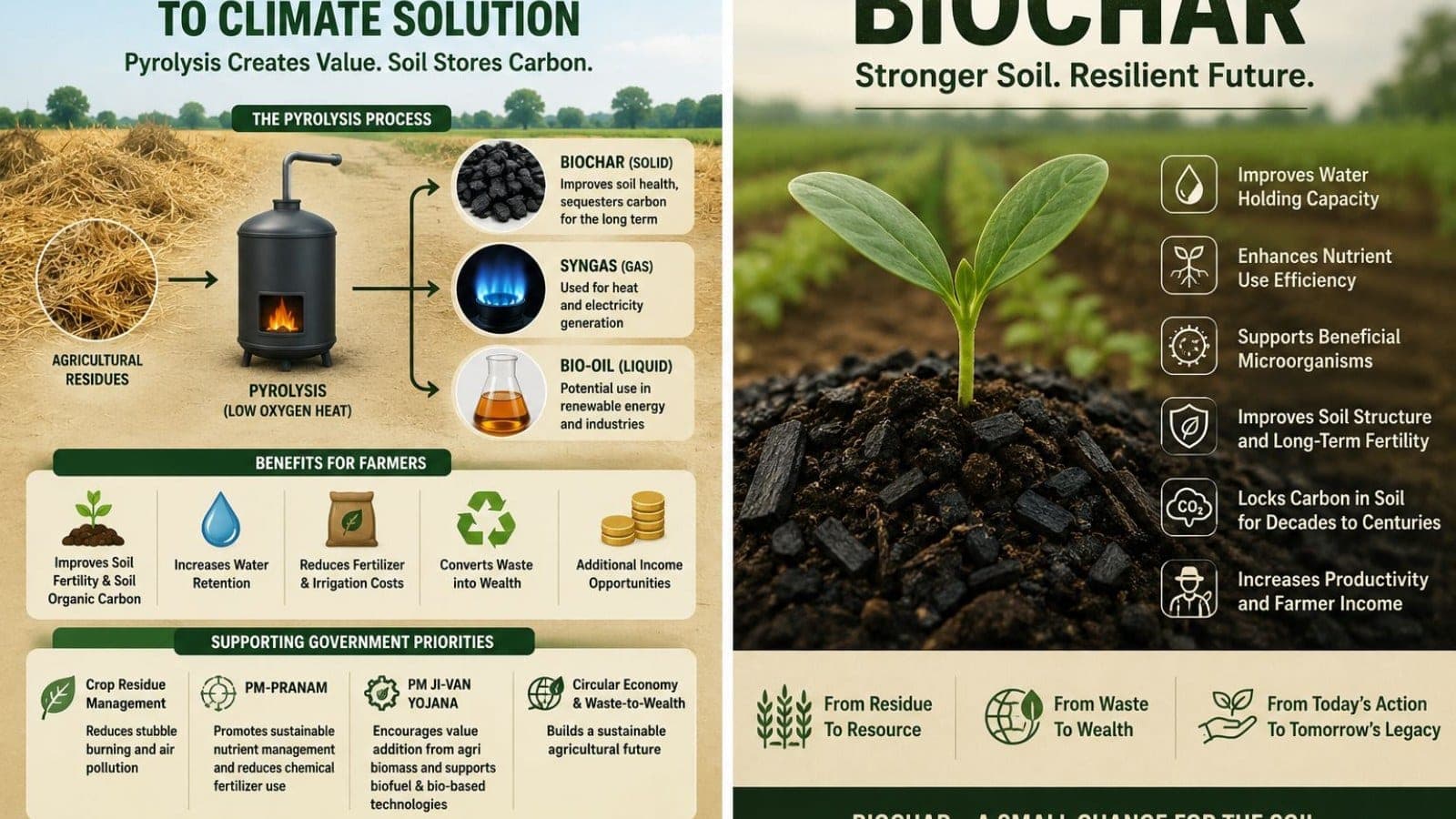
Every year, India produces millions of tonnes of crop residues that are largely burnt in open fields. Pyrolysis — heating this biomass in a low-oxygen environment — converts residues into biochar, syngas, and bio-oil, each offering distinct agronomic, energy, or commercial value. Biochar, the solid output, improves soil organic carbon, water retention, and nutrient-use efficiency, while also creating potential income streams for farmers through biomass utilisation and verified carbon removal projects.
The residue problem
Millions of Tonnes, Burnt Away Every Year
India generates millions of tonnes of agricultural residues annually, and open-field burning remains a widespread disposal method — a practice that degrades air quality, destroys topsoil microbiota, and squanders a potentially valuable raw material. The scale of the problem makes business-as-usual increasingly untenable, both environmentally and economically.
Pyrolysis — the controlled heating of biomass in a low-oxygen environment — offers a direct conversion pathway. Rather than releasing carbon and particulates into the atmosphere, the process captures the energy and carbon locked in crop waste and redistributes it across three commercially relevant output streams: a solid (biochar), a gas (syngas), and a liquid (bio-oil).
What pyrolysis produces
Three Output Streams, Each With Distinct Value
Biochar (solid): The primary agronomic product, biochar improves soil organic carbon (SOC), enhances a soil's water-holding capacity, increases nutrient-use efficiency, and supports beneficial microbial communities. Over time, these effects can translate into lower fertiliser input costs for farmers — a concrete economic incentive alongside the environmental benefit.
Syngas (gas): The gaseous output can be used to generate heat or electricity, improving the overall energy efficiency of the pyrolysis operation itself and reducing its running costs.
Bio-oil (liquid): The liquid fraction carries potential applications in renewable energy and industrial processing, adding a third value layer to what would otherwise be waste biomass.
Together, the three streams reframe agricultural residue from a disposal burden into a multi-product feedstock.
Policy alignment
Existing Schemes Already Support Biochar's Rollout
India does not yet have a dedicated National Biochar Policy, but the technology aligns clearly with several live Government of India programmes:
- PM-PRANAM promotes sustainable nutrient management and reduced dependence on chemical fertilisers, making soil-improving technologies like biochar directly relevant to its mandate.
- Pradhan Mantri JI-VAN Yojana supports value addition from agricultural biomass and encourages residue-to-product conversion over burning.
- Crop Residue Management (CRM) initiatives fund and promote alternatives to stubble burning, targeting cleaner air and better biomass utilisation.
The absence of a dedicated biochar policy is a gap, but the alignment across three separate central schemes suggests that institutional groundwork is already in place for mainstreaming the technology.
The climate and income case
From Soil Amendment to Climate-Smart Livelihood Tool
Biochar's value proposition extends well beyond agronomy. As a stable, carbon-rich material derived from biomass, it functions as a long-term carbon sink — sequestering carbon that would otherwise be released through burning or decomposition. This makes it a credible input for verified carbon removal projects, potentially opening a secondary income stream for farmers who supply biomass or participate in structured programmes.
At the macro level, scaled biochar adoption supports multiple objectives simultaneously: reduced air pollution from stubble burning, improved farm-level soil health and productivity, rural energy generation from syngas, and a measurable contribution to India's Net Zero 2070 climate commitment. The convergence of agronomic, environmental, and economic benefit in a single technology is what distinguishes biochar from narrower soil-amendment solutions.
Why it matters
With stubble burning continuing to trigger seasonal air-quality crises across major farm states, biochar offers a technically viable, policy-aligned alternative that simultaneously improves soil health and opens new rural income channels. The technology sits squarely within existing government schemes — PM-PRANAM, Pradhan Mantri JI-VAN Yojana, and CRM initiatives — giving it real traction as India moves toward its Net Zero 2070 target. Farmers, agri-input companies, and carbon-market participants should watch for any dedicated national biochar policy, which remains absent at this stage but would be a significant enabler.
Frequently asked
What is biochar and how is it produced?
Biochar is a solid, carbon-rich material produced by heating agricultural biomass in a low-oxygen environment through a process called pyrolysis. The same process also yields syngas and bio-oil as co-products.
How does biochar benefit farmers?
Biochar improves soil organic carbon, enhances water-holding capacity, increases nutrient-use efficiency, and supports beneficial soil microbial activity. Over time, it can reduce fertiliser input costs and, where applicable, generate additional income through biomass utilisation and verified carbon removal projects.
Which government schemes support biochar adoption in India?
Three central schemes align with biochar: PM-PRANAM (sustainable nutrient management), Pradhan Mantri JI-VAN Yojana (biomass value addition), and Crop Residue Management initiatives (alternatives to stubble burning). India does not yet have a dedicated National Biochar Policy.
How does biochar contribute to India's climate goals?
Biochar sequesters carbon that would otherwise be released through open burning or decomposition, making it a long-term carbon sink. This contribution supports India's Net Zero 2070 vision while simultaneously reducing air pollution from stubble burning.
This is an original IndianAgri report. The analysis and India context are IndianAgri's own.