India Potato Summit 2026, Lucknow: Dates, Programme, Stalls and the UP Call to Growers
Uttar Pradesh grows a third of India's potatoes and sold 20 lakh tonnes of them to the government this year at distress prices. In November its districts are sending growers to Lucknow to meet the buyers, processors and bankers who could change that.
The short answer
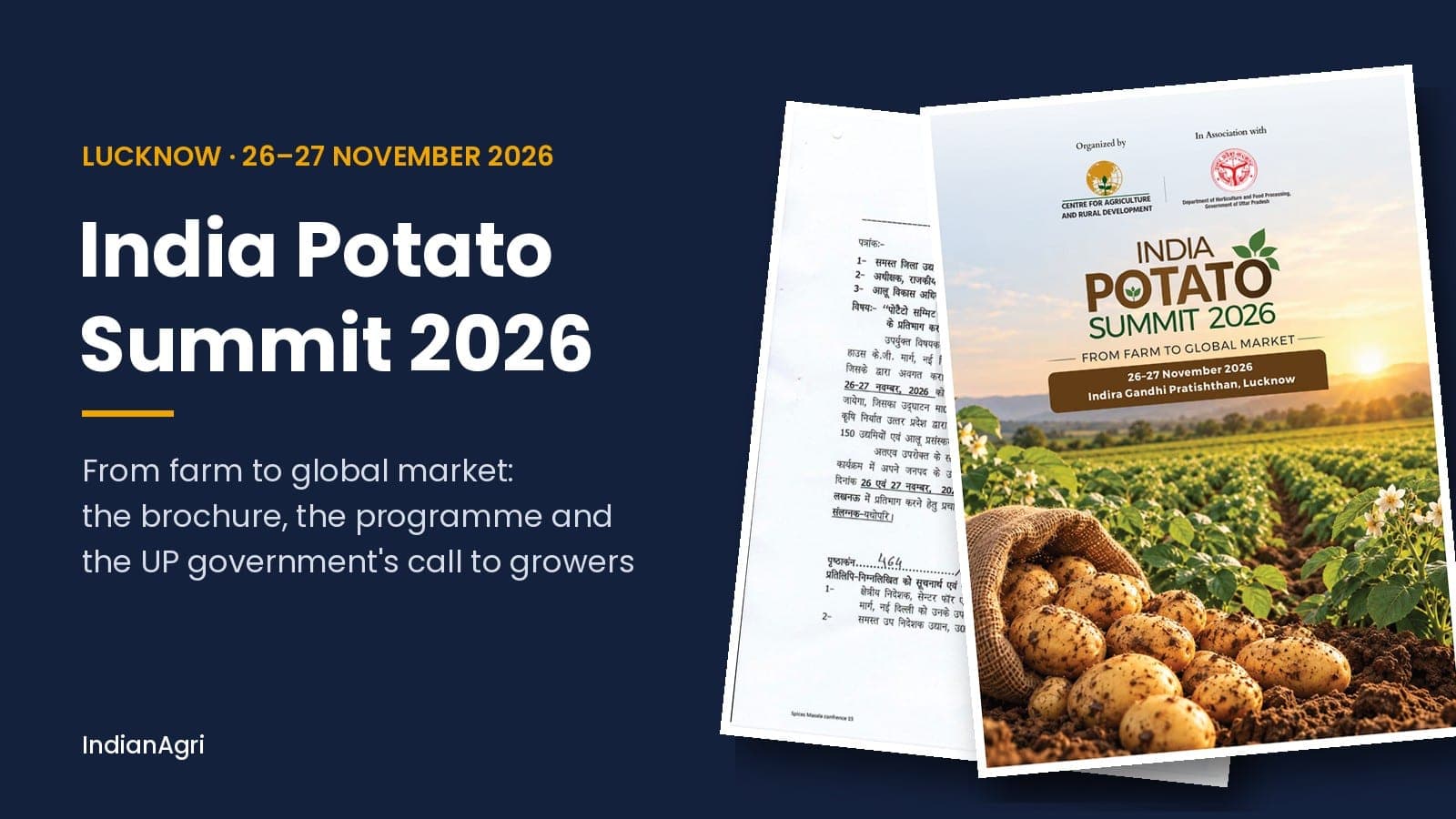
The India Potato Summit 2026 — From Farm to Global Market — takes place on 26 and 27 November 2026 at the Pluto Auditorium, Indira Gandhi Pratishthan, Lucknow. It is organised by the Centre for Agriculture and Rural Development (CARD) in association with the Department of Horticulture and Food Processing, Government of Uttar Pradesh, and combines technical sessions, a technology exhibition and FPO–industry business meetings. On 16 October 2026 the Directorate of Horticulture, Uttar Pradesh, asked district officers to send outstanding potato growers, entrepreneurs and processors, against CARD's request for 150 participants a day. Sessions cover seed and varieties, cold storage, processing, export and phytosanitary standards, FPO supply agreements and enterprise finance. A 3 m × 3 m expo stall costs ₹80,000 plus GST; sponsorship runs from ₹2.5 lakh to ₹15 lakh.
Start here
Two days in Lucknow, and the state is sending growers
Uttar Pradesh grows about a third of India's potatoes, and for two days at the end of November the people who grow, store, process and sell them are being asked to sit in one hall.
The India Potato Summit 2026 — From Farm to Global Market runs on Thursday 26 and Friday 27 November 2026 at the Pluto Auditorium, Indira Gandhi Pratishthan, Lucknow. It is organised by the Centre for Agriculture and Rural Development (CARD), a New Delhi non-governmental organisation registered in 2000, in association with the Department of Horticulture and Food Processing, Government of Uttar Pradesh. The format is three things at once: technical sessions, a technology exhibition, and scheduled business meetings between farmer producer organisations and industry.
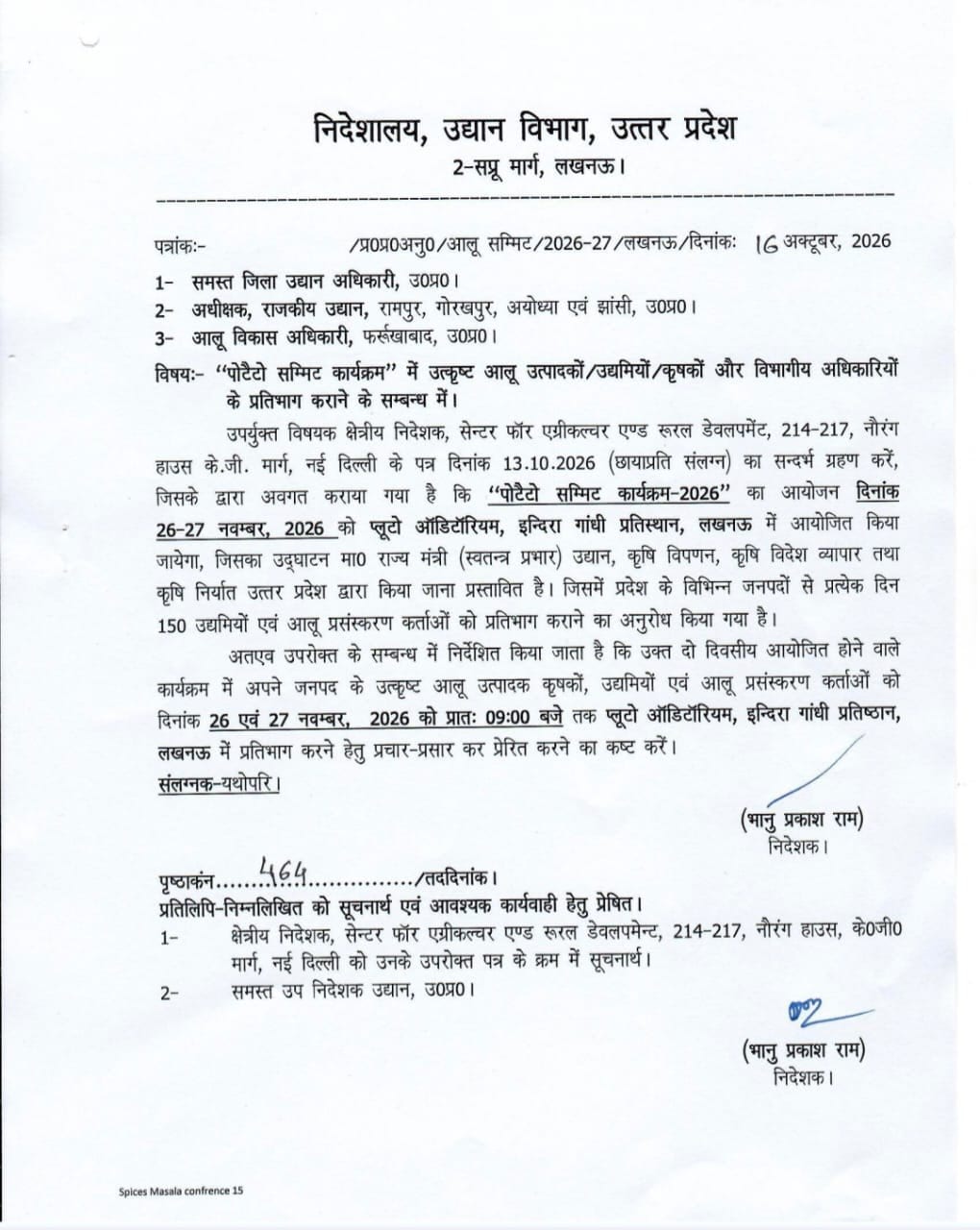
What lifts it above an ordinary conference notice is a letter. On 16 October 2026 the Directorate of Horticulture, Uttar Pradesh wrote to every District Horticulture Officer in the state, to the superintendents of the government gardens at Rampur, Gorakhpur, Ayodhya and Jhansi, and to the Potato Development Officer at Farrukhabad. CARD had asked for 150 entrepreneurs and potato processors from the districts on each day, and the Director told the districts to publicise the summit and encourage their best potato growers, entrepreneurs and processors to be in Lucknow by 9 a.m. on both days. The letter also says the inauguration is proposed to be done by the state's Minister of State (Independent Charge) for Horticulture, Agricultural Marketing, Agricultural Foreign Trade and Agricultural Export.
In plain terms: a processor, seed company or machinery maker who takes a stall here can expect growers who were sent by their own district office, not just whoever walks in.
The two documentsRead the source, not our summaryThe organiser's full brochure — background, programme, who should attend and sponsorship — and the Directorate of Horticulture's letter of 16 October 2026 to the districts, in the original Hindi.Summit brochureUP Horticulture letter
Why now
A very large crop, and a very small export cheque
The brochure makes its case in one comparison, and it is worth reading slowly.
India harvests far more potato than the countries that make money from it. On the organisers' figures, drawn from FAO data for 2023, India produced about 60 million tonnes, the Netherlands 6.5 million and Belgium 4 million. Yet in calendar 2024 exports of frozen prepared potatoes, French fries included, earned Belgium about US$3.7 billion, the Netherlands US$2.7 billion and Canada US$2.1 billion — against roughly US$203 million for India. Belgium, with a fifteenth of India's crop, earned around eighteen times as much from this one product line.
India is moving. Government-reported exports of value-added potato products reached 2.77 lakh tonnes, worth US$289.4 million, in 2025-26, the brochure notes. But the same year showed the other side of a big crop: in April 2026 the Centre approved procurement of 20 lakh tonnes of potatoes in Uttar Pradesh under the Market Intervention Scheme because prices had collapsed. And the International Potato Center's South Asia Regional Centre at Agra, approved in June 2025, gives research a base in the same state.
That is the summit's argument: the problem is no longer how much India grows, but who buys it, in what form, and at what price.
The numbers
What the official figures actually say
Uttar Pradesh produced 20.4 million tonnes of potato in 2024-25, about 34.8% of the national crop and the largest of 29 reporting states.
That works out at 118.2 quintals an acre, a figure we derive from the published area and production because the department publishes no yield series for this crop. It is an average across every grower; what one acre gives depends on variety, season, irrigation and soil.
| Measure | Uttar Pradesh | Period |
|---|---|---|
| Production | 20.4 million tonnes | 2024-25 (Final Estimates) |
| Area | 698 '000 hectares | 2024-25 |
| Yield per acre | 118.2 quintals (29,200 kg/ha) | 2024-25, derived |
Compiled by IndianAgri from Horticulture Statistics Division, Department of Agriculture & Farmers Welfare, Ministry of Agriculture & Farmers Welfare, Government of India. Every figure on this page carries its originating department, its estimate round and the date we took it — see the full potato series, six years deep, by state.
The programme
Seed on day one, money on day two
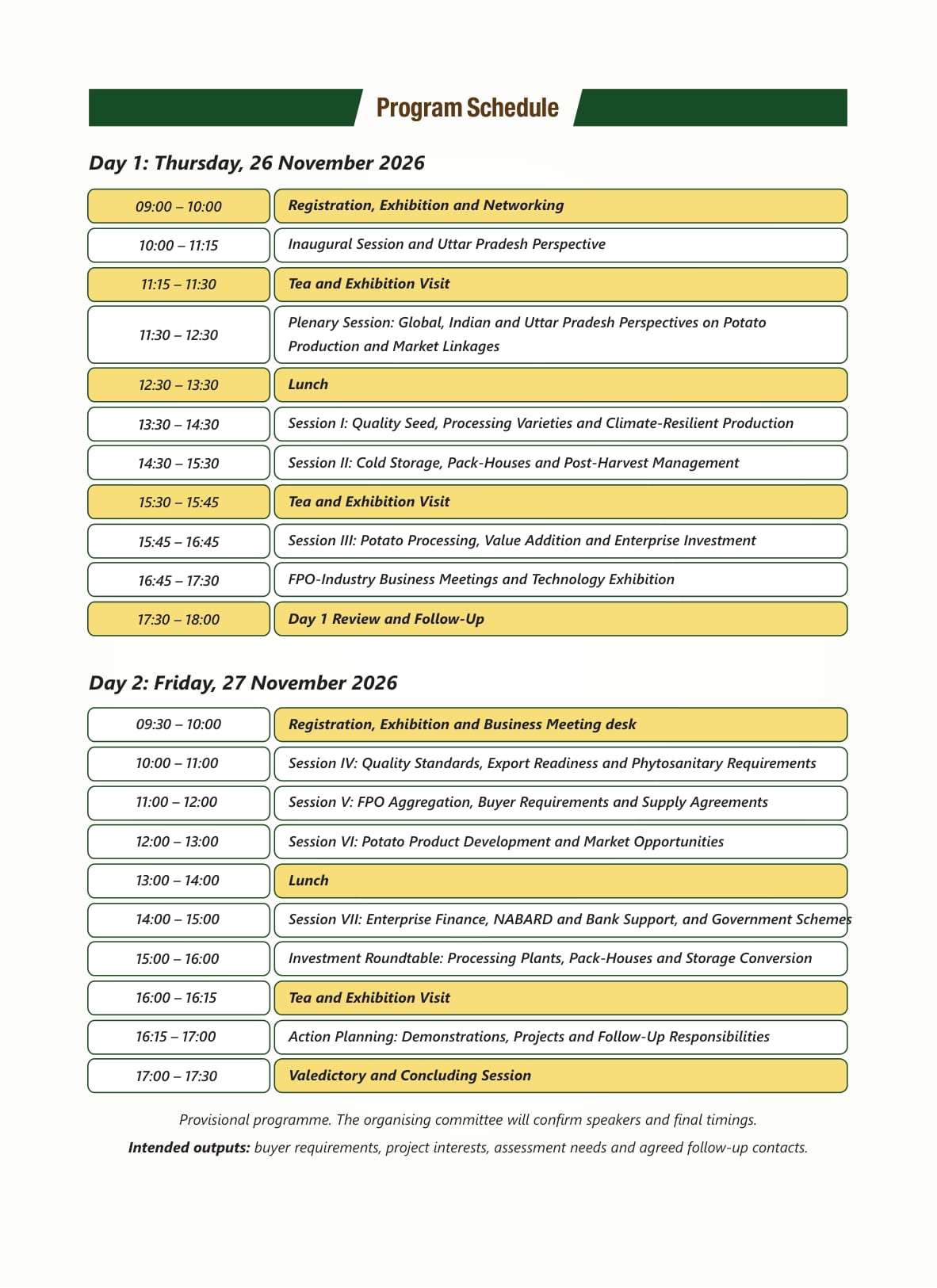
The organisers publish a provisional two-day programme; speakers and final timings are still to be confirmed.
Day 1 — Thursday 26 November. Registration and exhibition from 9:00, the inaugural session and an Uttar Pradesh perspective at 10:00, then a plenary on global, Indian and UP potato production and market links. The afternoon runs three working sessions back to back:
- Session I — quality seed, processing varieties and climate-resilient production
- Session II — cold storage, pack-houses and post-harvest management
- Session III — potato processing, value addition and enterprise investment
It closes with FPO–industry business meetings in the exhibition from 16:45, and a day-one review.
Day 2 — Friday 27 November. From 9:30, with a business meeting desk open alongside registration:
- Session IV — quality standards, export readiness and phytosanitary requirements
- Session V — FPO aggregation, buyer requirements and supply agreements
- Session VI — potato product development and market opportunities
- Session VII — enterprise finance, NABARD and bank support, and government schemes
- Investment roundtable — processing plants, pack-houses and cold-storage conversion
The summit ends with an action-planning session on demonstrations and projects, and the valedictory at 17:00. The organisers say the intended outputs are buyer requirements, project interests, assessment needs and agreed follow-up contacts — a useful test of whether the two days were worth it.
Who should go
If you touch a potato between the field and the fryer
The brochure lists twelve kinds of participant. Grouped by what each would come for:
- Growers and FPOs — buyers' specifications, aggregation and supply agreements, and the finance session if a pack-house or store is on the plan
- Seed companies — the variety and seed session, and the growers the districts are sending
- Processors of chips, fries, flakes and starch — contract supply, and the export and phytosanitary session
- Cold storage, logistics, grading, packing and testing firms — the post-harvest session and the storage-conversion roundtable
- Machinery, fertiliser and crop-protection companies — an exhibition audience of growers who were invited by name
- Banks and financial institutions — the finance session and the investment roundtable
- Exporters and traders, and government and research institutions
The discussion areas the organisers name are practical rather than grand: reliable seed and varieties matched to the buyer, grading and temperature control so a potato still meets the specification on the day of sale, heat and disease risk, a role for women, young farmers and trained agri-entrepreneurs, and credit — NABARD refinance, bank lending and subsidies for processing units, cold stores, pack-houses and FPO-led enterprises.
Exhibit or sponsor
A 3 × 3 metre stall is ₹80,000; sponsorship runs from ₹2.5 lakh
For companies the summit is sold in five ways. The figures are the organisers', as printed in the brochure:
| Option | Price | What comes with it |
|---|---|---|
| Title sponsor | ₹15 lakh | 36 sq m of exhibition space, 10 delegate passes, a 20-minute presentation, back cover of the souvenir, a 3-minute corporate film, largest logo |
| Gold sponsor | ₹10 lakh | 18 sq m, 8 passes, a 15-minute presentation, a full inside page in the souvenir |
| Silver sponsor | ₹5 lakh | 9 sq m, 5 passes, a 10-minute presentation, a half page in the souvenir |
| Associate sponsor | ₹2.5 lakh | 6 sq m, 3 passes, a quarter page in the souvenir |
| Expo stall only | ₹80,000 + GST | One 3 m × 3 m stall |
Every sponsor tier also puts a catalogue or leaflet in each delegate kit, with the copies supplied by the sponsor. Title and Gold sponsors are acknowledged at both the inaugural and the concluding sessions; Silver and Associate at the concluding session.
Delegates register through a QR code printed on the back page of the brochure; the brochure does not state a delegate fee, so ask the organisers before you travel.
Summit brochureIndia Potato Summit 2026, all six pagesThe organisers' background note, the full programme, the twelve participant groups, every sponsorship tier and the delegate registration QR code.Download the brochure
The brochure also prints the organiser's bank account for payment. We have deliberately not reproduced it here: confirm payment details with CARD directly, by phone, before transferring any money.
Contacts
Who to call, and the potato event three weeks later
For participation, exhibition and sponsorship the organisers list:
- Shobhit Shrivastava, Regional Director, CARD — +91 96213 61577
- M. S. Khan, Nodal Officer — +91 99972 86694, shakeel@card.org.in
- Arindam Singha Roy, Executive Director, CARD — +91 92892 77447
- CARD head office, B-Wing, 2nd Floor, Naurang House, K.G. Marg, New Delhi 110001 — 011-41501465, card.org.in
Growers in Uttar Pradesh have a shorter route: the District Horticulture Officer in your district received the Directorate's letter and has been asked to send growers and processors to Lucknow.
Lucknow is not the season's only potato meeting. The Global Potato Summit 2026 follows at Gandhinagar on 16 and 17 December — our listing has the details. The two are different animals: Lucknow is a state-backed meeting built around Uttar Pradesh's growers and FPOs, Gandhinagar a trade summit for the processing and seed industry. For the state-by-state picture behind both, see Uttar Pradesh's share of India's potato crop on our sister site IndianPotato, and India's frozen fries exports for 2025-26 for the export side.
Why it matters
India grows close to 60 million tonnes of potato a year but earns a small fraction of what Belgium or the Netherlands earn from processed potato exports, and Uttar Pradesh — the largest producing state — needed government procurement of 20 lakh tonnes in April 2026 to support collapsed prices. A summit that puts district-nominated growers in the same room as processors, cold-storage operators, exporters and banks is aimed at exactly that gap: contract supply, storage and processing capacity, and the finance to build them. For a company selling seed, machinery, storage or processing equipment, it is an unusually well-targeted grower audience.
Frequently asked
When and where is the India Potato Summit 2026?
On 26 and 27 November 2026 at the Pluto Auditorium, Indira Gandhi Pratishthan, Lucknow, Uttar Pradesh. Registration opens at 9:00 on the first day and 9:30 on the second.
Who is organising the India Potato Summit 2026?
The Centre for Agriculture and Rural Development (CARD), a New Delhi non-governmental organisation, in association with the Department of Horticulture and Food Processing, Government of Uttar Pradesh. The Directorate of Horticulture, Uttar Pradesh, has asked district officers to send growers, entrepreneurs and processors.
How much does a stall at the India Potato Summit cost?
A separate 3 m × 3 m expo stall costs ₹80,000 plus GST. Sponsorship packages, which include exhibition space and delegate passes, are ₹2.5 lakh (Associate), ₹5 lakh (Silver), ₹10 lakh (Gold) and ₹15 lakh (Title), as printed in the organisers' brochure.
How do farmers attend the India Potato Summit in Lucknow?
Delegates register through the QR code in the organisers' brochure. In Uttar Pradesh, District Horticulture Officers have been asked by the Directorate of Horticulture to encourage growers, entrepreneurs and processors to attend, so the district horticulture office is the first place to ask.
What topics will the India Potato Summit 2026 cover?
Quality seed and processing varieties, climate-resilient production, cold storage and pack-houses, processing and value addition, quality standards and phytosanitary requirements for export, FPO aggregation and supply agreements, product development, and enterprise finance including NABARD and bank support, plus an investment roundtable on processing plants and storage conversion.
How much potato does Uttar Pradesh produce?
Uttar Pradesh produced about 20.4 million tonnes of potato in 2024-25 on the Final Estimates, roughly 35% of India's crop and the most of any state, according to the Horticulture Statistics Division of the Ministry of Agriculture & Farmers Welfare.
Source
- India Potato Summit 2026 — official brochure (CARD, with UP Department of Horticulture and Food Processing)
- Directorate of Horticulture, Uttar Pradesh — letter to District Horticulture Officers, 16 October 2026
- Centre for Agriculture and Rural Development (CARD)
- IndianAgri Atlas — potato, area and production by state
Dates, venue, programme, participant groups and sponsorship prices are taken from the organisers' own six-page brochure; the request for 150 participants a day, the proposed inaugural guest and the instruction to districts are taken from the Directorate of Horticulture, Uttar Pradesh letter of 16 October 2026, which is in Hindi and summarised here in English. Both documents are linked above so readers can check every detail against the source. The international export comparison is the organisers', drawn from FAO and trade data as stated in their brochure; the Uttar Pradesh production figures are IndianAgri's own, from the Ministry of Agriculture & Farmers Welfare. IndianAgri is not an organiser of the summit. The organiser's bank account details appear in the brochure but are deliberately not reproduced in the article text. The programme is provisional and this guide is dated 19 October 2026 — confirm timings, fees and payment details with the organisers before travelling or paying.
Edited by Devendra Kumar Jha. How we report, source and correct: editorial policy. Spotted an error? Tell us.