Mushroom Value Addition in India: 8 Products and How to Sell Them
India grows about 3 lakh tonnes of mushrooms a year, almost all sold fresh. Two agriculture students set out how drying, pickling and ready-to-eat products can turn a two-day crop into year-round income.
Written by
Satish Tiwari and Neelam Patel · B.Sc. (Hons.) Agriculture students, College of Agriculture, Kotwa, Azamgarh
Satish Tiwari is a fourth-year B.Sc. (Hons.) Agriculture student at the College of Agriculture, Kotwa, Azamgarh, Uttar Pradesh. He wrote this article with Neelam Patel, a second-year student at the same college.
The short answer
Value addition turns perishable fresh mushrooms, which are 85–90% water and spoil within a day or two, into products that keep for months. The main methods are drying to below 10–12% moisture (cabinet dryer at 55–60°C), canning (blanch at 95–100°C, brine with 2% salt, sterilise at about 118°C; up to a year), steeping (8–10 days) and low-dose irradiation. Common value-added products are dried mushroom and powder, pickle, soup powder, biscuits, badi, papad, ketchup and murabba.
Start here
A fresh mushroom has a few days. A dried one has a year.
Mushrooms are one of the few crops a small farmer can grow without much land. They grow on agricultural waste such as paddy straw and wheat straw, they are ready in weeks, and they are low in fat and calories while carrying protein, minerals and dietary fibre. India now grows roughly 3 lakh tonnes a year.
The catch is time. A fresh mushroom is 85–90% water, and it starts to brown, soften and spoil within a day or two of harvest. Without cold storage or quick transport, the grower must sell the same day, at whatever price the local market offers — or lose the crop.
That is why value addition matters. Drying, pickling, canning and turning mushrooms into ready-to-eat foods such as soup powder, biscuits or badi stretch shelf life from days to months, cut waste, and let growers sell when and where the price is better. This article sets out the main preservation methods, eight value-added products with their recipes, and what holds back mushroom marketing in India.
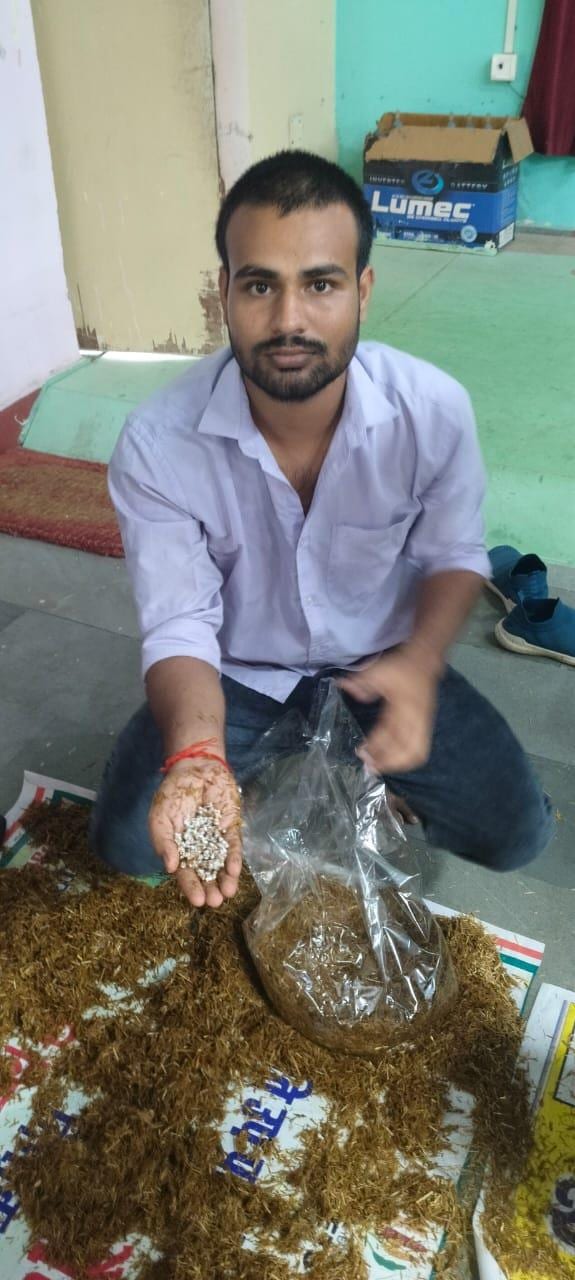
Where India stands
Mushroom production in India: 3 lakh tonnes and climbing
Organised mushroom growing in India began only in the 1960s. Output has since risen from about 44,000 tonnes to nearly 0.31 million tonnes, which puts India among the world's top five producers, though far behind China, which dominates a global harvest of more than 40 million tonnes. Better strains, scientific cultivation and climate control have also raised biological efficiency — the weight of fresh mushrooms per weight of dry substrate — from around 7% in the 1970s to nearly 25% by 2022.
Five species make up almost all commercial cultivation:
| Mushroom | Botanical name | Share of India's output |
|---|---|---|
| Button | Agaricus bisporus | about 70% |
| Oyster (dhingri) | Pleurotus spp. | about 17% |
| Paddy straw | Volvariella volvacea | about 9% |
| Milky | Calocybe indica | about 3% |
| Shiitake, Hericium, Ganoderma | specialty | small share |
Bihar is the largest producing state at about 35,600 tonnes (around 11% of national output), followed by Odisha (34,500 tonnes) and Maharashtra (32,500 tonnes), with Uttar Pradesh and Uttarakhand close behind. Where each species grows follows the climate and the straw:
- Button mushroom suits the cooler north. Punjab and Haryana are the main centres for compost making and seasonal button crops from September to mid-March; Himachal Pradesh also specialises in it.
- Milky mushroom likes warm, humid weather and is grown mostly in the south.
- Paddy straw mushroom is big in Odisha and Chhattisgarh, where paddy straw is cheap and plentiful.
- Shiitake, Hericium and Ganoderma have improved, short-duration strains in India but are still at an early stage. They are high-value and need little land, which makes them promising for small and marginal farmers.
Figures as cited by the authors from Bijla and Sharma, ICAR-Directorate of Mushroom Research, Solan (2023).
Value-added mushroom products offer substantially higher economic returns compared to fresh produce.
Exports
Who buys India's mushrooms abroad
India earned about US$ 8.65 million from mushroom exports in 2020, mostly from processed products. France took about 42% of the value and Germany about 21%, followed by Switzerland (8%), Nepal (4%) and Hong Kong (3%). Canned mushrooms dominate world trade in processed mushrooms, so better post-harvest handling, quality assurance and processing capacity are what would lift that figure.
Growing mushrooms and want a better price?Tell us what you grow and how muchWe will point you to buyers, processors and dryer makers, and to training on value-added products near you.Email usWhatsApp us
Preservation
Four ways to make mushrooms last
1. Drying. The most useful method for a small grower. Drying takes moisture from 85–90% down to below 10–12%, which stops microbial spoilage. Sun drying is common, but a cabinet dryer at 55–60°C gives better colour, lower final moisture and a longer storage life. Dried mushrooms can be ground into powder for soups, bakery products, seasonings and nutraceuticals.
2. Canning. The standard for long storage and commercial trade; shelf life is up to one year. Mushrooms are canned whole, sliced or as "stems and pieces". The steps:
- Clean and grade.
- Blanch at 95–100°C for 5–6 minutes to stop enzymes and cut the microbial load.
- Fill cans with brine: 2% salt plus 0.1% citric acid or 100 ppm ascorbic acid.
- Sterilise at about 118°C, then cool, label and pack.
3. Steeping. A cheap, short-term method. Blanched mushrooms are kept in a solution of 2% salt, 2% citric acid, 2% sodium bicarbonate and 0.15% potassium metabisulphite (KMS). They stay acceptable for about 8–10 days at 21–28°C — enough to reach a distant market or a processor.
4. Irradiation. Low-dose gamma irradiation slows ripening and cuts losses of moisture, colour, texture and flavour. Button mushrooms treated at close to 2 kGy and stored at 10°C have been reported to last about 10 days longer; 10 kGy kills almost all microbes. This needs an irradiation facility, so it suits larger units and exporters.
| Method | Shelf life | Scale |
|---|---|---|
| Steeping in salt-acid-KMS | 8–10 days at 21–28°C | Any grower |
| Irradiation (~2 kGy) + 10°C | about 10 days more | Facility needed |
| Drying (cabinet, 55–60°C) | months, in airtight packs | Small unit |
| Canning (118°C) | up to 1 year | Processing plant |
Value-added products
Eight mushroom products you can make and sell
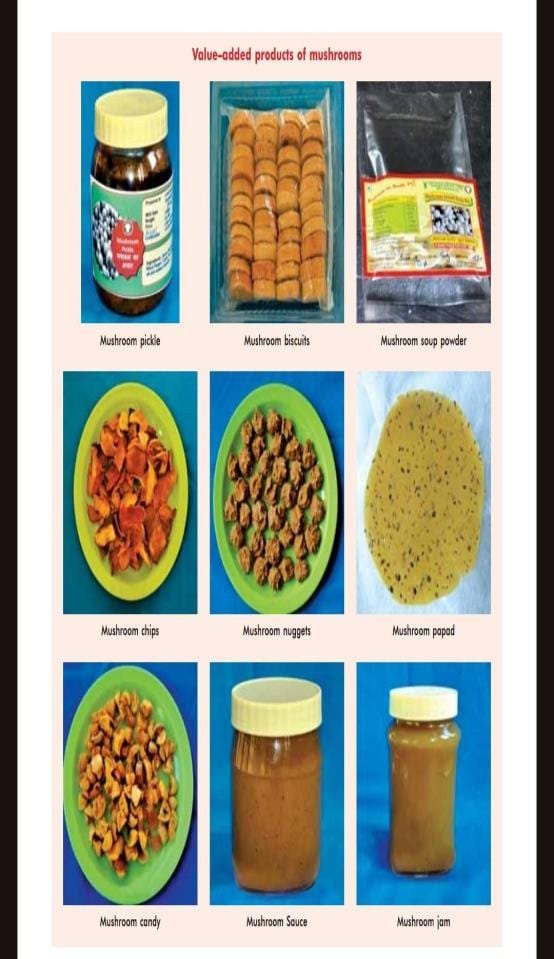
Mushroom pickle. Wash and slice the mushrooms and blanch them for about 5 minutes in 0.05% KMS solution. Rinse in cold water several times, then cure overnight with 10% salt. Throw away the liquid that comes out, add spices and oil to taste, and pack airtight. Properly packed, it keeps for up to a year, and can be made at home or at commercial scale.
Mushroom biscuits. Use refined wheat flour and button or oyster mushroom powder in an 80:20 ratio, with sugar, bakery fat, baking powder, ammonium bicarbonate, salt, milk powder and vanilla essence. Mix to a smooth dough, rest it for about 10 minutes under a damp cloth, roll, cut and bake at 180°C for about 20 minutes.
Mushroom soup powder. Grind dried button or oyster mushrooms and sieve to a fine, even powder. Blend with milk powder, corn flour, salt, sugar, black pepper and oregano. The buyer boils it with water for about 5 minutes.
Mushroom nuggets (badi). Mix coarsely ground dried mushroom with urad (black gram) flour at 1:8, add water, salt and red chilli to a paste, shape into 2–4 cm balls and sun-dry on steel trays. Deep-fry them as a snack or add them to vegetable curry.
Mushroom papad. Add mushroom paste or powder to the usual papad batter of urad, lentil, chickpea, rice, tapioca or potato flour. It raises the protein in a snack people already buy.
Mushroom ketchup. Cook sliced fresh button mushrooms in water for about 20 minutes and grind to a paste. Add salt, sugar, acetic acid, sodium benzoate, onion, garlic, ginger, cumin, black pepper, red chilli and arrowroot, and cook until the total soluble solids reach about 35°Brix. Fill into sterilised bottles.
Mushroom murabba. Grade, wash and prick fresh button mushrooms and blanch them in 0.05% KMS for about 10 minutes. Soak overnight in 50°Brix sugar syrup in the fridge, then raise the syrup to 60°Brix and 70°Brix by adding sugar and heating with 0.1% citric acid. Keep them in the syrup for about a week, then pack in fresh 68°Brix syrup.
Dried slices and powder. The simplest product of all, and the base for the soup powder, biscuits and badi above. Powder also sells to food makers as a natural thickener and flavouring.
Buying dried mushroom, powder or pickle in bulk?Get quotes from growers and small processorsHotels, caterers, food brands and exporters: send the product, quantity and pack size.Email usWhatsApp us
The marketing problem
Why mushroom growers still struggle to sell
Production has grown much faster than processing and marketing. Most of India's mushrooms are still sold fresh, through unorganised channels, and the grower carries all the risk of a crop that will not wait. The authors list the main constraints:
- Perishability. Quality falls within hours of harvest.
- No cold chain. Too few cold stores and refrigerated vehicles near growing areas.
- Poor grading and packaging. Mixed sizes in plain polythene fetch the lowest price.
- Low awareness of value-added products, among growers and buyers alike.
- Weak market infrastructure and price swings, especially in the peak button season.
These hit small producers hardest. Research has also lagged: far more work has gone into how to grow mushrooms than into commercialisation, consumer behaviour and supply-chain integration.
What works
How to sell more and earn more from mushrooms
Put together, the authors' recommendations come down to five steps a grower or an FPO can take:
- Process the surplus, not just the rejects. Keep a small cabinet dryer and dry whatever the fresh market cannot take at a fair price that day.
- Grade and pack. Uniform sizes in labelled, breathable packs sell for more than loose mushrooms.
- Sell direct. Hotels, restaurants, caterers, housing societies and online orders pay more than the mandi, and digital marketing costs little.
- Make one or two products well — pickle, soup powder or badi — and get the FSSAI registration needed to sell them.
- Diversify species by season. Button in the cool months in the north; oyster, milky and paddy straw in warmer months and regions, so there is produce to sell all year.
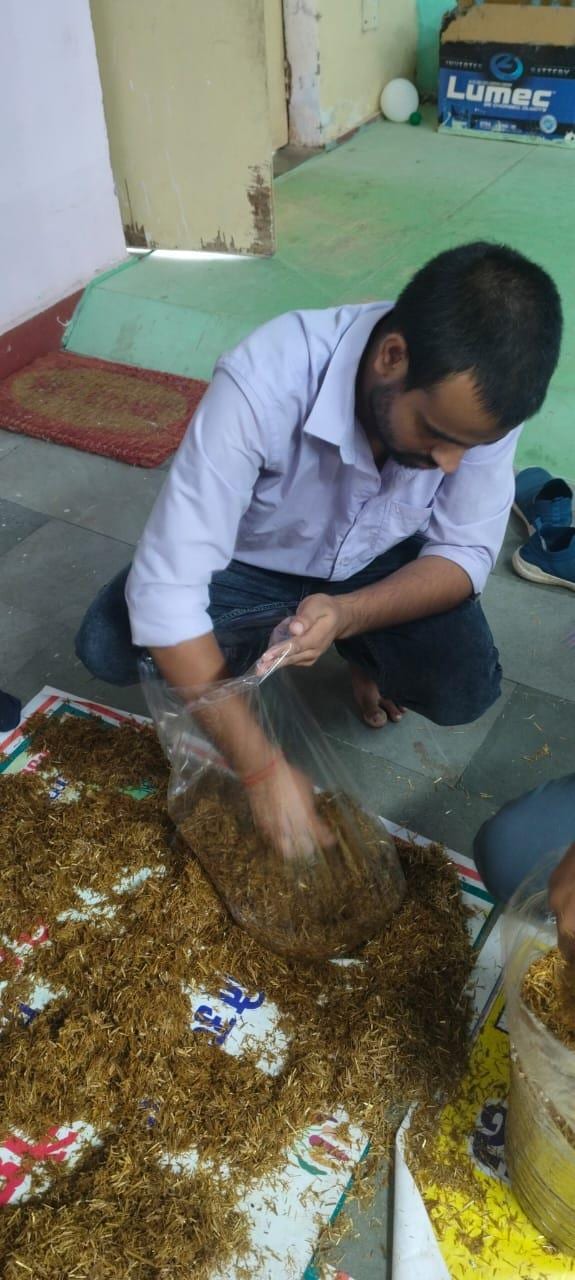
In short
Production is only half the business
Mushrooms are nutritious, grow on farm waste and need little land, which makes them a natural fit for small farmers and rural entrepreneurs. But a crop that spoils in two days is only as profitable as the grower's ability to sell it fast or keep it. Drying, pickling, canning and ready-to-eat products turn a perishable harvest into stock that can wait for a better price, and value-added products earn far more than fresh mushrooms sold at the farm gate. The missing pieces are cold chains, grading and packaging standards, and organised selling. Production, processing and marketing have to be planned together.
Make dryers, spawn, packaging or processing machines?Reach mushroom growers and FPOs on IndianAgriWrite to the desk to be listed for growers who are moving into drying, powder and pickles.Email usWhatsApp us
The original articleValue addition and Marketing of Mushrooms, by Satish Tiwari and Neelam PatelThe authors' full paper, which this article was edited from, with their references. IndianAgri hosts a copy so the source of this piece stays checkable.Download the article
Why it matters
India's mushroom output has grown to about 0.31 million tonnes, but most is still sold fresh through unorganised channels, so growers must sell the same day at whatever price is offered. Simple processing lets small farmers and FPOs hold stock, reach better markets and earn more from the same crop.
Frequently asked
What are the value-added products of mushroom?
The main ones are dried mushroom and mushroom powder, pickle, soup powder, biscuits, nuggets (badi), papad, ketchup or sauce, murabba (preserve), chips, candy and jam, as well as canned mushrooms for the trade.
How do you dry mushrooms for storage?
Dry them until moisture falls from 85–90% to below 10–12%. Sun drying works, but a cabinet dryer at 55–60°C gives better colour and a longer storage life. Store dried mushrooms in airtight packs; they can also be ground into powder.
How is mushroom pickle made?
Slice washed mushrooms and blanch them for about 5 minutes in 0.05% potassium metabisulphite (KMS) solution, rinse in cold water, then cure overnight with 10% salt. Drain the liquid, add spices and oil, and pack airtight. It keeps for up to a year.
How long can mushrooms be preserved?
Fresh mushrooms last a day or two without cooling. Steeping in a salt, citric acid, sodium bicarbonate and KMS solution keeps them 8–10 days at 21–28°C; low-dose irradiation adds about 10 days in cold storage; dried mushrooms keep for months; and canned mushrooms and pickle last up to a year.
Which state produces the most mushrooms in India?
Bihar, with about 35,600 tonnes a year (around 11% of the national total), followed by Odisha and Maharashtra, according to ICAR-Directorate of Mushroom Research figures (Bijla and Sharma, 2023).
Which mushroom is grown most in India?
Button mushroom (Agaricus bisporus), about 70% of output, followed by oyster (about 17%), paddy straw (about 9%) and milky mushroom (about 3%).
What are the main problems in mushroom marketing in India?
High perishability, lack of cold storage and refrigerated transport, poor grading and packaging, low awareness of value-added products, weak market infrastructure and price swings, with most mushrooms sold fresh through unorganised channels.
About the author
Satish Tiwari and Neelam Patel
B.Sc. (Hons.) Agriculture students, College of Agriculture, Kotwa, Azamgarh
Satish Tiwari is a fourth-year B.Sc. (Hons.) Agriculture student at the College of Agriculture, Kotwa, Azamgarh, Uttar Pradesh. He wrote this article with Neelam Patel, a second-year student at the same college.
Want to publish your agriculture story? Publish with IndianAgri
Source
- Satish Tiwari and Neelam Patel, Value addition and Marketing of Mushrooms (PDF)
- ICAR-Directorate of Mushroom Research, Solan
A contributed article by Satish Tiwari and Neelam Patel, B.Sc. (Hons.) Agriculture students at the College of Agriculture, Kotwa, Azamgarh. IndianAgri edited and restructured it, added the tables and the action steps, and left out an older 2011 state table and one growth figure that did not agree with the rest of the data. Production and export figures are as cited by the authors from ICAR-Directorate of Mushroom Research publications. Views are the authors'.
Edited by Devendra Kumar Jha. How we report, source and correct: editorial policy. Spotted an error? Tell us.