Sea Buckthorn in India: Where It Grows, Uses, Price
A thorny Himalayan shrub with bright orange berries: where it grows, how it is picked, what it is made into, what it fetches, and why 85% of Ladakh's crop is still left on the bush.
The short answer
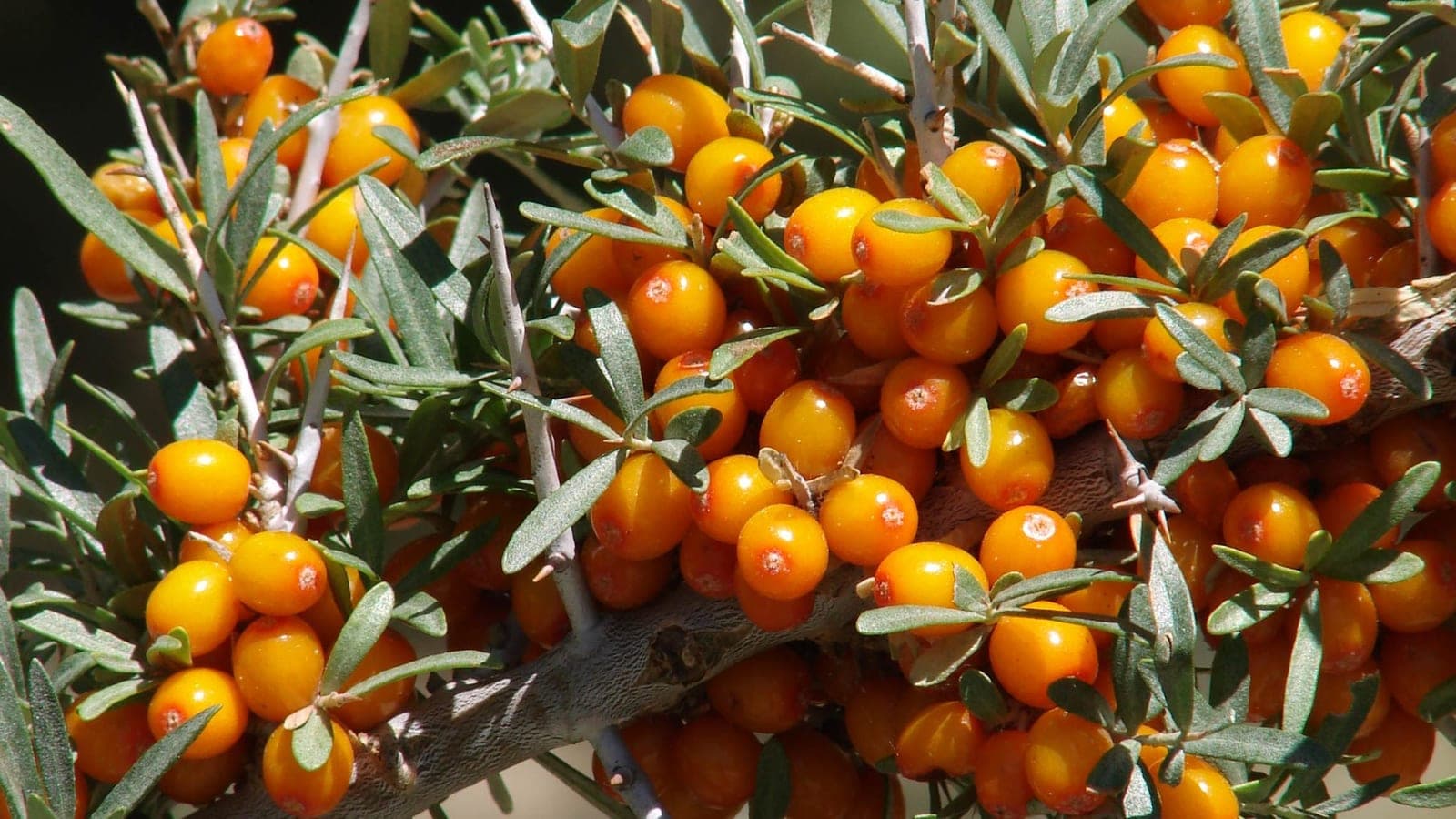
Sea buckthorn (Hippophae) is a thorny shrub of the cold Himalaya with small orange berries. In India it grows on about 13,000 hectares at 2,000 to 4,300 metres in Ladakh, Himachal Pradesh, Uttarakhand, Sikkim and Arunachal Pradesh, with Ladakh holding over 70% of the area; only about 600 tonnes of berries are harvested a year. The berries are picked from September to November and made into pulp, juice, oil from the pulp and seed, dried berries and leaf tea. In 2026 UT Ladakh set a minimum price of ₹300 a kg for farmers' berries, double the ₹150 of 2025.
Key facts
Sea buckthorn in India at a glance
| Sea buckthorn in India | |
|---|---|
| Botanical name | Hippophae species, family Elaeagnaceae |
| Species in India | Three: H. rhamnoides, H. salicifolia, H. tibetana |
| Area in India | About 13,000 ha (NIFTEM-Thanjavur's model DPR) |
| Berries harvested | About 600 tonnes a year (same DPR) |
| Where | Ladakh, Himachal Pradesh, Uttarakhand, Sikkim, Arunachal Pradesh, at 2,000 to 4,300 m |
| Largest area | Ladakh, 70.9% of the area in NIFTEM's table |
| Harvest | September to the end of November |
| Price paid to Ladakh's farmers, 2026 | Minimum ₹300 a kg, up from ₹150 in 2025 (UT Ladakh, 18 Sep 2026) |
| GI tag | "Ladakh Sea Buckthorn", Class 31, registered in November 2023 |
| World area | 2.33 million ha in 52 countries, about 2.1 million ha of it in China (International Seabuckthorn Association, 2020, via Wang et al. 2022) |
Figures read on 21 October 2026. IndianAgri does not grow, process or sell sea buckthorn; we connect buyers, sellers and people setting up units, and say so wherever we make an offer.
Names
What is sea buckthorn called in Hindi and in Ladakh?
There is no single standard Hindi name in the sources we read. In Hindi it is mostly just called सी बकथॉर्न (sea buckthorn). The local names are older and more useful:
- Ladakh: Tsermang and Sastalulu in Ladakhi, and Leh Berry in English (Flowers of India).
- Himachal Pradesh and elsewhere in the Himalaya: Chharma, Amli, Sarila, Tirku and Sarma are listed as vernacular names by the Foundation for Revitalisation of Local Health Traditions (FRLHT ENVIS), which does not say which name belongs to which language.
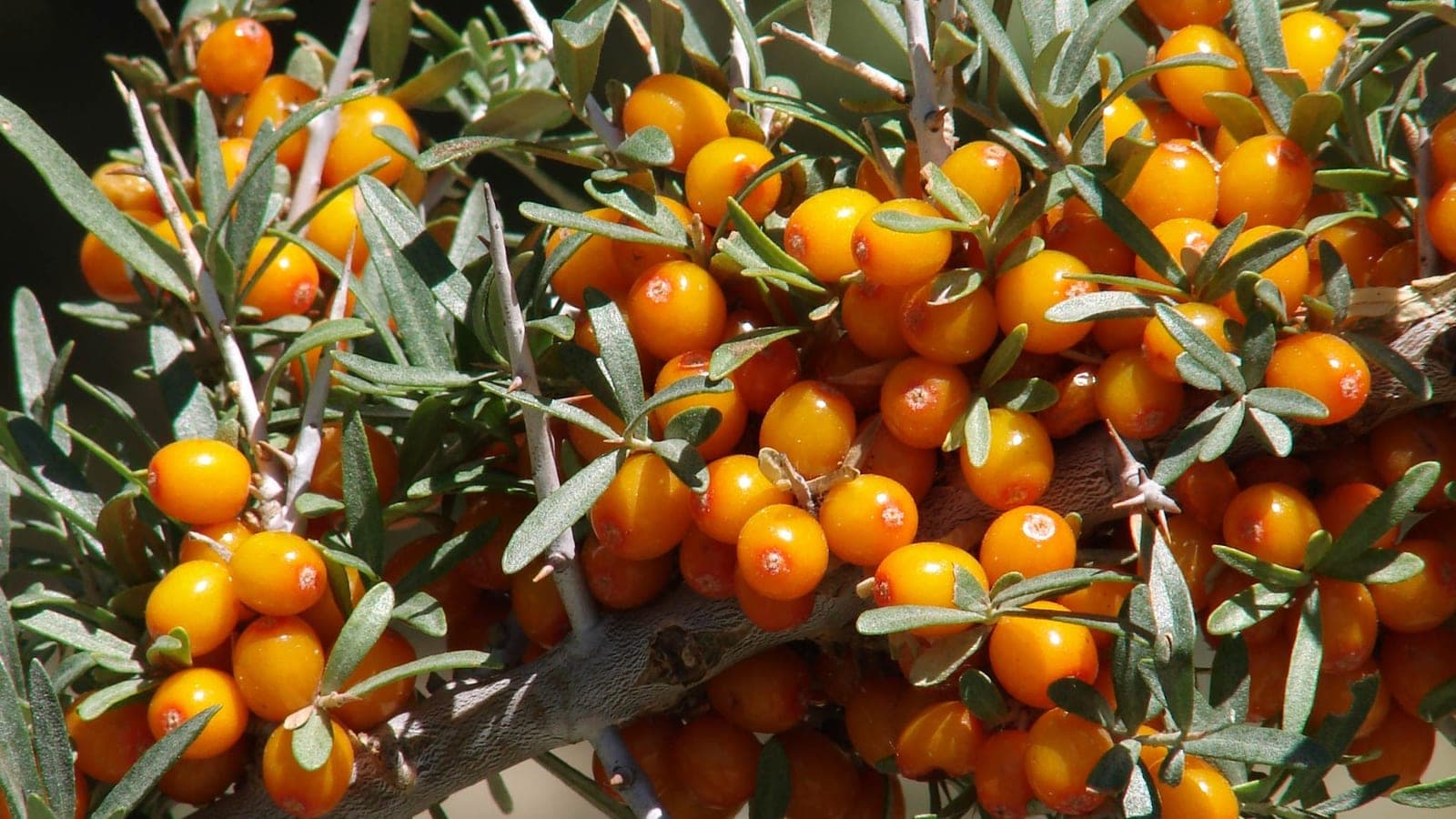
- Scientific: Hippophae rhamnoides is the common species; the Ladakh plant is listed as subspecies turkestanica. NIFTEM's DPR calls the crop "cold desert gold".
The Hindi version of this guide is here: सी बकथॉर्न को हिंदी में क्या कहते हैं.
Species
The three kinds found in India
As described in NIFTEM-Thanjavur's model DPR (p5):
| Species | Plant | Height | 100 fruits weigh | Fruit colour |
|---|---|---|---|---|
| H. rhamnoides | Shrub or small tree | 2–5 m | 8–27 g | Red to reddish orange |
| H. salicifolia | Tree | 4–9 m | 30–35 g | Yellow |
| H. tibetana | Under-shrub | 0.2–0.6 m | 15–21 g | Orange with green stripes |
H. rhamnoides is the species picked and processed in Ladakh. The DPR's table also records which species grows in which state.
Where it grows
Where sea buckthorn grows in India, state by state
NIFTEM's DPR gives this area table (p4):
| State / UT | Area (ha) | Share |
|---|---|---|
| Ladakh | 9,267 | 70.9% |
| Uttarakhand | 2,000 | 15.4% |
| Himachal Pradesh | 1,000 | 7.6% |
| Sikkim | 800 | 6.1% |
| Total in the table | 13,067 | 100% |
Ladakh's figure comes from a satellite estimate: 7,184 ha of pure stands and 2,083 ha mixed with other plants. Arunachal Pradesh is named as a growing area but has no figure in the table.
Two cautions on these numbers. First, NIFTEM says plainly that "there is no production data available": the area is an estimate and the ~600 tonnes is what gets harvested, not what grows. Less than 5% of Ladakh's resource was harvested in an average year. Second, the figures do not agree everywhere: Ladakh's Lieutenant Governor put Ladakh at "nearly 64%" of India's sea buckthorn area when opening the Centre of Excellence at Nimoo in December 2025 (UT Ladakh release). Both agree Ladakh is by far the largest.
Places in Ladakh named in the UT's own releases: the Choglamsar forest near Leh, where it "grows extensively"; Nubra Valley, proposed site of a national research centre; and in Kargil, Sankoo and Taisuru (berries harvested) and Suru and Zanskar (pulping).
Harvest
When and how it is harvested, and how much a plant gives
The fruit stays on the bush from August to April, but it is harvested from September to the end of November, when the colour shows it is ripe and the juice reaches up to 12 °Brix (NIFTEM DPR, p7). UT Ladakh timed its 2026 conclave for 18–19 September because that is the peak of the season.
Why picking is hard. The berries sit tight on very thorny branches. The DPR describes two methods: beating the branches, or breaking off fruiting branches. Ladakh's Lieutenant Governor said in September 2026 that because of this, almost 85% of the annual crop is wasted and only about 15% is used commercially; he set a target of 50% this year (UT Ladakh, 18 Sep 2026).
Yields quoted in the DPR (p7–8):
| System | Yield |
|---|---|
| Wild plant | 1–2 kg a year |
| Average bush | 2–3 kg |
| Natural stands | 750–1,500 kg a hectare |
| Shelter-belt planting | 4–5 tonnes a hectare |
| Orchard | Up to 10 tonnes a hectare |
| Exotic high-yield varieties | 10–15 kg a plant |
Fresh berries spoil fast. They should be cooled to 4–6 °C straight after picking and frozen (IQF) if they must be kept longer.
Growing it
How to grow sea buckthorn: the standard practice
The DPR lists ICAR's standard practices (p6–7). In short:
- Planting material: hardwood stem cuttings. DIHAR, the DRDO lab in Leh, raises 15,000–20,000 rooted plants a year.
- Spacing: 4 m × 2 m, in pits of 2 × 2 × 2 feet.
- Manure and fertiliser: 20 kg farmyard manure a plant (the DPR also says 20–40 kg a basin) and 50 kg nitrogen a hectare at planting.
- Weeds: black polythene mulch, or a mulch of Artemisia.
- Pruning: remove 10–25% of the canopy; more than 25% cuts the crop.
- Climate: the plant takes −43 °C to 40 °C (p6; the DPR's p2 misprints the lower figure as 43 °C).
Ladakh's Horticulture Department runs a sea buckthorn nursery and demonstration orchard at the Centre of Excellence in Nimoo, sanctioned by the Government of India for ₹7.89 crore (UT Ladakh; Nimoo visit, April 2025).
Can it grow in the plains? It grows naturally at 2,000–4,300 m. We found no official trial results for the Indian plains, so we do not say it can.
Products
What sea buckthorn is made into
Almost every part is used: the pulp for juice, concentrate and syrup; the oil in the pulp and in the seed; the dried berry; and the leaves for herbal tea. Cosmetics use the oils.
What 100 kg of berries gives (NIFTEM DPR, p8–9):
| From the pulper | Yield |
|---|---|
| Pulp | about 74% (73.82 ± 3.33%) |
| Cake (skin and seed) | about 24% (24.14 ± 2.96%) |
| Dried whole berry, if sun-dried instead | about 33.25 kg from 100 kg (over a month of drying) |
Seed is separated from the dried cake; seed oil is generally extracted with supercritical CO₂.
Prices. Two kinds of figure exist, and they are not the same thing:
- What Ladakh's farmers are paid for berries: a minimum of ₹300 a kg in 2026, up from ₹150 in 2025, as announced by the Lieutenant Governor on 18 September 2026 (UT Ladakh).
- Product prices quoted in NIFTEM's DPR (the PDF is dated December 2025 but the prices carry no date): pulp ₹110–120 a kg, clean seed ₹250–300 a kg, hull ₹20–30 a kg, dried berry ₹200–300 a kg.
These are not today's market rates. Ladakh's Chief Secretary noted on 8 October 2026 that rates vary among buyers and asked for the procurement system to be examined (UT Ladakh).
For the buyer's side, our sister site lists the sea buckthorn products India supplies, with a dated juice price table. For the factory side, see how a sea buckthorn processing unit is laid out and what NIFTEM's model unit costs.
Composition
What is in the berry
Sea buckthorn is known for a lot of vitamin C and for oil in its soft pulp, which is unusual in a fruit. The figures vary widely with species, place and ripeness:
- Vitamin C: 52.86 to 896 mg per 100 g of fruit across published studies; 275 mg per 100 g for berries from Ladakh (Wang et al. 2022, Frontiers in Nutrition).
- Fats: the main fatty acids in the berries are palmitic, palmitoleic (an omega-7) and oleic acid (same review).
- NIFTEM's table (per 100 g, citing the Directorate of Arecanut and Spices Development and USDA): moisture 91 g, carbohydrate 5 g, fat 2 g, protein 1 g, crude fibre 0.5 g, vitamin C 909 mg, vitamin A 1,500 µg, vitamin E 3 mg, potassium 420 mg, sodium 6 mg. The DPR's own text on the same page gives different vitamin C and E figures (600 mg and 160 mg), so treat single numbers with care.
IndianAgri makes no health claim for sea buckthorn. Claims on packs and in project reports are the seller's to prove.
The world
Sea buckthorn around the world
The International Seabuckthorn Association's 2020 report, as cited by Wang et al. (2022), counted 2.33 million hectares in 52 countries as of December 2020, about 2.1 million hectares of it in China (Frontiers in Nutrition). NIFTEM's DPR uses an older round figure of about 3.0 million hectares, wild and planted, with about 90% in China, Mongolia, Russia, northern Europe and Canada, and China the largest producer.
So India's 13,000 hectares are well under 1% of the world's area. The country Ladakh is now looking to is Mongolia: Mongolian producers, including the head of the UVS Seabuckthorn Producer Association, spoke at Leh's conclave in September 2026, and Ladakh's Chief Secretary asked officials to study the Mongolian model (UT Ladakh, 19 Sep 2026).
We found no FAO production series for sea buckthorn, so this page gives no world tonnage.
Schemes and institutions
Who works on sea buckthorn in India
- GI tag. "Ladakh Sea Buckthorn" was registered as a Geographical Indication in Class 31 in November 2023, with the Department of Industries and Commerce, UT Ladakh, as registered proprietor (Voice of Ladakh, 17 Nov 2023). Ladakh's Lieutenant Governor referred to the registration in his 18 September 2026 speech. We could not open the GI Registry's own record.
- ODOP and PM-FME. Sea buckthorn is Leh district's One District One Product, as the Lieutenant Governor noted in September 2026; ODOP products are the focus of the PM-FME scheme of the Ministry of Food Processing Industries. Our sister site explains what a PM-FME sea buckthorn unit costs in NIFTEM's model.
- DIHAR (DRDO), Leh. The Defence Institute of High Altitude Research developed processing technologies for the berry and licensed sea buckthorn products to companies, including Patanjali Ayurved in 2015 (Medical Dialogues, 25 Aug 2015). Dr Tsering Stobdan of DIHAR spoke on the way forward for Ladakh at the 2026 conclave.
- Centre of Excellence for Sea Buckthorn, Nimoo (UT Ladakh Horticulture), inaugurated on 4 December 2025 (release).
- Proposed national centre. The Union Ministry of Agriculture has set up a committee to examine a National Sanjeevani Research Centre for sea buckthorn in Nubra Valley.
- Research and support at the 2026 conclave: CSIR-IHBT (Palampur), NIFTEM, KVK Leh (University of Ladakh), the Indian Institute of Packaging and APEDA, which spoke on exports.
- Co-operatives. Ladakh's Cooperative Department runs a committee on sea buckthorn procurement and aggregation (31 Aug 2026).
Trade
Who is processing Ladakh's berries now
Ladakh's own releases name a few local processors and their shipments:
- Halman Apricots, Kargil, sent 4.5 tonnes of dried sea buckthorn to Chandigarh on 1 November 2025, with another six tonnes to follow, and processed about 35 tonnes of pulp that financial year (UT Ladakh).
- Rabbani Agri Processing Unit, Sankoo (Kargil), dispatched its final consignment of 20 tonnes of pulp to Delhi on 12 October 2026, with Well with India Pvt. Ltd. (UT Ladakh).
- A local entrepreneur runs the processing unit at the Nimoo Centre of Excellence and told officials in April 2025 that demand is well above what is collected (UT Ladakh).
The September 2026 conclave brought together 20 buyers and about 120 MSME-registered entrepreneurs and self-help groups. On every account the problem is supply, not demand: picking, aggregation and pulping in the villages.
Buy, sell or set up
Selling berries, buying pulp or planning a unit?
IndianAgri connects people across the sea buckthorn chain. We do not trade it ourselves.
Collect or grow sea buckthorn in Ladakh, Himachal, Uttarakhand, Sikkim or Arunachal? List your berries, pulp or seed: tell us the product, the quantity you expect this season, your village or town, whether it is certified organic, and how to reach you.
Buying pulp, juice, seed or oil? Send a buying request with the product, quantity and destination, or write to us.
Planning a processing unit? Ask for help with the project report, the machines and the PM-FME application. We help you prepare; the scheme's authorities decide.
Or message us on WhatsApp. Our team replies within one working day. Spotted a wrong figure? Tell us.
Why it matters
Demand for sea buckthorn pulp, juice and oil is running ahead of what India collects: Ladakh says 85% of its crop goes unpicked. Anyone who can harvest, pulp or buy at scale, from a village cooperative to a juice maker, is looking at a crop with a government-backed price, a GI tag and a short, fixed season.
Frequently asked
What is sea buckthorn called in Hindi?
There is no single standard Hindi name in official sources; in Hindi it is usually just called सी बकथॉर्न (sea buckthorn). In Ladakh it is Tsermang or Leh Berry, and Chharma and Amli are among its Himalayan local names.
Where does sea buckthorn grow in India?
In the cold, high Himalaya, at 2,000 to 4,300 metres: Ladakh, Himachal Pradesh (Lahaul-Spiti and Kinnaur), Uttarakhand, Sikkim and Arunachal Pradesh. NIFTEM-Thanjavur's model DPR puts India's area at about 13,000 hectares.
Which state grows the most sea buckthorn?
Ladakh, with 9,267 hectares or 70.9% of the area in NIFTEM's table, followed by Uttarakhand (2,000 ha), Himachal Pradesh (1,000 ha) and Sikkim (800 ha).
When is sea buckthorn harvested?
From September to the end of November. The berries ripen orange and stay on the bush for months, but September is the peak of the picking season in Ladakh.
How much does sea buckthorn cost per kg?
UT Ladakh set a minimum procurement price of ₹300 a kg for berries in 2026, up from ₹150 in 2025 (announced 18 September 2026). NIFTEM's model DPR quotes undated prices of ₹110–120 a kg for pulp, ₹250–300 for clean seed and ₹200–300 for dried berries.
Can sea buckthorn be grown in the plains?
It grows naturally at 2,000 to 4,300 metres and tolerates −43 °C to 40 °C. We found no official trial results for the Indian plains, so we cannot say it will crop there.
How many types of sea buckthorn are found in India?
Three: Hippophae rhamnoides (a shrub with red to orange berries, the one processed in Ladakh), H. salicifolia (a tree with yellow berries) and H. tibetana (a knee-high under-shrub).
What is made from sea buckthorn?
Juice, pulp, concentrate and syrup from the pulp; oil from the pulp and the seed; dried berries; herbal tea from the leaves; and cosmetics that use the oils. A pulper turns about 74% of the berry into pulp and 24% into cake.
Who is the largest producer of sea buckthorn in the world?
China, with about 2.1 million of the world's 2.33 million hectares in 2020, according to the International Seabuckthorn Association's figures cited in a 2022 Frontiers in Nutrition review.
Is sea buckthorn the same as Leh Berry?
Yes. Leh Berry is a common English name for sea buckthorn in Ladakh, where its Ladakhi name is Tsermang. "Ladakh Sea Buckthorn" has had a GI tag since November 2023.
Source
- NIFTEM-Thanjavur's model DPR for a sea buckthorn beverage unit (PM-FME scheme, PDF dated December 2025)
- UT Ladakh: L-G announces minimum ₹300/kg procurement price, International Sea Buckthorn Conclave, 18 Sep 2026
- UT Ladakh: Seabuckthorn Conclave-cum-Reverse Buyer-Seller Meet concludes, 19 Sep 2026
- UT Ladakh: Chief Secretary reviews mission-mode strategy for seabuckthorn, 8 Oct 2026
- UT Ladakh: Committee on promotion of sea buckthorn activities, Kargil, 31 Aug 2026
- UT Ladakh: Centre of Excellence for Sea Buckthorn at Nimoo inaugurated, 4 Dec 2025
- UT Ladakh: Secretary Horticulture visits Centre of Excellence, Nimoo, 25 Apr 2025
- UT Ladakh: 4.5 tonnes of dried seabuckthorn from Kargil to Chandigarh, 1 Nov 2025
- UT Ladakh: seabuckthorn pulp consignment from Sankoo to Delhi, 12 Oct 2026
- Wang Z. et al. (2022), Phytochemistry, health benefits, and food applications of sea buckthorn: a comprehensive review, Frontiers in Nutrition 9
- FRLHT ENVIS, taxon data sheet: Hippophae rhamnoides (vernacular names)
- Flowers of India: Leh Berry (Ladakhi names)
- Voice of Ladakh: Ladakh secures 4th GI tag for sea buckthorn, 17 Nov 2023
- Medical Dialogues: DRDO partners with Patanjali for seabuckthorn products, 25 Aug 2015
- Photo: "Seabuckthorn berries, Nubra valley, Ladakh", Karunakar Rayker, Wikimedia Commons, CC BY-SA 2.0 (cropped)
Read on 21 October 2026. India's area, species, agronomy, yields, post-harvest yields and the undated product prices are from NIFTEM-Thanjavur's model DPR for a sea buckthorn beverage unit under PM-FME (PDF dated December 2025); where the DPR contradicts itself (vitamin C and E, a temperature misprint) we say so. The 2026 procurement price, crop wastage, Centre of Excellence and consignments are from UT Ladakh's own press releases. World area and composition are from Wang et al. (2022), Frontiers in Nutrition, citing the International Seabuckthorn Association. No source we read gives a standard Hindi name. IndianAgri makes no health claim and does not trade sea buckthorn. Photo: Karunakar Rayker, Wikimedia Commons, CC BY-SA 2.0.
Edited by Devendra Kumar Jha. How we report, source and correct: editorial policy. Spotted an error? Tell us.