Agriculture 5.0: How Kerala Can Lead India's Smart Farming Revolution
From AI-driven pest alerts to drone-based nutrient mapping, Kerala's agri sector stands at a digital inflection point — and the state has the institutions, talent, and entrepreneurial spirit to lead nationally.

Expert insights
Mathew Abraham · CEO, Manappuram Agro Farms Ltd.
Mathew Abraham is CEO of Manappuram Agro Farms Ltd., a former Deputy Director of Agriculture for Kerala, and a certified National Extension Facilitator (MANAGE) and Certified Farm Advisor (ICAR).
The short answer
Kerala agriculture is entering the era of Agriculture 5.0, where artificial intelligence, IoT sensors, satellite imagery, drones, and predictive analytics work alongside farmers to drive smarter, more sustainable production. The state's structural challenges — fragmented landholdings, rising labour costs, and climate uncertainty — are reframed here as design opportunities rather than obstacles. A multi-stakeholder push involving government, universities, startups, and private enterprises is seen as the essential next step for digital transformation.
The inflection point
Kerala Agriculture at a Digital Crossroads
Kerala's farming sector has long been shaped by small, fragmented landholdings, escalating labour costs, and growing climate volatility. For decades, these realities were treated as constraints. The emerging view reframes them as an invitation to fundamentally redesign how the state produces, markets, and delivers food.
Agriculture 5.0 — the integration of artificial intelligence, IoT sensor networks, satellite imagery, drones, and real-time predictive analytics into everyday farm operations — represents that redesign. Critically, this is not about replacing generations of farmer wisdom. It is about augmenting it with tools that deliver actionable intelligence at the right moment.
The shift in the central question is telling: from "How do we produce more?" to "How do we produce smarter?" — a reorientation that has profound implications for cost structures, resource efficiency, and market competitiveness across Kerala's diverse agri-landscape.
Tech in the field
AI, Drones, and Sensors: Already Deployable, Not Futuristic
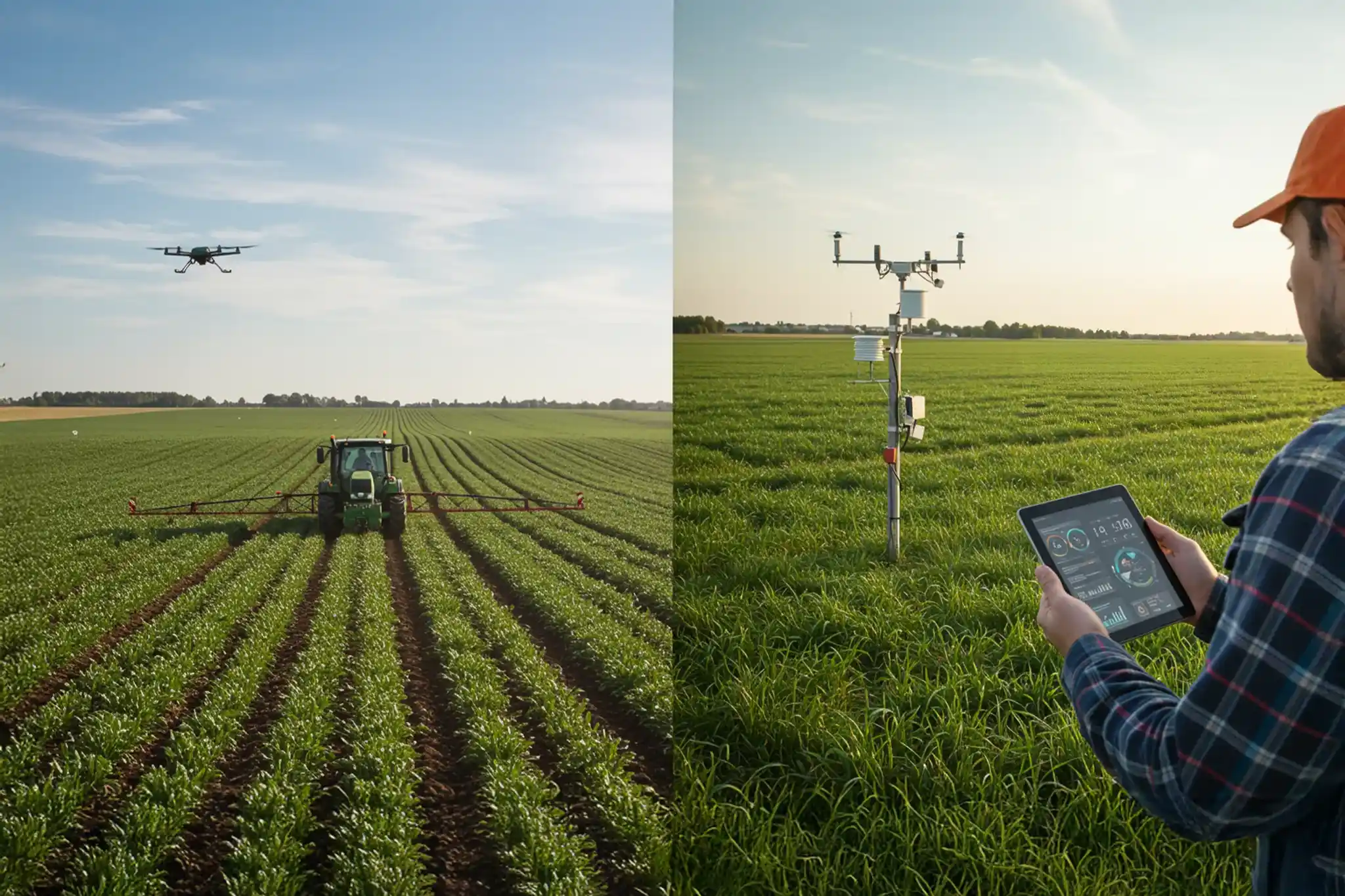
The technologies underpinning Agriculture 5.0 are not in prototype stages — they are operational and scalable today. Consider what is already possible:
- Pre-emptive pest alerts sent to a farmer's mobile before an infestation takes hold
- Automated precision irrigation that delivers exactly the water volume each crop needs
- Drone-mounted sensors detecting nutrient deficiencies before symptoms appear visually
- AI-generated weather advisories recommending the optimal harvest window
Together, these capabilities shift farming from reactive management to proactive planning, enabling farmers to cut input costs, reduce post-harvest losses, and improve yield quality.
Addressing Kerala's serious human-wildlife conflict, the same technology stack — thermal cameras, AI-based intrusion detection, and real-time monitoring systems — offers non-lethal, scalable solutions. The most durable outcomes, however, will come from combining these innovations with the ecological knowledge held by indigenous communities.
Agriculture is no longer about growing crops. It is about growing intelligence, opportunity, sustainability, and hope.
Beyond the farm gate
Value Chains, Traceability, and a New Rural Economy
Modern consumers are asking harder questions: Where was this grown? Is it safe? Can its origin be traced? This behavioural shift creates substantial commercial openings beyond primary production.
Opportunities now emerging include:
- Precision vegetable farming and specialty crop production
- Certified organic supply chains with verifiable provenance
- Value addition, branding, and farm-to-fork traceability platforms
On the logistics side, cold chains, digital marketplaces, smart aggregation, and last-mile delivery are graduating from support functions into profitable standalone businesses. Even agricultural data itself is surfacing as a valuable asset — helping banks, insurers, and agri-businesses make better credit and risk decisions.
The Entechanda Network — which directly linked government market outlets with vegetable farmers to reduce middlemen, improve price discovery, and cut post-harvest losses — demonstrated what is possible when technology and institutions work in concert. Scaling similar digital platforms through Farmer Producer Organisations (FPOs) is identified as a high-impact next step for agricultural marketing across the state.
Jobs and talent
Agriculture 5.0 as a Career Ecosystem for Kerala's Youth
The digital transformation of agriculture is not confined to those who work the land. Agriculture 5.0 is generating an entirely new professional category — one that draws in engineers, software developers, data scientists, AI specialists, and technology entrepreneurs.
Emerging agri-tech roles include:
- AI-based crop prediction and farm analytics
- IoT sensor network design and management
- Decision Support Systems development
- Smart irrigation platform engineering
- Precision farming application development
For a state with strong educational institutions and a history of producing technical talent, this convergence represents a significant economic opportunity. Agriculture is increasingly being described as one of the largest digital ecosystems of the coming decade — a framing that repositions it as a destination sector for high-skill employment rather than a fallback option.
The road ahead
Collaboration and Sustainability: The Twin Pillars of Kerala's Agri Future
Government institutions in Kerala have built a solid agricultural foundation over many decades. The consensus view is that the next phase demands digital transformation — and that it cannot be driven by any single stakeholder.
Closer integration between government departments, agricultural universities, startups, research institutions, private enterprises, and farmer bodies is seen as essential to building a resilient, future-ready agricultural ecosystem.
On the sustainability front, climate change is already visibly reshaping cropping calendars and yield patterns. The response framework includes:
- Climate-resilient crop varieties
- Precision irrigation to cut water waste
- Soil carbon improvement programmes
- Integrated farming systems
- Efficient resource management protocols
Sustainability, in this vision, is not an environmental add-on — it is the foundational design principle of every agricultural system built from here on. Kerala, with its knowledge base, institutional depth, and entrepreneurial culture, is positioned to demonstrate what that looks like at scale.
Why it matters
For Kerala's farming community and agri-businesses, the shift from experience-based to data-driven decision-making is no longer theoretical — the technologies already exist and are deployable. The rise of farm-to-fork traceability, digital marketplaces, and agricultural data as a bankable asset creates new commercial opportunities well beyond the farm gate. Policymakers should note the call for tighter collaboration between government institutions, research bodies, FPOs, and private startups to build a resilient, climate-ready agricultural ecosystem. The state that moves fastest on this integration stands to become the national benchmark for Agriculture 5.0.
Frequently asked
- What is Agriculture 5.0 and how does it apply to Kerala?
- Agriculture 5.0 refers to the integration of artificial intelligence, IoT sensors, satellite imagery, drones, and predictive analytics into farming operations. For Kerala, it offers a way to address structural challenges such as small landholdings, rising labour costs, and climate uncertainty by shifting from experience-based farming to data-driven decision-making.
- What role can FPOs play in Kerala's agricultural digital transformation?
- Farmer Producer Organisations (FPOs) are seen as key vehicles for scaling digital marketing platforms across Kerala. Models like the Entechanda Network, which connected government market outlets directly with vegetable farmers to reduce middlemen and improve price discovery, can be replicated and expanded through FPO-linked digital infrastructure.
- How does Agriculture 5.0 create jobs beyond farming?
- The shift to smart agriculture opens career paths for engineers, software developers, data scientists, and AI specialists working on crop prediction tools, IoT sensor networks, farm analytics platforms, decision support systems, smart irrigation software, and precision farming applications.
- How can technology help address Kerala's human-wildlife conflict?
- Technologies such as thermal cameras, AI-based intrusion detection, automated alert systems, and real-time monitoring are identified as scalable tools to manage human-wildlife conflict. However, the most effective solutions are expected to combine these innovations with the ecological knowledge held by indigenous communities.
Source
This report summarises and analyses coverage from linkedin.com. The analysis and India context are IndianAgri's own.