Yemineni: Fourteen Years Building Fertigation Controls for Indian Polyhouses
Put a meter in the mixing drum on Monday and again on Thursday and the readings will not match. Yemineni has spent fourteen years building the machines that end that - and the probe in the pipe, not the touchscreen on the cabinet, is the part that decides whether one was worth buying.
The short answer
Yemineni is a Bengaluru manufacturer of agricultural control systems, operating since 2012 from Jalahalli West. It builds automatic fertigation and irrigation controllers, greenhouse climate control systems, hydroponic controllers for NFT and deep-water culture, and the water treatment and auto-backwash filtration that sits upstream of them. Its fertigation system is sold as Fertipro: dosing pumps inject concentrated nutrient stock into the irrigation line, a probe reads the resulting EC and pH, and the controller corrects the dose until both match the target for that crop and stage. The company states it stores 15 to 20 crop programmes, runs from a touchscreen with a mobile app, logs every irrigation, and drives vents and fogging from an on-site weather station. Public listings put its fertigation control units at roughly ₹2.9 lakh to ₹3.95 lakh before installation. Its stated customers are growers around Bengaluru and Mysore.
Start here
Somebody has to mix the drum, and that is the problem being sold against
In a polyhouse, somebody mixes the nutrient solution twice a day. A scoop of this, a measured pour of that, stirred into a drum and sent down the lines.
Put a meter in that drum on Monday and again on Thursday and the readings will not match. The salt concentration drifts because the scoop is not a scale, because one bag is caked and the next is not, because the person mixing on Thursday is not the person who mixed on Monday. The plants register the difference well before anyone reads it on a meter.
Yemineni, a small firm in Bengaluru, has spent fourteen years building the machines that take that job away from the drum. It makes fertigation controllers, greenhouse climate systems and hydroponic controls, and it has been at it since 2012 — long enough to matter in a segment where most of the equipment in Indian polyhouses still arrives from somewhere else.
The company
Fourteen years, a small bench, and one narrow problem
Yemineni works out of Jalahalli West in north Bengaluru. Its own published profile puts it at fewer than ten people and an annual turnover in the ₹5–10 crore band — a workshop rather than a factory floor, which for control equipment is closer to the norm than the exception.
The specialism is narrow and has not wandered: getting water and nutrient to a plant in the right amount, at the right strength, without a person standing there doing it. Everything the company sells is a version of that problem — fertigation and irrigation control, greenhouse climate control, hydroponic controllers, and the water treatment and filtration that has to sit upstream of all of it.
Its stated customers are growers around Bengaluru and Mysore, which is the belt where protected cultivation in Karnataka is densest, and it frames its own pitch around using less water and less fertiliser rather than around yield alone.
The machine
Fertipro's one job is to hit the same number on every irrigation
The flagship is Fertipro, sold as an automatic fertigation and climate control system.
Concentrated stock solutions sit in separate tanks — nitrogen in one, potassium in another, acid in a third. When an irrigation starts, dosing pumps draw a small measured amount from each into the main line. A probe in that line reads the result and reports two numbers.
EC — electrical conductivity — is how much dissolved salt the water is carrying, which stands in for how strong the feed is. pH is how acidic it is, which decides whether the nutrients are in a form a root can actually take up. Get the pH wrong and iron and phosphorus lock up in the water even though you paid for them and they are sitting right there.
The controller compares both against the target you set and adjusts the pumps until they match. That loop is the whole product. Everything else is arranged around it.
The company says the controller stores 15 to 20 programmes, so a separate recipe can be held for each crop and each growth stage and called up when the crop moves on; that it runs from a touchscreen panel with a mobile app for remote access; and that it keeps a full history of what was applied, viewable as graphs.
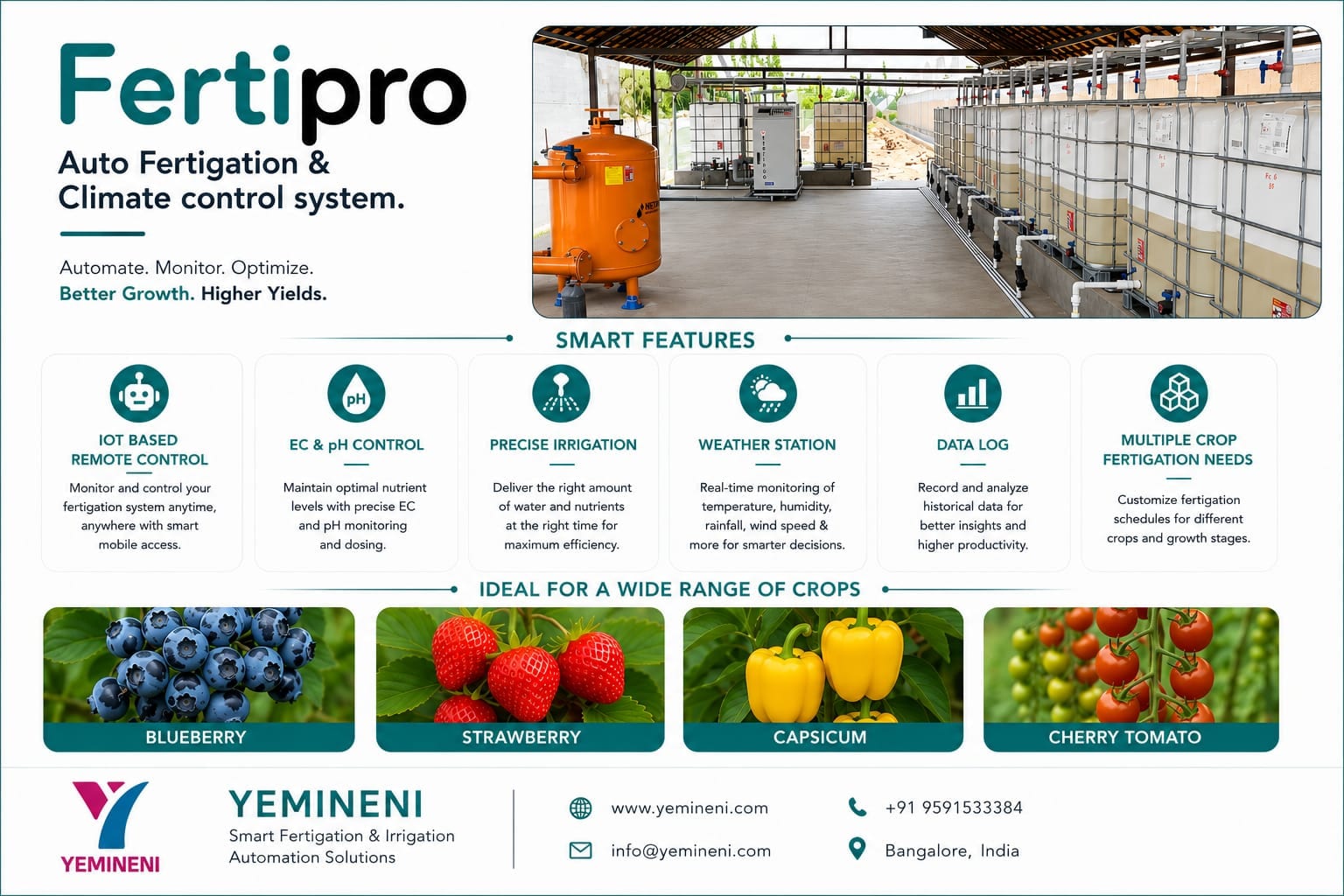
Those four crops are not a random selection. They are what protected cultivation in India grows when the economics work: high value per square metre, sold into a market that pays for consistency, and grown under cover where a control system has something to control.
The rest of the bench
Everything else it makes is the same idea pointed at a neighbouring problem
Greenhouse climate control. A station on the structure reads temperature, humidity, rainfall and wind, and those readings drive the vents, the fogging and the fans. The gain is not that a machine can open a vent — a person can open a vent. It is that the decision gets made against a measurement rather than against how the polyhouse felt to somebody at two in the afternoon, and that it gets made at three in the morning when nobody is there. Wind matters more than new growers expect: a vent left open in a gust is how polyhouse film tears, and the repair costs more than the crop it was protecting.
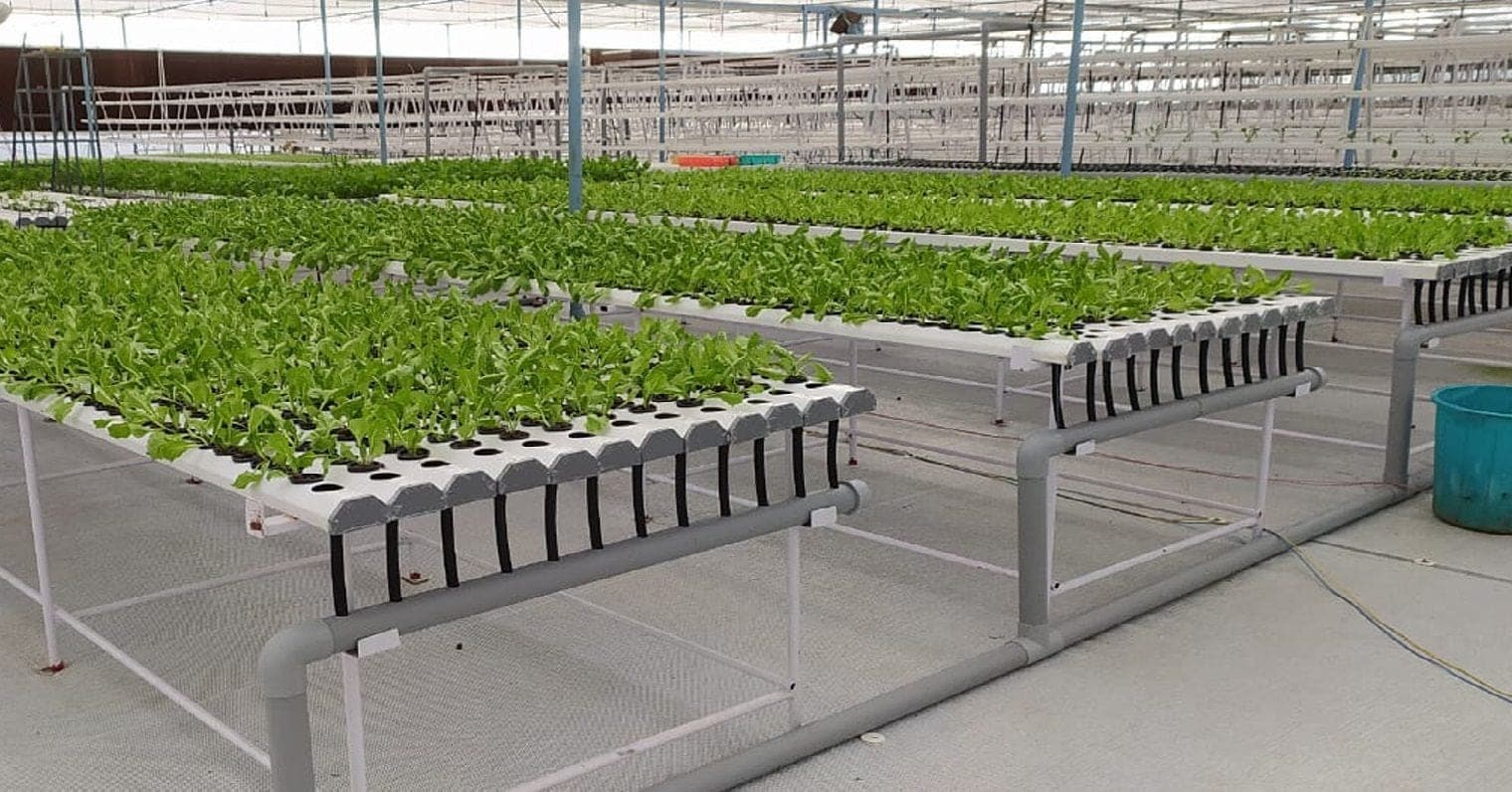
Hydroponic controllers for NFT and deep-water culture, where there is no soil to buffer a mistake and the nutrient solution is the growing medium. Dosing accuracy stops being a refinement and becomes the whole crop.
Water treatment — reverse osmosis and softeners — because hard or saline source water changes what a dosing system has to do, and no controller can fix water it was never given a chance to correct.
Filtration and valve control, including auto-backwash filters. Unglamorous, and the reason installations survive: a blocked dripper is the most common failure in any drip system, automated or not.
Who buys it
What a grower gets back for roughly three to four lakh
Public marketplace listings put the company's fertigation control units at about ₹2.9 lakh for the automatic fertigation control system and ₹3.95 lakh for the larger fertigation-irrigation unit. An installed system costs more and is site-specific — blocks, tanks, filtration, pipework and sensors are not in a listing price.
What that buys, in the order growers tend to notice it:
Fertiliser that stops leaving in the drainage. Hand mixing errs generous, because running short is the visible mistake and overfeeding is not. Dosing to a measured EC ends the habit, and at current fertiliser prices that is usually the first line to move.
A more even crop. Every plant on the block gets the same feed, so it matures together and more of it makes the top grade. For anyone selling tomatoes or capsicum into a graded market, the grade-out is the price.
One person covering more ground. Mixing and valve-turning stop being jobs. Across several blocks that is the difference between one supervisor and three.
A record of what was actually done. Every irrigation and dose is logged — which matters when a buyer asks, when a residue question comes up, or when one block does unexpectedly well and you want to know why. A notebook in a shed does not do this.
The sum only works on protected, high-value cropping. On an acre of polyhouse capsicum or strawberry, where the gross runs to lakhs and grade-out sets the price, a system that lifts uniformity and trims fertiliser has something to recover its cost from. On open-field cereal it has almost nothing to work with.
The wider point
In season, the supplier who can reach you beats the one with the better brochure
Fertigation and climate control arrived in India as imported kit, largely Israeli and Dutch, and much of what sits in Indian polyhouses still does. Imported equipment is generally good. What it is not is reachable in the third week of a flowering flush when a dosing pump fails.
That is the argument for a domestic maker, and it has nothing to do with patriotism. A controller built in Bengaluru by a firm that will answer the phone, holds spares in the country and can put somebody on a bus is worth more in a working season than a better specification that ships from Europe. It is the same calculation that decides whether any farm machine was a sound purchase, from a fertigation skid down to a power weeder: not what it does on the day it is installed, but who comes when it stops.
A fourteen-year track record is the part that carries weight here. Control equipment is easy to enter and hard to stay in, and a supplier still trading in year fourteen is a supplier likely to be reachable in year four of your installation.
If you are considering one
Ask about the probes, not about the software
This applies to any supplier, Yemineni included. The touchscreen is the part that gets demonstrated; the probes decide whether you are still using the system in year four.
EC and pH probes drift, and pH probes wear out. They need calibrating on a schedule and replacing periodically, and a system dosing against an uncalibrated probe is worse than no system, because it is confidently wrong. Ask what calibration involves, how often, what a replacement costs and who stocks it.
Ask what happens when the controller stops. There should be a manual bypass that lets you irrigate while it is repaired. A farm that cannot water without a working circuit board is one power surge from losing a crop.
Ask about your water first. A source-water test decides whether treatment is needed ahead of the dosing skid, and changes the quotation.
Ask to visit a working installation of similar size, without the salesperson. A grower two years in will tell you in ten minutes what a demonstration cannot.
On subsidy: micro-irrigation and protected-cultivation support runs through state horticulture departments, and automation is sometimes admissible inside a protected-cultivation package rather than on its own. Rates and ceilings differ by state and by category of holding, so the only reliable answer is the one your district horticulture officer gives you in writing.
Yemineni lists its address as Jalahalli West, Bengaluru, and publishes a phone number and email on its site for enquiries.
Why it matters
Protected cultivation is where Indian horticulture is adding value per square metre, and it is the one setting where a control system has something to control. Most of the equipment doing that job in Indian polyhouses was imported, and imported equipment is generally good - what it is not is reachable in the third week of a flowering flush when a dosing pump fails. A domestic maker fourteen years into the same narrow specialism, holding spares in the country and able to put somebody on a bus, changes that calculation. For a grower the gains are concrete: fertiliser that stops leaving in the drainage, a crop that matures evenly and grades better, one supervisor covering more blocks, and a log of what was applied that a buyer or certifier will accept.
Frequently asked
Who is Yemineni?
Yemineni is a Bengaluru-based manufacturer of agricultural control systems, operating since 2012 from Jalahalli West in the north of the city. It builds automatic fertigation and irrigation controllers, greenhouse climate control systems, hydroponic controllers for NFT and deep-water culture, and supporting water treatment and auto-backwash filtration. Its own published profile puts it at fewer than ten people with annual turnover in the ₹5–10 crore band, and its stated customers are growers around Bengaluru and Mysore.
What is Fertipro?
Fertipro is Yemineni's automatic fertigation and climate control system. Dosing pumps inject concentrated nutrient stock into the irrigation line, a probe in the line reads the resulting EC and pH, and the controller corrects the dose until both match the target set for that crop and growth stage. The company states it stores 15 to 20 crop programmes, runs from a touchscreen panel with a mobile app for remote access, logs every irrigation for later review, and drives vents and fogging from an on-site weather station. These are the manufacturer's descriptions; IndianAgri has not tested the system.
What does a Yemineni fertigation system cost?
Public marketplace listings show roughly ₹2.9 lakh for the automatic fertigation control system and about ₹3.95 lakh for the larger fertigation-irrigation unit. Installed cost is higher and site-specific, because it depends on the number of irrigation blocks, stock tanks, filtration, pipework and sensors. Treat listed prices as an order of magnitude and ask for a site quotation.
Why do EC and pH matter in fertigation?
EC indicates how concentrated the nutrient solution is, so controlling it prevents both underfeeding and the more common and more expensive habit of overfeeding. pH decides whether the nutrients in the water are chemically available to roots — at the wrong pH, elements such as iron and phosphorus become locked up and pass through the root zone unused even though they are present in the solution.
Which crops are these systems used for?
Protected, high-value cropping, where the return per square metre justifies the investment and the market pays for uniformity — polyhouse capsicum, cherry tomato, strawberry and blueberry, and hydroponic leafy greens. On open-field cereals the gross return per acre gives a system at this price very little to recover from.
What should I ask before buying any fertigation system?
Ask about the probes rather than the software: EC and pH probes drift and wear out, so establish what calibration involves, how often it is needed, what a replacement costs and who stocks it — a system dosing against an uncalibrated probe is confidently wrong. Confirm there is a manual bypass so you can irrigate while the controller is repaired. Have your source water tested, since hard or saline water may need treatment ahead of the dosing skid. Establish who attends a breakdown and how quickly. And ask to visit a working installation of similar size without the salesperson present.
Source
- Yemineni — company site
- Yemineni — automatic fertigation control system
- Yemineni — irrigation and fertigation control systems
- Yemineni — hydroponic (NFT/DFT) fertigation controller
- IndiaMART — Yemineni automatic fertigation control system listing (price)
- IndiaMART — Yemineni automatic fertigation-irrigation control unit listing
This is a profile of a company, and the distinction between what the company says and what IndianAgri has verified is kept explicit throughout. Product feature descriptions come from a product sheet supplied by Yemineni and from the company's own website, and are reported as the manufacturer's claims: IndianAgri has not tested any of this equipment, has not visited an installation, has not spoken to its customers, and makes no assessment of how it performs against competing products. Company size and turnover are as the company publishes them. Prices are taken from public marketplace listings rather than from the company, and are listed prices for control units only - an installed system costs more and is site-specific. One point is left open rather than resolved: the supplied product sheet is Yemineni-branded, while the cabinet in the company's own installation photograph carries Ferti Pro / Micro Agri Solutions markings; this article therefore names the product and the company that supplied the material, and asserts no corporate relationship between the two. The general observations about imported versus domestic supply, and the questions recommended before any purchase, are IndianAgri's own and apply to every supplier in this segment, Yemineni included. IndianAgri has no commercial relationship with Yemineni, was not paid and was not asked to produce this profile, and the company had no sight of it before publication. Subsidy admissibility for automation varies by state, scheme and category of holding and must be confirmed with your district horticulture officer.