Harvesting Tomorrow Summit 2026: Who's in the Room, and Why the Ticket Price Moves on 31 August
A machinery fair will tell you two lakh people came through the gate. This one had about 250 delegates, and that is not a weakness anybody is hiding — it is the product.
The short answer
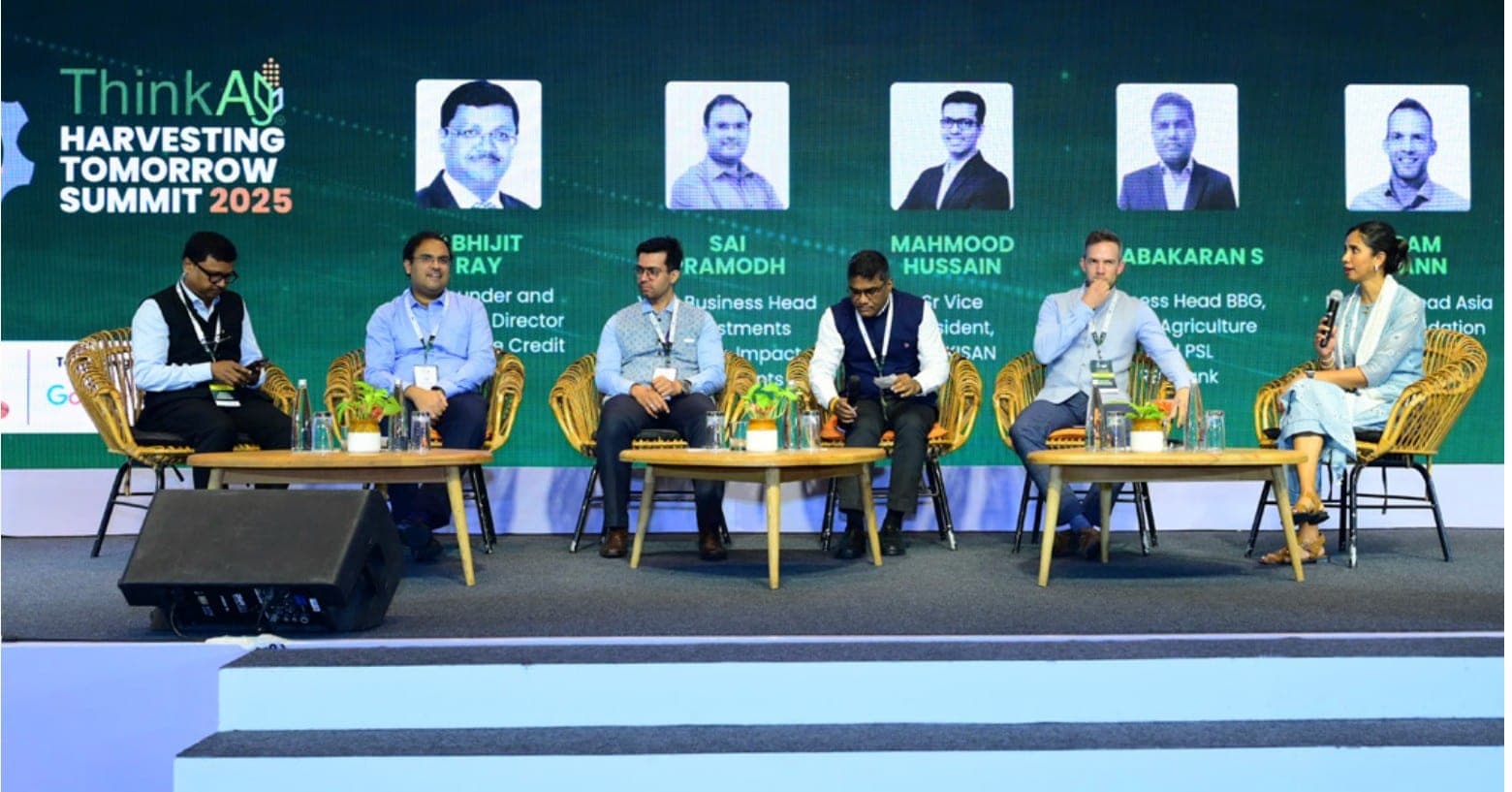
The Harvesting Tomorrow Summit 2026 (THTS 2026), organised by ThinkAg with the Rabo Foundation as title partner, runs on 8 and 9 December 2026 at the Bangalore International Centre, Bengaluru, on the theme Future-Ready AgFood Systems for the Global South. Registration has three tiers: launch pricing to 31 August 2026 at ₹8,750 plus GST for Indian delegates and USD 130 international, with no platform fee; regular pricing from 1 September at ₹10,000 or USD 150; and last chance pricing in November at ₹12,000 or USD 175, both with a platform fee. The delegate pass covers all sessions, the Innovation Showcase, 1:1 business meetings, two lunches and the networking reception. The 2025 edition drew about 250 delegates including 110-plus startups, 56-plus corporates and 41 investors from seven countries.
Start here
Two hundred and fifty people, which is the entire point
A farm machinery fair will tell you two lakh people came through the gate. This one had about 250 delegates, and that is not a weakness anybody is hiding. It is the product.
ThinkAg's Harvesting Tomorrow Summit 2026 runs on 8 and 9 December 2026 at the Bangalore International Centre, Bengaluru, under the theme Future-Ready AgFood Systems for the Global South. The title partner is the Rabo Foundation.
The reason to note it now rather than in November is the price ladder. Registration opened at a launch rate that ends on 31 August 2026 — and the later tiers add a platform fee the launch tier does not charge.
| Tier | Window | Indian delegate | International |
|---|---|---|---|
| Launch | 1–31 Aug 2026 | ₹8,750 + GST, no platform fee | USD 130, no platform fee |
| Regular | 1 Sep – 31 Oct 2026 | ₹10,000 + GST, plus platform fee | USD 150, plus platform fee |
| Last chance | 1–30 Nov 2026 | ₹12,000 + GST, plus platform fee | USD 175, plus platform fee |
At the standard 18% rate that puts the launch tier a shade over ₹10,300 all-in and the last tier past ₹14,100, before the platform fee. Booking in the next nine days is worth roughly ₹3,800 to an Indian delegate against leaving it to November.
The room
Who turns up, and how that has changed
ThinkAg publishes its own attendance series, which is more useful than a single headline number because it shows direction.
| 2023 | 2024 | 2025 | |
|---|---|---|---|
| Speakers | 60+ | 80+ | 90+ |
| Startups | 60+ | 95+ | 110+ |
| Corporates | 30+ | 40+ | 56+ |
| Investors and financial institutions | 30 | 34 | 41 |
| Countries | 4 | 8 | 7 |
The 2024 edition ran over three days rather than two, so it is not quite like for like. Every line has still risen except country count, which peaked in 2024.
Forty-one investors against a hundred and ten startups is the ratio that matters. Something close to one funder for every three companies is a density you do not get at a general exhibition, and it is what a founder is actually buying.
The corporate list is the other half of the argument, and it is not a startup-only crowd: past partners include NABARD, SBI, Axis Bank, Bayer, Mahindra Tractors, Godrej Agrovet, Dhanuka, Rasi Seeds, Samunnati, SatSure, Google Cloud and WWF. For anyone selling into agriculture, that is a procurement and partnership room as much as a funding one.
These are the organisers' own figures. Nobody audits delegate counts at Indian summits any more than at Indian trade fairs — but a series a body publishes about itself year after year is at least internally consistent, and the numbers here are modest enough to be believable.
The programme
Five tracks, and where the money conversation sits
The 2026 agenda is organised into five strategic tracks:
- Capital, Investment and Enterprise Growth — financing climate resilience, where the next round of money flows, corporate venture capital, and rural credit and insurance architecture
- Climate, Nature and Resource Resilience — the business case for regenerative agriculture, and making carbon markets actually work for farmers
- Technology, AI and Deep Innovation
- Animal Agriculture and Protein Systems
- Markets, Trade and Food Systems Transformation
Track one is the centre of gravity, and the session titles are unusually blunt about it — one asks where the next billion dollars will flow, another calls corporate venture capital the missing piece in India's agri-food innovation ecosystem.
Alongside the plenaries and breakouts runs an Innovation Showcase, which is where the startups get their few minutes in front of the room.
The money
What ₹8,750 buys, and what it does not
The delegate pass covers full access to every session — plenaries, breakouts and the Innovation Showcase — plus curated networking and 1:1 business meetings, two networking lunches and refreshments across both days, and the summit reception and cocktail dinner.
The 1:1 meetings are the line worth reading twice. At an event this size, a scheduled meeting system is the difference between two productive days and two days of standing near people you meant to talk to.
What it does not include is travel, accommodation or an exhibition presence — a stand or a showcase slot is a separate conversation with the organisers.
Registration openLaunch pricing ends 31 August 2026₹8,750 + GST for Indian delegates with no platform fee, rising to ₹10,000 from 1 September and ₹12,000 in November. Indian and international tiers are listed on the summit page.Register on the summit page
Enquiries go to Abhijit Goswami at ThinkAg — abhijit@thinkag.co.in, 9158433555.
Who it is for
Worth it if you are raising, scouting or deploying
A founder raising or about to raise. Forty-one investors in one building, an Innovation Showcase and a meeting scheduler, for less than the cost of two flights to chase the same conversations separately. If you are twelve months from needing money, go anyway and be a familiar face before you are a pitch.
A corporate scouting technology or partners. The whole point of a curated room is that the filtering is done before you arrive.
An investor or lender building a pipeline in the sector.
An FPO or farmer-producer business with genuine scale and something to sell or license — though the ticket is real money, and it is worth asking the organisers directly whether a concession exists before assuming it does not.
Probably not worth it for a working farmer, for a student looking for cheap credits, or for anyone hoping to browse machinery. This is a business summit priced like one. A farmer wanting to compare equipment gets more from a free-entry fair; a scholar wanting a publication line gets more from an academic conference. Neither of those is a criticism of this event — they are simply different products.
Placing it
A fair sells you a machine, a conference sells you a line, this sells you a room
It is worth being clear about which of these you are buying, because they are not substitutes.
Bharat Agri Tech at Indore and Agri Asia at Gandhinagar are trade fairs: free or cheap to enter, enormous, and valuable because six suppliers of the same machine stand within walking distance of each other. You go with a purchase in mind.
ICAHCFS at Dehradun is an academic conference: a few thousand rupees, and what you take home is a publication, a presentation and possibly an award.
Harvesting Tomorrow is a deal room. You are paying for who else has paid to be there, which is why the delegate count being small is a feature rather than an apology. Judge it the way you would judge any of them — by whether you arrive with something specific to do. Thirty useful conversations makes ₹8,750 look cheap; wandering in to see what turns up makes it expensive.
Why it matters
Indian agri-food technology is financed in a small number of rooms, and this is one of them. The ratio that matters is not the headline attendance but roughly one investor for every three startups, alongside corporates including NABARD, SBI, Bayer, Mahindra and Godrej Agrovet — a density a general trade exhibition cannot produce. For a founder near a raise, a corporate scouting technology, or a lender building a pipeline, that concentration is the product being sold. The immediate reason to decide now rather than later is arithmetic: launch pricing ends on 31 August 2026 and carries no platform fee, so the same seat costs materially more from 1 September and roughly ₹3,800 more if left until November.
Frequently asked
When and where is the Harvesting Tomorrow Summit 2026?
The Harvesting Tomorrow Summit 2026, organised by ThinkAg, runs on 8 and 9 December 2026 at the Bangalore International Centre in Bengaluru, India. The theme is Future-Ready AgFood Systems for the Global South, and the title partner is the Rabo Foundation.
What does it cost to attend the Harvesting Tomorrow Summit 2026?
Registration runs in three tiers. Launch pricing, from 1 to 31 August 2026, is ₹8,750 plus GST for Indian delegates and USD 130 for international delegates, with no platform fee. Regular registration from 1 September to 31 October 2026 is ₹10,000 plus GST or USD 150, and last chance registration through November 2026 is ₹12,000 plus GST or USD 175 — both with a platform fee applicable.
What does the delegate pass include?
Full access to all summit sessions including plenary discussions, breakout sessions and the Innovation Showcase; participation in curated networking and 1:1 business meetings; two networking lunches and refreshments across both days; and access to the summit networking reception and cocktail dinner. Travel, accommodation and any exhibition presence are separate.
Who attends the Harvesting Tomorrow Summit?
The 2025 edition drew around 250 delegates, including 110-plus startups, 56-plus corporates, 41 investors and financial institutions and 90-plus speakers, from seven countries. Past partners include NABARD, SBI, Axis Bank, Bayer, Mahindra Tractors, Godrej Agrovet, Samunnati, SatSure, Google Cloud and WWF. These are organiser-published figures and are not independently audited.
What are the tracks at the Harvesting Tomorrow Summit 2026?
Five: Capital, Investment and Enterprise Growth; Climate, Nature and Resource Resilience; Technology, AI and Deep Innovation; Animal Agriculture and Protein Systems; and Markets, Trade and Food Systems Transformation. An Innovation Showcase runs alongside the plenary and breakout sessions.
Is the Harvesting Tomorrow Summit worth it for farmers?
Generally no. It is a business and investment summit priced accordingly, aimed at startup founders, corporates, investors and financial institutions rather than at working farmers. A farmer wanting to compare equipment and prices will get more from a free-entry trade fair, and a research scholar seeking a publication or award will get more from an academic conference. An FPO or farmer-producer business with scale and something to license may be an exception, and should ask the organisers whether any concession applies.
Source
- Harvesting Tomorrow Summit 2026 — official event page (ThinkAg)
- ThinkAg — organisation site
- Harvesting Tomorrow Summit 2025 — previous edition and attendance figures
Dates, venue, theme, track list, delegate-pass inclusions, registration tiers and attendance figures are taken from ThinkAg's own event pages for the 2026 and 2025 summits. Attendance and partner counts are organiser-published and are not independently audited, which is true of Indian trade events generally; they are reported here as the organisers' figures and are reliable for order of magnitude rather than precision. The all-in rupee estimates apply the standard 18% GST rate to the quoted ex-GST fees and exclude the platform fee the organisers say applies to the regular and last-chance tiers; confirm the final payable amount at checkout. One caution for readers searching independently: thinkag.co.in's landing page still leads on the September 2025 summit with an active Register Now button, and the sister Look East summit has also already been held, so it is easy to arrive at a past event — the 2026 summit has its own page, linked above. IndianAgri is not an organiser, has no commercial relationship with ThinkAg or the summit, was not paid or asked to produce this guide and receives nothing if a reader registers. The judgements about who the summit suits, and the comparison with trade fairs and academic conferences, are IndianAgri's own.