Bharat Agri Tech 2027 in Indore: What's on the Floor, and Who Gains From Going
You can read about twenty reapers and still not know which one to buy. For three days in January, six companies selling the same machine stand a few hundred feet apart in Indore, and every one of them has to answer you.
The short answer
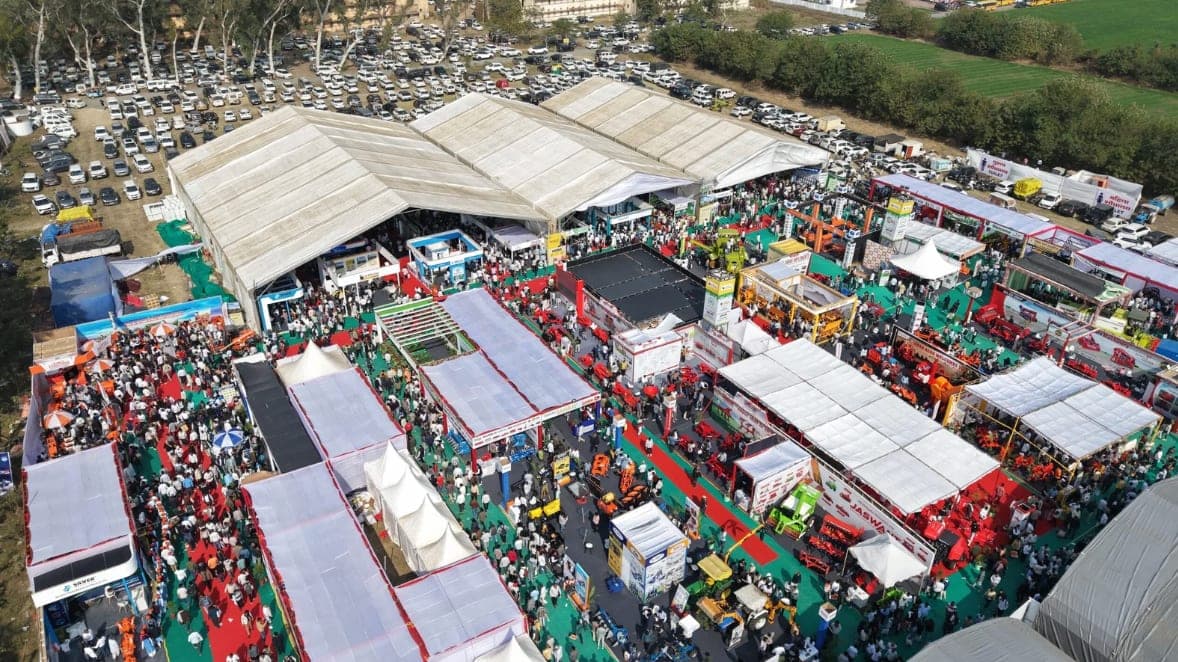
Bharat Agri Tech 2027 runs from 9 to 11 January 2027 at the BAPS Swaminarayan Akshardham Temple grounds, Nemawar Chouraha, Indore, Madhya Pradesh, organised by Yuva Udaan. This is a change of venue from earlier editions, which were held at the College of Agriculture in Indore. The fair covers advanced agricultural machinery, dairy, horticulture, organic products and food processing, with more than 20 workshops alongside the stands. Organisers expect 400-plus exhibitors, over 20,000 dealers and distributors and more than 2,00,000 visitors across 2,00,000-plus square feet; those are organiser estimates, not audited counts. Visitor entry is free.
Start here
Six machines that claim the same thing, and three days to ask
A farmer thinking about a reaper can read about twenty of them and still not know which one to buy. Brochures all say the same words. Nobody writes down what breaks.
That is the plain case for going to a fair like this one. For three days in January, six companies selling the same machine stand within a few hundred feet of each other, and every one of them has to answer you. You watch the machine run instead of reading about it. You ask what the wear parts cost. You ask how far away the nearest mechanic is. And because the man at the next stand sells a rival machine, you can walk over and ask him the same question.
Bharat Agri Tech runs on 9, 10 and 11 January 2027 in Indore. Entry for visitors is free.
January is the reason it works. It falls after rabi sowing and before harvest pressure, one of the few stretches when a working farmer can give three days to anything — and it comes while the year's spending decisions are still open, not after the money has gone.
The ground
Mostly machinery, and everything that gets sold alongside machinery
Yuva Udaan, which has run the fair since it started, describes it as an exhibition of advanced agri machinery, dairy, horticulture, organic products and food processing. On the ground, the machinery is what you notice first, and it is what most people come for.
Around it sits the rest of the chain — fertilisers and crop inputs, cold storage, food processing equipment, renewable energy, cow-based and organic products, packaging. And the banking and insurance stalls, which follow farm equipment everywhere in India for the obvious reason that almost none of it is bought outright.
There are also more than twenty workshops and sessions running alongside the stands, including free training on organic farming and on finding a market. That second one is worth more than it sounds. Most farmers who abandon organic certification do not fail at the agronomy; they fail at the paperwork and at finding somebody willing to pay a premium. An afternoon with people who have got through both is not a bad use of a day.
If you are buying
What a farmer actually carries home from three days
Strip away the banners and a fair earns its keep in four ordinary ways.
You compare prices in an afternoon. Six quotes for the same machine, gathered in one place on one day, from people who know you are collecting the other five. That is a stronger position than any of them would give you alone in a showroom.
You see it work. A machine running in front of you settles arguments a specification sheet cannot — how heavy it is to turn, how much noise it makes, whether one person can manage it.
You can sort the money out on the same ground. The banks and insurers keep stalls here precisely because almost nothing on display is bought outright. Loan terms, subsidy paperwork and insurance can be asked about on the spot, next to the machine they are for.
You can learn something free. Twenty-odd workshops run beside the stands, and nobody charges you to sit in.
The trip is also cheaper shared. An FPO, or four neighbours who intend to share a machine, split the travel between them and negotiate as a bigger buyer than any of them is alone.
Whatever the scale, the questions that decide a good purchase are the dull ones: what the wear parts cost, where the nearest mechanic is, how long a spare takes to arrive in season. They are the same questions from a combine down to a power weeder.
If you are selling
Twenty thousand dealers matter more than two lakh visitors
A public farm fair and a trade fair look identical from the gate and are completely different propositions once you are inside. What separates them is who is walking the aisles.
Bharat Agri Tech expects 20,000 dealers and distributors. If you sell anything into agriculture in central India, that is the reason to be there, and it is a far better reason than footfall. Territory arrangements, stocking terms and the conversations that decide whose machine sits in a district showroom next season happen face to face, at events like this, and almost never over a phone call.
The arithmetic is simply that they come to you. Meeting the same number of dealers by touring districts would take a sales team weeks and cost more than a stall does. A new product gets put in front of the people who would have to stock it, all in one week, with the competition standing near enough to be compared against — which is uncomfortable, and useful.
So a stand here can be judged quite simply. Thirty serious distributor conversations is a successful three days whether two lakh people walked past the front of it or twenty thousand did.
For a farmer, the same density cuts a different way: the people staffing the stands are selling to the trade as much as to you, and a dealer who wants your district's business will often talk more usefully than the manufacturer beside him.
The crowd
Two lakh visitors is a number the organisers supply, not one anybody counts
The fair advertises more than 2,00,000 visitors, over 20,000 dealers and distributors, 400-plus exhibitors and upwards of 2,00,000 square feet of ground.
Take the first of those gently. Nobody audits visitor numbers at Indian exhibitions — there is no body that checks them, and organisers have every reason to count generously. For scale, Agri Asia at Gandhinagar expects around 100,000 across its three days. This one claims twice that, in Indore.
It may well be right. A free-entry fair on open ground in the middle of one of India's denser farming belts can move extraordinary numbers of people, and regional krishi melas routinely do. The point is only that you should plan for a crowd rather than trust a headcount.
Worth going?
Three days in January, and what they actually cost
Entry is free, so the cost of attending is your time and your travel — and for a smallholder in January that is not nothing.
It is worth the trip if you are within a day's reach and close to spending real money, on equipment, on a processing line, on an irrigation system. Standing next to six suppliers in an afternoon and watching machines run is something no amount of searching replicates.
It is probably not worth several days of travel to browse with nothing in view. Central India is well served by regional fairs, catalogues are online, and three days in a short season is a real expense even when the ticket is free.
Before you go
Register early, and do not sign anything at the stand
Visitor registration is free and handled separately from exhibitor booking. Do it online beforehand — at a fair expecting crowds of this size, the queue at the gate is the avoidable part.
Check the address rather than trusting last year's. The 2027 fair is at the BAPS Swaminarayan Akshardham grounds at Nemawar Chouraha; earlier editions were held at the College of Agriculture, a different part of Indore.
Get to the machinery on the first morning. Demonstrations and the people who can answer a real technical question are both easiest to reach before the ground fills up.
And leave without signing. Show-only pricing is a sales technique rather than a discount. Take the quote home and put it beside a dealer who will still be reachable when something breaks in the middle of sowing — being close to service is worth more than a few thousand rupees off the sticker, every time.
Ask about spares before you ask about price: what the dealer stocks, what he orders in, and how long an in-season order really takes. A machine standing idle for ten days in the sowing window is not a cheap machine, whatever it cost.
Floor planBharat Agri Tech 2027, hall by hallThe official layout for the Nemawar Chouraha ground, published by Yuva Udaan. On a site this size it saves an hour of walking.Download the PDF
Why it matters
Madhya Pradesh sits in the middle of a dense farming belt, and a free-entry January fair lands in one of the few windows when a working farmer can spare three days - after rabi sowing, before harvest pressure, and while the year's equipment and input decisions are still open. For a buyer the value is comparison: six quotes for the same machine in an afternoon, the machine running in front of you, and the finance stalls on the same ground. For a seller it is density - 20,000 dealers and distributors come to the stand, where reaching the same number by touring districts would take a sales team weeks and cost more than a stall does.
Frequently asked
When and where is Bharat Agri Tech 2027?
9, 10 and 11 January 2027, at the BAPS Swaminarayan Akshardham Temple grounds, Nemawar Chouraha, Indore, Madhya Pradesh. Note that this is a change of venue — earlier editions were held at the College of Agriculture in Indore, so directions from a previous year will send you to the wrong place. The fair is organised by Yuva Udaan.
What is exhibited at Bharat Agri Tech?
The fair is built around advanced agricultural machinery, dairy, horticulture, organic products and food processing, with supporting segments covering fertilisers and crop inputs, cold chain, renewable energy, cow-based products, packaging, and agricultural banking and insurance. The organisers also list more than 20 interactive sessions and workshops, including free training on organic farming and market development.
How many people attend Bharat Agri Tech?
The organisers expect more than 2,00,000 visitors, over 20,000 dealers and distributors, and 400-plus exhibitors across more than 2,00,000 square feet. Treat these as organiser estimates rather than audited figures — visitor counts at Indian trade exhibitions are not independently verified. They are reliable for judging that this is a large regional fair and no more precise than that.
Is entry free for farmers?
Yes — visitor registration is free and is handled separately from exhibitor stall booking, which is paid. Registering online in advance is worth doing at an event expecting crowds of this size, since it avoids queuing at the gate.
Source
- Bharat Agri Tech — official event site
- Bharat Agri Tech — organiser's Facebook page (stall booking, edition announcements)
- Utsav (Government of India) — Bharat Agri Tech, Indore listing
- TradeIndia — Bharat Agri Tech 2027, Indore
Dates, venue, organiser and segment list are as published on the event's own site and corroborated against independent exhibition listings including the Government of India's Utsav portal. Two points needed judgement. First, the edition number: the official site refers to a 7th edition while the organiser's own Facebook page announces the 2027 fair as its 8th, so no edition number is stated in this article rather than repeating one that the organiser's channels contradict. Second, the venue: earlier editions were held at the College of Agriculture, Indore, and the move to the Akshardham grounds at Nemawar Chouraha is noted in the practical section because a returning visitor navigating from memory would otherwise go to the wrong place. The attendance figures — 400-plus exhibitors, 2,00,000-plus visitors, 20,000-plus dealers, 2,00,000-plus sq ft — are organiser estimates and are not independently audited, which is true of Indian trade exhibitions generally; they are reported as claims and are reliable only for order of magnitude. IndianAgri has no commercial relationship with Bharat Agri Tech or Yuva Udaan, was not paid or asked to produce this guide, and the judgements about who should and should not attend are its own. Confirm dates, timings, venue and registration on the official site before travelling.