Beyond the Farm Gate: Why Agriculture Is Becoming a Global Technology Industry
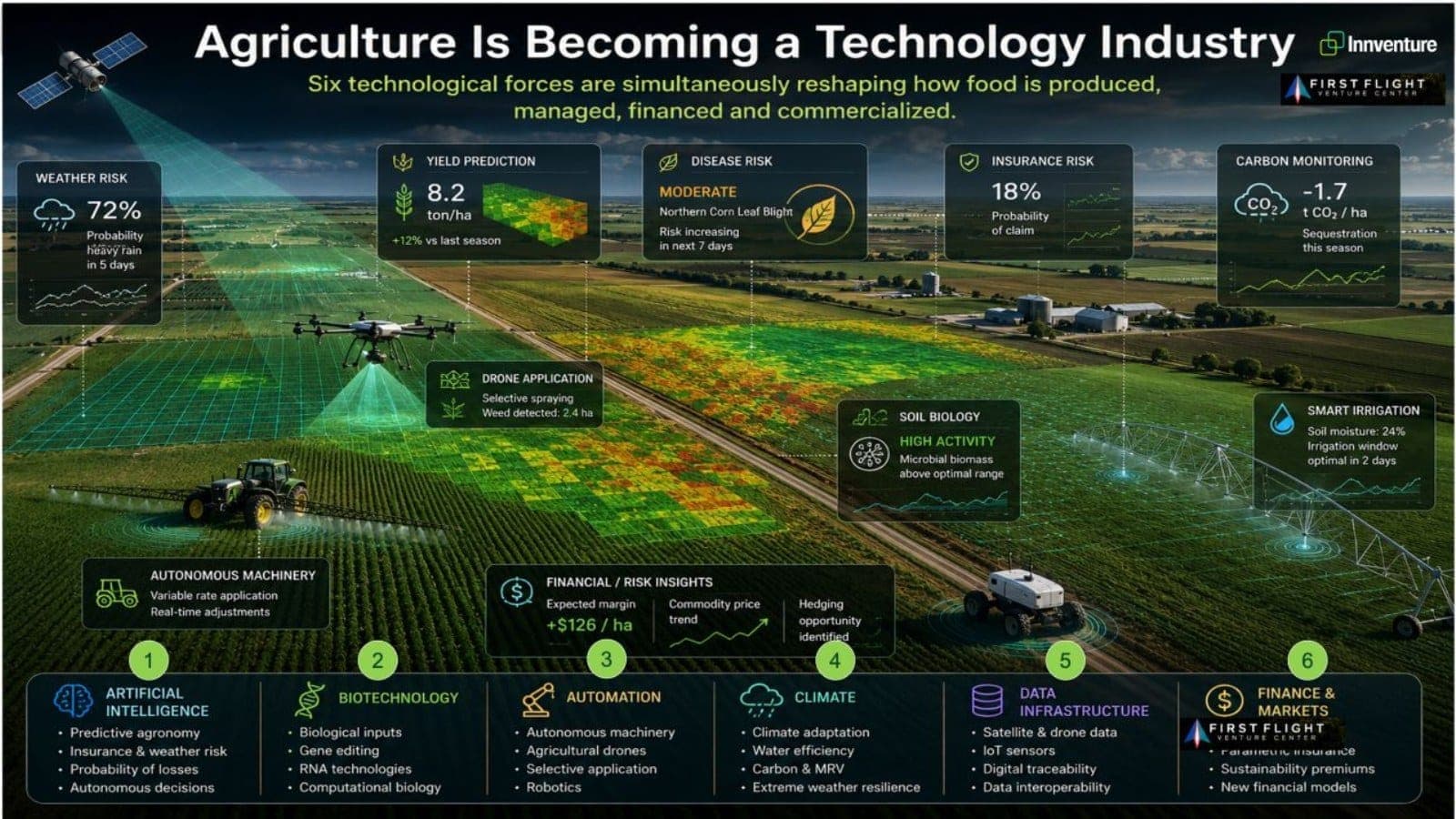
Six converging technological forces — AI, biotechnology, automation, climate tech, data infrastructure, and new financial models — are fundamentally redrawing what agriculture is, who works in it, and how value is created across the entire

Expert insights
Nico Reinoso · Global Business Development Executive & Agronomist
Nico Reinoso is an agronomist and global business development executive with over 25 years scaling agriculture, AgTech, AgriFoodTech, and ClimateTech businesses across 27+ countries.
The short answer
Agriculture is undergoing a structural shift unlike any previous wave of innovation, with six major technologies converging simultaneously to reshape food production, risk management, and financing. The sector is attracting AI engineers, data scientists, roboticists, and venture capitalists alongside traditional agronomists and farmers. Yet the defining challenge remains unchanged: technology only delivers value when a farmer chooses to adopt it.
The inflection point
A Convergence Unlike Any Before
Agriculture has always evolved — but in sequential chapters. Mechanization replaced manual labour; chemistry transformed yields; genetics unlocked new crop traits; and precision agriculture brought GPS and sensors to the field. Each wave arrived largely on its own terms, giving the industry time to absorb and adapt.
What is unfolding now is categorically different. For the first time, six major technological forces are arriving together: Artificial Intelligence, Biotechnology, Automation, Climate Technologies, Data Infrastructure, and new Financial Models. Their simultaneous convergence is not merely accelerating change — it is restructuring the entire logic of how food is produced, how decisions are made, how risks are priced, and where value ultimately accrues across the food system. The question is no longer whether agriculture is a technology industry. The argument is that it already is.
The talent shift
Who Builds the Future of Food
For years, agriculture struggled to pull skilled professionals from outside its traditional boundaries. That dynamic has reversed sharply. Today, AI engineers, software developers, data scientists, roboticists, biotechnologists, climate scientists, economists, entrepreneurs, and venture capitalists are all staking a claim in the future of food production.
The draw is straightforward: agriculture presents some of the most complex, high-stakes, and globally significant problems available to any technologist or entrepreneur. Feeding a growing world under mounting climate pressure, while managing supply-chain volatility and resource scarcity, is exactly the kind of challenge that attracts serious talent and serious capital.
For India specifically, this shift has profound implications. As AgTech and AgriFoodTech attract cross-sector talent globally, the domestic industry has an opportunity to build multi-disciplinary teams that can design solutions calibrated to the realities of Indian farming — not simply import them.
Technology has no impact until a farmer decides to use it.
The adoption imperative
Technology Has No Impact Until a Farmer Decides to Use It
Across more than 30 years and more than 20 countries, one lesson has proved durable: innovation is not successful because it is technically brilliant — it is successful because it solves a real problem, fits naturally into a producer's operation, and generates measurable value.
This is the central tension in modern AgTech. The industry is producing genuinely transformative tools, but the gap between laboratory or pilot performance and farm-level adoption remains wide. Products that fail to integrate into a grower's existing workflow, economics, or decision-making rhythm rarely scale — regardless of their technical merit.
A farmer-centric approach to innovation — one that connects science, technology, and business with the concrete needs of producers — is therefore not a soft principle but a commercial necessity. The future of agriculture will be defined not by who develops the most advanced technology, but by those who can convert innovation into adoption, and adoption into tangible value for producers.
The India read
What This Convergence Means for Indian Agriculture
India's agricultural sector sits at a compelling intersection: it is large, diverse, digitally under-penetrated, and under sustained pressure from climate variability, input costs, and market access constraints — precisely the conditions where converging technologies can deliver outsized impact.
- AI and data infrastructure have the potential to sharpen advisory services, credit underwriting, and supply-chain logistics for millions of smallholders.
- Biotechnology and climate technologies can address crop resilience challenges that are intensifying with each passing season.
- New financial models — including parametric insurance and outcome-based lending — could extend risk coverage to farmers historically excluded from formal markets.
The critical question for Indian agri-businesses and policymakers is not whether these technologies will arrive, but whether the adoption infrastructure — extension services, digital literacy, last-mile connectivity — will be strong enough to translate them into farm-level outcomes.
Why it matters
For Indian farmers, agri-businesses, and policymakers, this convergence signals that the next competitive advantage will not come from any single breakthrough but from the ability to bridge innovation and real-world adoption at scale. As global talent and venture capital flow into AgTech and AgriFoodTech, India's vast and diverse farming base positions it as both a critical testbed and a major beneficiary — provided new tools are designed around producers' actual needs. Policymakers and agri-businesses would do well to invest not just in technology development but in the human and institutional infrastructure that translates innovation into measurable value on the ground.
Frequently asked
What are the six technological forces converging in agriculture today?
The six forces identified are Artificial Intelligence, Biotechnology, Automation, Climate Technologies, Data Infrastructure, and new Financial Models. Together, they are reshaping food production, decision-making, risk management, and value creation across the entire food system.
How is the talent landscape in agriculture changing?
Agriculture is attracting professionals well beyond its traditional base of agronomists and farmers. AI engineers, software developers, data scientists, roboticists, biotechnologists, climate scientists, economists, entrepreneurs, and venture capitalists are all increasingly entering the sector, drawn by the scale and significance of the challenges it presents.
Why does farmer adoption matter more than technological brilliance?
Innovation only creates impact when a farmer actively chooses to use it. A technology that does not solve a real problem, fit naturally into a producer's operation, or generate measurable value will not scale — regardless of its technical sophistication. This makes a farmer-centric design approach a commercial necessity, not just a philosophical one.
How does this global technology shift relate to Indian agriculture?
India's farming sector — large, diverse, and facing climate and market pressures — is well-positioned to benefit from converging AgTech tools in areas like AI-driven advisory services, biotechnology for crop resilience, and new financial models such as parametric insurance. The critical enabler, however, will be building strong adoption infrastructure including extension services, digital literacy, and last-mile connectivity.
This is an original IndianAgri report. The analysis and India context are IndianAgri's own.