From Software Engineer to Coconut Entrepreneur: The Story Behind Tengin and India's Rural Value-Addition Push
Madhu Kargunda left an eight-year investment banking tech career to return to his family's coconut farm, launching Tengin — India's first all-coconut brand — to prove that agriculture paired with local value addition can anchor rural liveli

About the Leader
Madhu Kargunda · Founder, Tengin
Madhu Kargunda is the founder of Tengin, India's first all-coconut brand, and an Elevate Startup Winner recognised by the Government of Karnataka in 2023.
The short answer
Madhu Kargunda, a software engineer-turned-agripreneur, founded Tengin after recognising that farming alone could not deliver sustainable rural incomes. The Karnataka-based brand value-adds coconuts at the village level, working with farmers and women's collectives to retain more income within rural communities. Tengin was recognised as an Elevate Startup Winner by the Government of Karnataka in 2023, and its founder has now received the Top Most Agriculture Leaders of India award at the Agriculture Innovation Congress & Awards.
The backstory
A Farming Family, a Tech Career, and an Unfilled Gap
Madhu Kargunda's path is one that resonates across rural India. Born into a farming household, he followed his parents' aspirations — completing a Master's in Computer Applications before spending eight years as a software engineer in investment banking. It is a trajectory that millions of farm families recognise: agriculture providing the foundation while the next generation is steered towards more stable, urban professions.
Yet repeated visits to his village sharpened an uncomfortable observation. Young people were abandoning farming — not out of contempt for the land, but because smallholder agriculture, on its own, was failing to deliver reliable livelihoods. The income uncertainty and structural challenges that had motivated his parents to push him towards technology were, a generation later, still driving youth away from the fields.
That recognition became the turning point. Kargunda returned to the farm — not merely to cultivate coconuts, but to re-engage with the soil, study its condition, and rethink what a modern farming enterprise could look like.
Back to the land
Natural Farming, Soil Carbon, and Moving Beyond Monocropping
On returning to his family farm, Kargunda shifted focus squarely onto sustainable agronomic practices. The operation moved towards natural farming methods, with deliberate efforts to improve soil organic carbon — a key indicator of long-term soil health and productivity that is increasingly central to both Indian government programmes and global sustainability conversations.
The farm also stepped away from monocropping, diversifying its coconut-centred system to build greater resilience. Crucially, Kargunda began sharing these practices with neighbouring farmers, creating a knowledge-sharing loop that extended the impact beyond a single holding.
This on-ground engagement delivered a second, equally important insight: agronomic improvement alone is insufficient. Without value addition at the local level, farmers remain price-takers, vulnerable to commodity market swings and middlemen margins. The answer, as Kargunda framed it, is a combined model — agriculture plus local value addition — where processing, packaging, and branding happen close to the source rather than in distant urban facilities.
Agriculture alone is not enough. Agriculture + local value addition is the future.
The enterprise
Tengin: Building a Circular Coconut Economy in Karnataka's Villages
Tengin — recognised as India's first all-coconut brand — was built on the premise that every part of the coconut can generate value, and that this value should remain, as far as possible, within the rural community that produced it.
The brand's model rests on four interlocking pillars:
- Village-level processing: Value addition happens at source, not in distant factories, keeping margins closer to farmers.
- Women's collectives: Women are active partners in the enterprise, broadening the income base within rural households.
- Circular economy design: The goal is to ensure no part of the coconut is wasted, with each element — from flesh to husk to shell — finding a productive use.
- Consumer transparency: Products are positioned on quality and provenance, appealing to buyers who want to know where their food originates.
The Government of Karnataka recognised Tengin's potential by naming it an Elevate Startup Winner in 2023 — a validation of both its commercial model and its social architecture.
The recognition
Top Most Agriculture Leaders Award Shines a Light on Grassroots Innovation
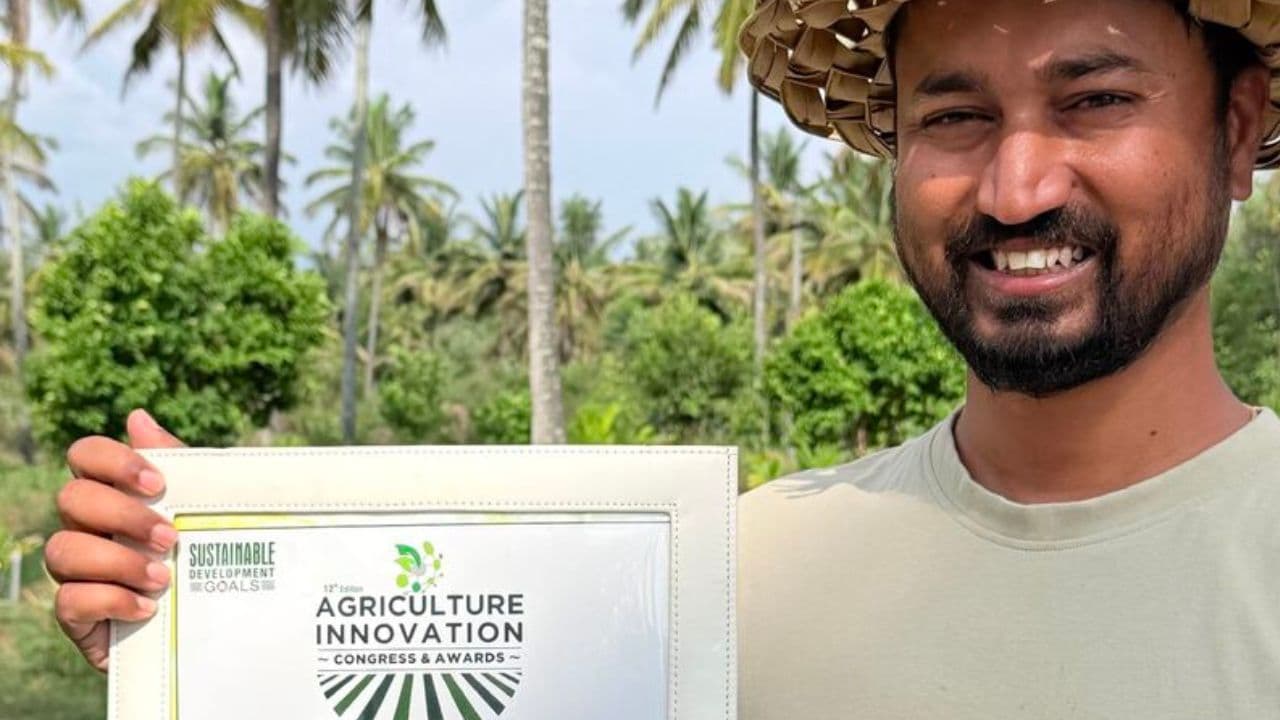
Kargunda recently received the Top Most Agriculture Leaders of India award at the Agriculture Innovation Congress & Awards — a recognition he framed not as a personal milestone but as an acknowledgement of the farmers, women partners, and consumers who have made Tengin possible.
For the wider agri-sector, the award carries a signal worth noting: innovation in Indian agriculture is no longer defined solely by laboratory breakthroughs or policy reforms. Entrepreneurial models that blend traditional farming with modern branding, women's economic inclusion, and sustainable practices are increasingly being seen as legitimate and scalable contributors to agricultural transformation.
Kargunda's stated ambition reaches further than a single brand's growth. He has articulated a vision in which young Indians choose agriculture — not as a last resort, but as a career that offers purpose, dignity, innovation, and financial sustainability. Whether Tengin's model can help shift that cultural calculus, at scale, remains the central question to watch.
Why it matters
Tengin's model — pairing primary agriculture with village-level processing and women's collectives — offers a replicable template for breaking the cycle of rural outmigration that is thinning India's agricultural workforce. For policymakers and agri-business investors, it underscores the case for directing support not just at farm productivity but at the post-harvest, value-addition layer where rural income gains are often greatest. Traders and commodity players should note the growing consumer appetite for traceable, origin-honest food products that brands like Tengin are tapping. The question to watch: whether such models can scale without losing the community-ownership ethos that makes them work.
Frequently asked
What is Tengin and what does it do?
Tengin is India's first all-coconut brand, founded by Madhu Kargunda. It value-adds coconuts at the village level, working with farmers and women's collectives to keep more income within rural communities and build a circular economy around the coconut.
Has Tengin received any government recognition?
Yes. The Government of Karnataka recognised Tengin as an Elevate Startup Winner in 2023.
Why did the founder leave a technology career to return to farming?
Madhu Kargunda observed that young people were leaving agriculture because farming alone was not providing a sustainable livelihood. He returned to his family's coconut farm to practise natural farming and eventually launched Tengin to demonstrate that agriculture combined with local value addition could anchor rural incomes.
What farming practices does Tengin promote?
Tengin practises natural farming, works to improve soil organic carbon, and moves beyond monocropping. The founder also shares these practices with fellow farmers in his community.
This is an original IndianAgri report. The analysis and India context are IndianAgri's own.