Government and NABL food testing labs in India: how to find a reliable lab at a fair price
Where to test food, spices and herbal powders at a fair price: the government and public labs that take outside samples, the rate lists they publish, and the checks that stop you paying for the wrong report.
The short answer
Start with public labs: FSSAI-notified state and government labs, the Export Inspection Agency labs, Spices Board quality labs, and institutes such as NIFTEM and CSIR labs that take outside samples. Before you send anything, check in NABL's directory that the lab is accredited for each test you need, on your kind of product. Then ask for one quote for all your samples, and test only what your buyer's specification lists. FSSAI's list of 9 October 2026 names 243 notified labs with valid NABL accreditation.
Our offer
We don't run a lab. We help you pick the right one.
IndianAgri does not test anything and is not paid by the labs on this page to rank them: they are listed by type, never by price. Tell us your products and your buyer's country, and we'll tell you which tests you need and get quotes from 2–3 accredited labs. Our team replies within one working day. We never promise a price, a turnaround or that a shipment will clear customs.
Step 1
First decide which tests you need
This is the biggest saving. Most high bills come from testing for things nobody asked for. A lab's "full package" can carry dozens of parameters; your buyer may need six.
Start from three things, in this order:
- Your buyer's specification, in writing. If they have a test list, test that list.
- The rules of the country you sell in. For food sold in India, FSSAI's standards. For an export, the importing country's rules.
- India's own standard for the product, if one exists. FSSAI sets one for turmeric powder and dried ginger powder, for example, but has no product standard for moringa, ashwagandha, tulsi, neem, amla or beetroot powder (Food Products Standards compendium, version of 23 Sep 2022). For those, the buyer's specification decides.
| FSSAI limit (dry basis unless stated) | Turmeric powder | Dried ginger powder |
|---|---|---|
| Moisture | not more than 10.0% | not more than 12.0% |
| Total ash | not more than 9.0% | not more than 8.0% (unbleached) |
| Acid-insoluble ash (sand and silica) | not more than 1.5% | not more than 1.0% |
| Strength | curcuminoids at least 2.0% | volatile oil at least 1.0% |
For dried herbs and spices, FSSAI's contaminant limits are lead 10 ppm (dry matter), arsenic 5.0 ppm, and aflatoxin B1 15 µg/kg with total aflatoxins 30 µg/kg; turmeric also has a cadmium limit of 0.1 ppm (consolidated text of 3 Feb 2026). An amendment notified on 14 May 2026 changes some metal and aflatoxin limits from 1 December 2026 (USDA summary), so ask the lab to test against the limits in force on your shipping date.
Exporting herbal powders? Our sister site sets out which tests the UAE asks for, how it treats a powder sold as food and one sold as a supplement, and the documents importers want. For buyers outside India, see the global guide to botanical powder testing.
Lab finder
Government labs that test food
FSSAI keeps the official list. Its order of 9 October 2026 names 243 FSSAI-notified food labs with valid NABL accreditation, with each lab's NABL certificate number, contact and validity dates, and a second list of 17 labs whose accreditation has expired, is suspended or is being denotified (FSSAI food laboratories; the list as a PDF). Most of the 243 are private. The government and public labs below are the ones we could check on their own or a government page.
FSSAI's 2014 PDFs of 61 or 68 labs still turn up in search. They are twelve years old: use the October 2026 list instead.
| Lab | Where | What it tests | Who can send samples | NABL certificate | Published charges |
|---|---|---|---|---|---|
| Spices Board Quality Evaluation Laboratory (head office) | Kochi, Kerala | Spices and herbs: moisture, ash, acid-insoluble ash, aflatoxin, ochratoxin, ethylene oxide, heavy metals, pesticide panels, microbiology | "Customer samples"; no registration condition printed. Ask before sending a non-spice powder | TC-6491, valid to 25 Mar 2028 | Form 75, Issue 51, 21 Sep 2026 |
| Spices Board QELs (regional) | Guntur · Gummidipoondi (Chennai) · Narela (Delhi) · Kandla · Mumbai (Vashi) | Spices; Kandla chemical only | Not stated on the site: ask the lab | Guntur NABLT0926AD19330 (to 5 Sep 2030); Chennai TC-7104 (to 27 Mar 2030); Narela TC-7776 (to 5 Jan 2029); Kandla TC-16029 (to 5 May 2029); Mumbai not found in our search | Older forms only (Mumbai 26 Oct 2023; Narela 2018): ask for the current one |
| Export Inspection Agency (EIA) laboratories, Export Inspection Council | Mumbai · Chennai · Kochi · Kolkata · Delhi · Bhubaneswar · Visakhapatnam · Bhimavaram | Export food analysis; all eight labs NABL-accredited (ISO/IEC 17025) | EIC's site does not say whether any exporter can send samples: ask the nearest EIA | Mumbai TC-5359; Chennai TC-7030; Kochi NABLT0926KL19481; Kolkata TC-7423; Delhi TC-7935 | None published |
| State Public Health Laboratory, Assam | Guwahati | Food under the FSS Act; water | Private commercial and individual samples | Not found in our search | ₹1,000 per commercial food sample, routine parameters (page updated 6 Jan 2026) |
| MSME Testing Centre (Southern Region) | Guindy, Chennai | Radionuclide checks on export food; water. FSSAI-notified | Industry; 25% off for registered micro and 10% for small units (2021 charges order) | TC-11413, valid to 21 Feb 2027 | 2021 common charges list food tests for Cs-137 only |
Lab finder
Public institutes that take outside samples
FSSAI also names referral labs, which re-test samples in appeals; its list "as on 05.12.2025" names 24 (the page itself says 20) and includes four Spices Board QELs, CFRA, NIFTEM-Thanjavur, CSIR-CFTRI and others (referral lab list). Whether each takes private samples is up to the lab.
| Lab | Where | What it tests | Who can send samples | NABL certificate | Published charges |
|---|---|---|---|---|---|
| Centre for Food Research and Analysis (CFRA), NIFTEM | Kundli, Sonipat, Haryana | Chemical and biological food testing; FSSAI primary, referral and national reference lab; APEDA-recognised for herbs and spices | "We are open to everyone": exporters, industry, entrepreneurs | TC-4009 | Not published; quoted through its ERP portal or helpline |
| Food Testing Laboratory, NIFTEM-Thanjavur | Thanjavur, Tamil Nadu | Moisture, ash, heavy metals, mycotoxins, pesticide screening, microbiology, extracts, volatile oil. FSSAI referral lab | Outside samples (public rate list) | Certificate number not found in our search | Rate list, undated (file of 4 Jun 2026), +18% GST |
| CSIR-CIMAP | Lucknow | Ayurvedic crude drugs and formulations: microbiology, heavy metals, pesticides, aflatoxin, ash, loss on drying, HPTLC | Outside samples, paid in advance. Reports are for R&D and quality use, "cannot be used as a certificates in legal disputes" | Not found in our search | AYUSH rate sheet, undated (file of 2020), +18% GST |
| CSIR-IIIM | Jammu | Heavy metals by ICP-MS, pesticide residues, microbial load | Outside samples (public price list) | Not found in our search | Price list, August 2024, before GST |
| Food Safety & Analytical Quality Control Laboratory, CSIR-CFTRI | Mysuru, Karnataka | Proximate, additives, contaminants (metals, pesticides, aflatoxins), microbiology. FSSAI referral lab; accredited for "more than 300 analytical parameters" | Industry, through its customer service cell (csc@cftri.res.in) | Certificate number not found in our search | No food-testing rate list published |
Check a lab's details are still right? Tell us and we will fix the table.
Check a lab
How to check a lab in the NABL directory
A lab is accredited for specific tests on specific products, not for everything. A lab accredited for moisture may not be accredited for pesticides or aflatoxin. Check before you send a sample:
- Open the search. On nabl-india.org go to Laboratory Search → Accredited Laboratories (direct link).
- Narrow it down. Set Field to Testing, pick your State and City, and set Type of CAB to Open to Others (labs that take outside samples). In the keywords box type the test or the product, for example aflatoxin or spices.
- Read the scope. In the results, open View Certificate and Scope of Accreditation. Find each test you need, for your kind of product, and the method. If it is not in the scope, the report for that test is not accredited.
- Check the dates. Note Certificate Valid Till. To check a certificate number you were given, type it into Certificate Number. Then look at NABL's suspended labs list (16 Oct 2026; suspension lasts up to six months, then accreditation is withdrawn if not lifted) and withdrawn list (16 Sep 2026).
Outside India, the same check works through the national accreditation body: ILAC's signatory search lists them by country.
Know the labels
FSSAI-notified, NABL-accredited, APEDA-recognised: what is the difference?
| Label | Who gives it | What it means for you |
|---|---|---|
| NABL-accredited | National Accreditation Board for Testing and Calibration Laboratories | Checked against ISO/IEC 17025 for the tests in its scope only. India's NABL is a signatory of the international ILAC arrangement, so its accredited results travel. |
| FSSAI-notified | FSSAI, under Section 43 of the FSS Act | A NABL-accredited lab FSSAI recognises for food analysis under the Act. 243 had valid accreditation on 9 Oct 2026. |
| APEDA-recognised | APEDA | Recognised for testing APEDA export products. Its live list on 22 Oct 2026 has 134 general labs, 71 of them with a scope that includes herbs, spices and condiments (list). |
For the paperwork rather than the testing: EIC and the EIAs issue certificates of origin, including under the India-UAE CEPA (EIC).
Charges
What public labs charge: the rate lists we found
Few labs publish their charges. These are the dated lists we found on the labs' own sites, exactly as printed. Charges change; confirm before you send.
Spices Board QEL, Kochi (Form 75, Issue 51, dated 21 Sep 2026). The form does not print a tax line in this issue: ask whether GST is extra.
| Test | Charge per sample |
|---|---|
| Moisture | ₹450 |
| Total ash | ₹450 |
| Acid-insoluble ash | ₹450 |
| Aerobic plate count | ₹600 |
| Yeast and mould | ₹500 |
| E. coli | ₹900 |
| Salmonella (ISO) | ₹1,700 |
| Aflatoxin B1, B2, G1, G2 (HPLC) | ₹3,000 |
| Heavy metals, one metal | ₹500 |
| Heavy metals, 11-metal panel | ₹2,500 |
| Pesticide residues, panel VIII A | ₹3,600 |
| Ethylene oxide | ₹2,750 |
It also prints the sample quantity and days for each test, for example 200 g and 3 days for aflatoxin, and 100 g and 5 days for total ash.
NIFTEM-Thanjavur Food Testing Laboratory (rate list, undated; file created 4 Jun 2026). Plus 18% GST. Solid samples: at least 400 g.
| Test | Charge per sample |
|---|---|
| Moisture | ₹165 |
| Ash | ₹385 |
| Acid-insoluble ash (sand/silica) | ₹385 |
| Total plate count | ₹1,100 |
| Yeast and mould | ₹1,100 |
| E. coli screening | ₹1,100 |
| Salmonella screening | ₹1,100 |
| Aflatoxin B1, B2, G1, G2 | ₹2,750 |
| Heavy metal, per element | ₹880 |
| Pesticide screening LC-MS/MS, per group | ₹5,500 |
Others: CSIR-CIMAP's AYUSH sheet (undated, file of 2020) lists ₹1,500 per microbiology test, ₹1,000 per heavy metal and ₹4,000 for aflatoxin, plus 18% (sheet). CSIR-IIIM's August 2024 list charges ₹5,000 for four heavy metals by ICP-MS, ₹3,000 for microbial load and ₹34,600 for pesticide residues, before GST (list). Assam's State Public Health Laboratory charges ₹1,000 for a commercial food sample on routine parameters (page).
Labs that publish no food-testing charges: the EIA labs, CFRA (NIFTEM Kundli) and CSIR-CFTRI. Ask them for a written quote.
Save money
How to bring your testing bill down
- Test only what the buyer's spec and the destination's rules list. Accreditation is per test, and so is the bill.
- Screen first. Moisture, ash, acid-insoluble ash and total plate count are the cheap tests. WHO's method book says that when the total count is over the limit, the material "should be rejected without being subjected to further testing" (WHO, 2011). Don't pay for pesticides on a lot that fails hygiene.
- Group your products. If you send several powders, ask for one quote for all of them, and ask whether one pesticide or metal panel price applies per sample or per group.
- Send enough sample, sealed and labelled. Too little means a second trip and a second fee. The lab's form usually prints the quantity.
- Keep a reference sample from the same lot, so a disputed result can be re-tested without re-sampling.
- Ask the buyer if a certificate of analysis plus periodic third-party tests is enough, instead of a full test on every batch.
- Check scope before you pay. A cheap report for a test outside the lab's scope may be refused by your buyer.
- Ask APEDA about testing aid. Its export promotion scheme paid registered exporters up to 50% of the testing cost, capped at ₹5,000 a sample and ₹20 lakh per exporter over 2021-22 to 2025-26, for tests the importing country requires (guidelines). That period has ended; ask APEDA whether it runs in 2026-27 before you count on it.
For labs
Running a NABL or government lab?
Get listed on this page free: send your NABL certificate number, scope and a link to your published charges, if any. Featured listings are paid and always labelled Featured lab · paid placement. They never change the order of the government and public lab tables. Ask about a listing.
Why it matters
A lab report is often the first thing a buyer asks for, and the bill can be larger than the sample. Picking the right tests and an accredited public lab can cut that cost without a report your buyer refuses.
Frequently asked
Which government labs test food samples for businesses?
Labs that say on their own pages that they take outside samples include the Spices Board QEL in Kochi ("customer samples"), CFRA at NIFTEM Kundli ("open to everyone"), NIFTEM-Thanjavur, CSIR-CIMAP, CSIR-IIIM, CSIR-CFTRI and Assam's State Public Health Laboratory. FSSAI's list of 243 notified labs (9 Oct 2026) gives contacts for the rest; ask each lab before sending.
How do I check if a lab is NABL accredited for my test?
Search the lab on NABL's accredited laboratory search (nablwp.qci.org.in/laboratorysearchone), open "View Certificate and Scope of Accreditation" and find your exact test and product type in the scope. Then check "Certificate Valid Till" and NABL's suspended and withdrawn lists.
What is the difference between an FSSAI-notified lab and a NABL lab?
NABL accreditation means a lab has been checked against ISO/IEC 17025 for the tests in its scope. An FSSAI-notified lab is a NABL-accredited lab that FSSAI also recognises for food analysis under Section 43 of the FSS Act.
Can the Spices Board lab test my herbal powder?
Its Kochi lab's charges form (21 Sep 2026) is for "customer samples", mentions herbs, and sets no registration condition. It does not say whether non-spice herbal powders are accepted, so write to the lab first.
How much does food testing cost in India?
It depends on the tests. The Spices Board's Kochi list (21 Sep 2026) charges ₹450 for moisture, ₹3,000 for aflatoxin and ₹2,500 for an 11-metal panel; NIFTEM-Thanjavur's list charges ₹880 per heavy metal and ₹2,750 for aflatoxin, plus GST. Ask for one quote for all your samples.
Is there a government scheme to pay for export testing?
APEDA's export promotion scheme paid registered exporters up to 50% of testing costs, capped at ₹5,000 a sample and ₹20 lakh per exporter, for tests the importing country requires, over 2021-22 to 2025-26. Ask APEDA whether it continues in 2026-27.
How much sample does a lab need?
Each lab prints its own. The Spices Board's Kochi form asks for 100 g to 375 g depending on the test (300 g for herbs on some tests), and NIFTEM-Thanjavur asks for at least 400 g of a solid sample.
Where is the official list of FSSAI notified laboratories?
On fssai.gov.in under Food Testing → Food Laboratories. The current list is dated 9 October 2026: 243 labs with valid NABL accreditation and 17 expired, suspended or being denotified. The 2014 PDFs of 61 or 68 labs are out of date.
Source
- FSSAI: Food laboratories (food testing section)
- FSSAI: FSSAI-recognised labs with NABL validity as on 9 Oct 2026
- FSSAI: Referral laboratories notified under Section 43(2), as on 05.12.2025
- FSSAI: Food Products Standards compendium, Version XXV (23.09.2022)
- FSSAI: Contaminants, Toxins and Residues compendium, Version IX (03.02.2026)
- USDA FAS GAIN IN2026-0044: FSSAI final regulations on contaminants (14 Aug 2026)
- Spices Board: QEL Kochi Form 75, Issue 51 (21-09-2026)
- Spices Board: Quality Evaluation Laboratory
- Export Inspection Council: laboratories
- Export Inspection Council: certificate of origin
- APEDA: recognised laboratories (live list)
- APEDA: export promotion scheme operational guidelines, 2021-22 to 2025-26
- NIFTEM Kundli: Centre for Food Research and Analysis
- NIFTEM-Thanjavur: food testing charges
- CSIR-CIMAP: test parameters and charges for AYUSH products
- CSIR-IIIM: revised price list (Aug 2024)
- CSIR-CFTRI: services
- Assam FDA: sample analysis and fees structure
- NABL: accredited laboratory search
- NABL: suspended laboratories as on 16-10-2026
- NABL: withdrawal of accreditation as on 16-09-2026
- WHO: Quality control methods for herbal materials (2011)
- ILAC: signatory search
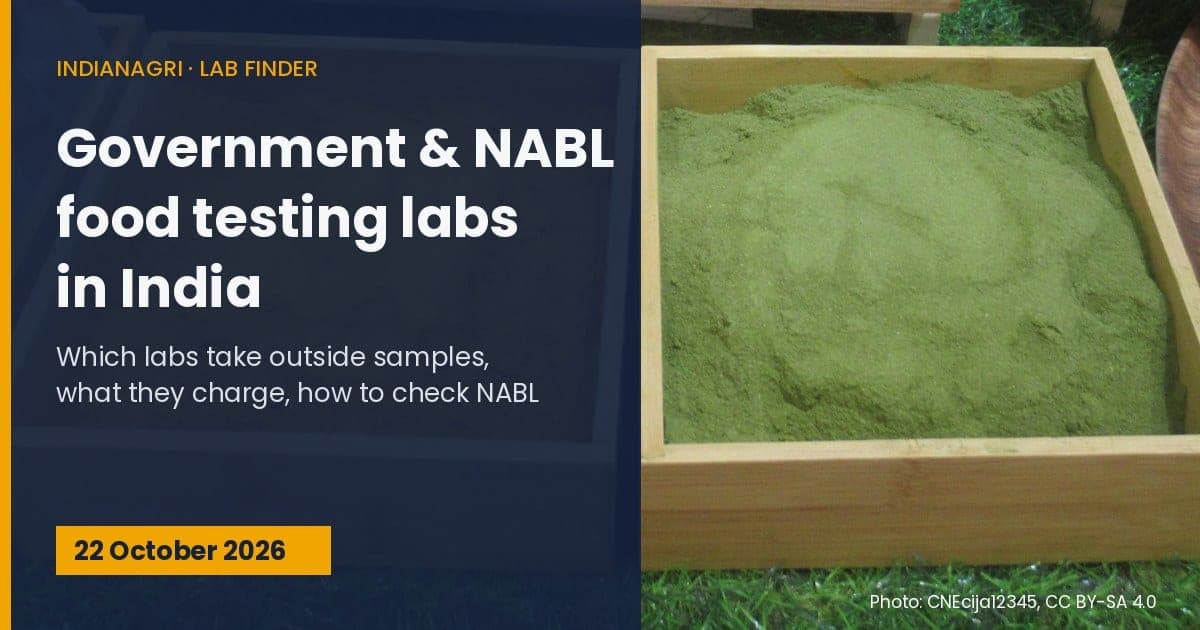
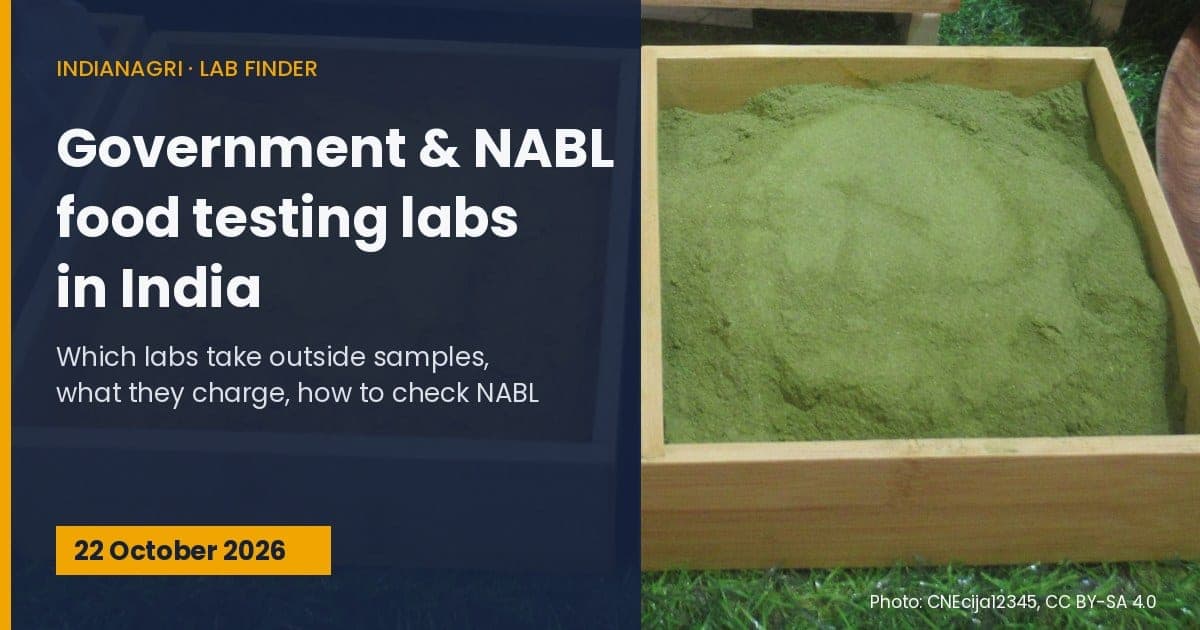
- Photo: "Turmeric and Moringa oleifera powder", CNEcija12345, Wikimedia Commons, CC BY-SA 4.0
Read on 22 October 2026. Lab lists and counts are from FSSAI's validity order of 9 Oct 2026 and referral list as on 5 Dec 2025, APEDA's live list and EIC's own pages; NABL certificate numbers and validity are from the NABL directory and the FSSAI order. Charges are exactly as printed in each lab's own dated list. Limits are from FSSAI's compendiums (products 23 Sep 2022; contaminants 3 Feb 2026). Labs are grouped by type, not ranked by price. IndianAgri runs no lab and takes no payment from the labs listed in the tables. Photo: CNEcija12345, Wikimedia Commons, CC BY-SA 4.0.
Edited by Devendra Kumar Jha. How we report, source and correct: editorial policy. Spotted an error? Tell us.