Green Banana Flour Isn't a Spec — the Harvest Window Is What Actually Matters
Two suppliers can both sell "green banana flour," yet deliver completely different functional performance. The difference isn't the label — it's what happened in the orchard before the fruit ever reached a dryer.

Expert insights
Subha Shree · Founder, Smarex Ingredients
Subha Shree is the Founder of Smarex Ingredients, a venture focused on building Green Banana RS2 Resistant Starch as a commercial food ingredient.
The short answer
Green banana flour's functional value comes from resistant starch (RS2), which begins converting into digestible sugars the moment ripening starts — a process that begins long before the fruit reaches a processing facility. Because of this, "green banana flour" is not a meaningful specification on its own: two suppliers using the same label can deliver very different functional performance depending on harvest timing, fruit maturity at harvest, how quickly it was processed afterward, and how it was handled before drying.
The core insight
Resistant Starch Starts Converting Before the Fruit Reaches the Factory
As a banana ripens, its resistant starch (RS2) does not simply decline — it is gradually converted into digestible sugars. That conversion is a biological process tied to ripening, and it begins in the field and in transit, long before a bunch ever reaches a processing facility.
This matters because it means the functional quality of the finished ingredient is shaped as much by decisions made in the orchard as by anything that happens during manufacturing. A drying or milling process cannot compensate for starch that has already converted during a delayed or poorly managed harvest — the raw material's functional ceiling is set before processing even begins. For a formulator relying on RS2 content to deliver a specific nutritional or functional claim, that timing question is not a minor sourcing detail; it is the difference between an ingredient that performs as expected and one that quietly falls short of spec after the fact.
The labelling problem
"Green Banana Flour" Describes an Appearance, Not a Performance
Two suppliers can both market "green banana flour," yet the functional performance of their ingredients can differ substantially. The label refers to the colour and general category of the product — it says nothing about how that particular batch was sourced.
The variables that actually determine functional quality sit upstream of the flour itself, and they come down to four specific questions: When was the fruit harvested? How mature was it at harvest? How quickly was it processed after harvest? And how was it handled before drying? Two batches can answer those four questions completely differently while both still qualifying, on paper, as "green banana flour." A buyer comparing two quotes on price or appearance alone is comparing two products that may not be functionally interchangeable at all — and the finished flour gives no visual indication of which harvest and handling path it actually followed.
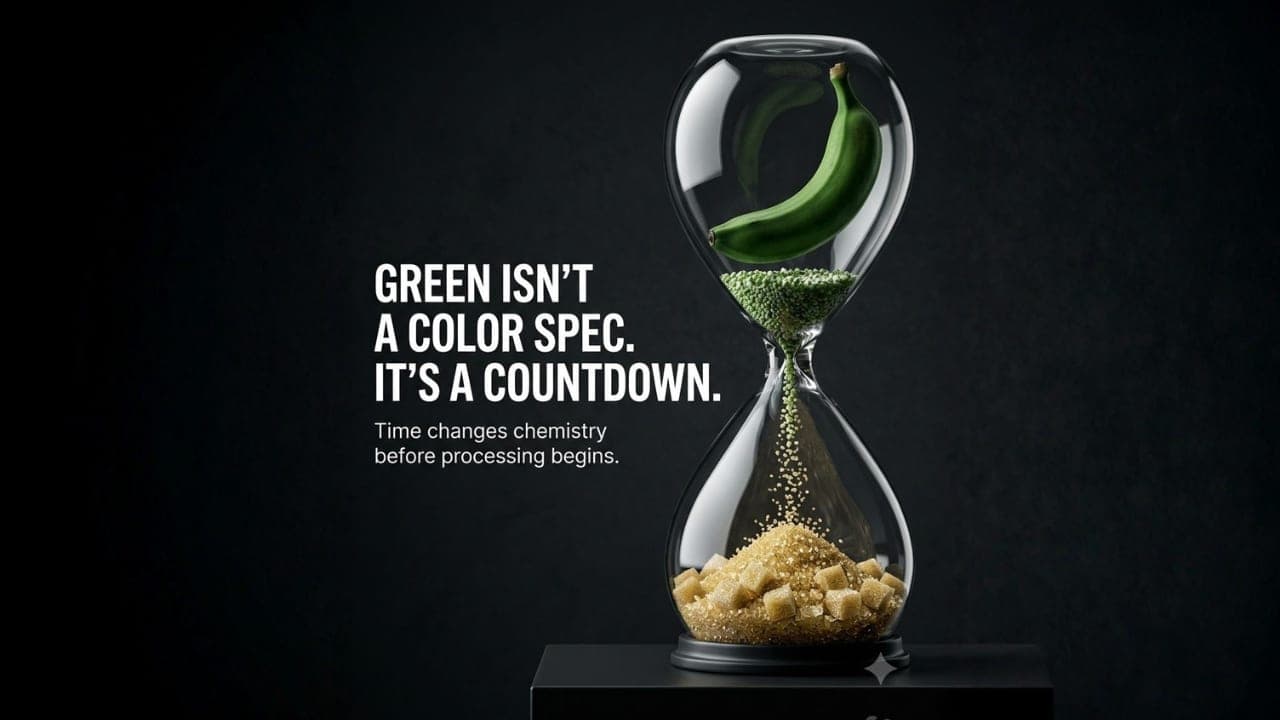
Green isn't a colour spec. It's a countdown.
The irreversible part
Once Converted, Resistant Starch Cannot Be Recovered by Processing
The conversion of resistant starch to digestible sugar during ripening is not reversible. No downstream processing step — drying, milling, or formulation — can restore RS2 content once that conversion has taken place in the fruit itself.
That makes sourcing, not manufacturing, the point in the supply chain where functional quality is actually won or lost. Defining the right harvest window and protecting the fruit's condition through transport and initial handling is what preserves the functionality a food manufacturer is ultimately paying for.
The sourcing philosophy
Building a Supply Chain Around the Harvest Window, Not Just the Colour
Smarex Ingredients, a venture building green banana RS2 resistant starch as a commercial food ingredient, is structuring its sourcing approach around this critical harvest window — treating the timing and handling of harvest as a functional specification in its own right, not an afterthought to processing. Sourcing, on this view, is not simply about finding bananas that are green; it is about defining the right harvest window and protecting that functionality all the way through the supply chain, from the orchard to the dryer.
The underlying premise is straightforward: functional ingredients should start with functional raw materials, not assumptions based on appearance. For Indian food manufacturers and formulators sourcing green banana ingredients, the practical takeaway is to ask suppliers to define their harvest window and handling protocol explicitly, and to treat that answer as part of the specification — because the flour itself, once produced, cannot tell that story on its own. Only the sourcing process can.
Why it matters
For Indian food manufacturers formulating with green banana flour or RS2 ingredients, this reframes supplier evaluation entirely: asking for "green banana flour" on a purchase order is not enough, and testing a single batch tells you little about whether that performance will repeat. Buyers need suppliers who can describe and control their harvest window, not just their drying process — and once resistant starch has converted during ripening, no downstream processing step can bring it back.
Frequently asked
What is resistant starch (RS2) in green bananas?
RS2 is a form of resistant starch present in unripe (green) bananas that behaves like dietary fibre. As the banana ripens, RS2 is gradually converted into digestible sugars, which is why fruit maturity and ripening stage directly affect the functional quality of banana-based ingredients.
Why can two "green banana flour" products perform differently?
Because "green banana flour" describes an appearance and category, not a specification. Functional performance depends on when the fruit was harvested, how mature it was at harvest, how quickly it was processed afterward, and how it was handled before drying — factors that vary by supplier.
Can processing restore resistant starch lost during ripening?
No. Once resistant starch has converted into digestible sugar during ripening, that conversion cannot be reversed by drying, milling, or any other processing step. The harvest window, not the manufacturing process, is what determines the ingredient's functional ceiling.
What should food manufacturers ask green banana ingredient suppliers?
Buyers should ask suppliers to define their harvest window and handling protocol explicitly — harvest timing, fruit maturity at harvest, processing speed after harvest, and handling before drying — rather than relying on the "green banana flour" label or appearance alone.
This is an original IndianAgri report based on a LinkedIn post by Subha Shree, Founder of Smarex Ingredients. The analysis and India context are IndianAgri's own.