India's Fertilizer Trap: Why Higher Inputs No Longer Guarantee Higher Yields
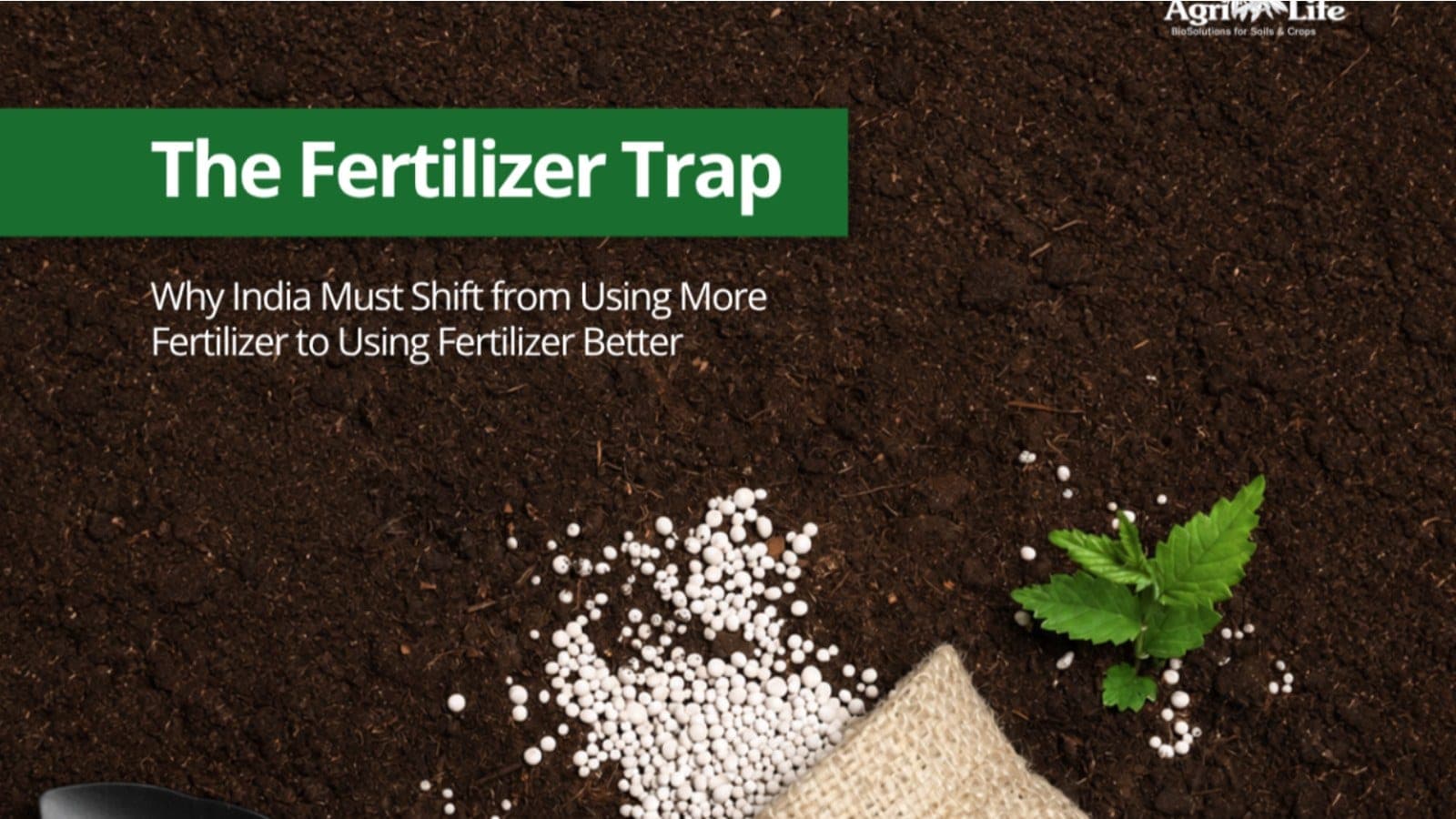
With over ₹2 lakh crore spent annually on fertilizer subsidies and nitrogen-use efficiency stuck at just 35–40%, India's farming sector must pivot from input volume to nutrient intelligence.

Expert insights
Venkatesh Devanur · CEO, Agri Life and Owner, SOM Phytopharma
Venkatesh Devanur leads Agri Life and SOM Phytopharma, developing biofertilizers, biopesticides, biostimulants, and nanotechnology-derived inputs for sustainable agriculture.
The short answer
India spends more than ₹2 lakh crore every year on fertilizer subsidies, yet a large share of the nutrients applied never reaches the crop — lost instead to leaching, runoff, and volatilization. Nitrogen-use efficiency (NUE) in the country hovers at only 35–40%, meaning the majority of applied nitrogen is wasted, driving up costs and degrading soils. Experts argue the solution lies not in applying more fertilizer, but in improving how efficiently every unit of nutrient is used — through balanced nutrition, biofertilizers, biostimulants, nanotechnology, and integrated nutrient management.
The core problem
A ₹2 Lakh Crore Subsidy Bill With Shrinking Returns
Fertilizers were central to India's Green Revolution and remain deeply embedded in the country's food security strategy. But the returns on chemical inputs are diminishing — and the costs, both fiscal and ecological, are mounting.
India now spends over ₹2 lakh crore annually on fertilizer subsidies, yet a substantial portion of the nutrients applied across the country's fields never contributes to crop production. These nutrients exit farming systems through leaching into groundwater, surface runoff into water bodies, and volatilization into the atmosphere — generating economic losses and measurable environmental harm.
Experts describe this as a 'fertilizer trap': a cycle in which farmers apply ever-larger quantities of inputs just to sustain previous yield levels, while soil health continues to deteriorate. The challenge for Indian agriculture is no longer solely about producing enough food — it is about producing it efficiently, without compromising the natural resource base on which farming depends.
The efficiency gap
Only 35–40% of Applied Nitrogen Actually Reaches the Crop
A widely held assumption in farming is that more fertilizer reliably produces more yield. The data tells a more complicated story.
Studies estimate that nitrogen-use efficiency (NUE) in India stands at only 35–40%, meaning well over half of applied nitrogen is lost before a crop can absorb it. Beyond a threshold, additional fertilizer application generates:
- Rising cultivation costs with no proportional yield gain
- Accelerated soil degradation and declining organic carbon
- Reduced microbial activity and lower water-holding capacity
- Groundwater contamination through nitrate leaching
- Increased greenhouse gas emissions
The problem is compounded by the structure of India's subsidy regime. Heavily subsidised urea has encouraged excess nitrogen application, often without adequate phosphorus, potassium, sulphur, or micronutrients. This nutrient imbalance weakens soil structure and reduces the crop's response to fertilizer over successive seasons — locking farmers into an expensive and counterproductive escalation of inputs.
The pivot
Nutrient Use Efficiency: Getting More From Every Kilogram Applied
The modern agronomic response to India's fertilizer trap centres on Nutrient Use Efficiency (NUE) — maximising the crop response generated by each unit of nutrient applied, rather than simply maximising the volume of inputs used.
Improving NUE requires an integrated toolkit rather than any single product:
Five evidence-backed strategies
1. Balanced nutrition: Soil-test-based application ensures crops receive a complete nutrient profile, preventing both deficiencies and costly excesses.
2. Biofertilizers: Beneficial soil microorganisms make nutrients more bioavailable through natural biological processes, improving nutrient cycling and soil vitality.
3. Biostimulants: These inputs address abiotic stress, enhance root development and nutrient uptake, and improve overall plant performance — helping crops extract more value from available nutrients.
4. Nanotechnology: Nano-enabled nutrient products improve the precision of nutrient delivery, reducing losses and increasing availability at the root zone.
5. Integrated Nutrient Management (INM): Combining organic matter, crop residues, biofertilizers, biostimulants, and judicious fertilizer use creates a balanced system. Research increasingly shows that integrated approaches can lift productivity while reducing total fertilizer consumption.
The foundation
Soil Health Is Not a Side Issue — It Is the Whole Equation
Underlying every nutrient management strategy is a single non-negotiable: the biological health of the soil itself.
Healthy soil is a living ecosystem — dense with microorganisms that recycle nutrients, build structure, retain moisture, and sustain resilient crop growth season after season. When soil biology is compromised by imbalanced or excessive chemical inputs, fertilizer efficiency declines regardless of how much product is applied.
Conversely, when soil health improves — through organic matter additions, reduced tillage, biofertilizer use, and balanced nutrition — fertilizer efficiency improves alongside it, creating a virtuous cycle that reduces input dependence over time.
India's next productivity leap, experts argue, will not come from further increases in chemical input volumes. It will come from smarter nutrient management, restored soil biology, and farming practices that treat soil as a productive asset rather than an inert substrate.
Why it matters
For Indian farmers, the fertilizer trap translates directly into a profitability squeeze: rising input costs with diminishing yield returns and deteriorating soil health. For policymakers, the ₹2 lakh crore annual subsidy bill — much of it financing nutrient losses rather than crop production — represents a fiscal and environmental liability that integrated nutrient management strategies could help reduce. The shift toward NUE-focused farming is no longer a fringe idea; it is increasingly backed by research and supported by emerging input categories such as nano-nutrients and biostimulants. Traders and agri-businesses should watch the biofertilizer, biostimulant, and precision-agriculture input segments as the next frontier of demand growth.
Frequently asked
What is the 'fertilizer trap' and why does it affect Indian farmers?
The fertilizer trap refers to a cycle in which farmers apply increasingly larger quantities of fertilizer just to maintain previous yield levels, even as soil health deteriorates. With over ₹2 lakh crore spent annually on subsidies, a large share of nutrients never reaches the crop — lost instead through leaching, runoff, and volatilization — making farming costlier without delivering proportional yield gains.
How low is nitrogen-use efficiency (NUE) in India?
Studies estimate that NUE in India stands at only 35–40%, meaning that more than half of the nitrogen applied in fields is never utilised by the crop. This represents a significant economic loss for farmers and contributes to soil degradation and water pollution.
What strategies can improve nutrient use efficiency on Indian farms?
Experts recommend an integrated approach that includes soil-test-based balanced nutrition, biofertilizers, biostimulants, nanotechnology-enabled nutrient products, and Integrated Nutrient Management — combining organic matter, crop residues, and judicious fertilizer use to improve productivity while reducing unnecessary input consumption.
Why is soil health central to solving the fertilizer efficiency problem?
Healthy soil is a living ecosystem of microorganisms that recycle nutrients, improve structure, and retain moisture. When soil biology is damaged by imbalanced fertilizer use, efficiency declines regardless of how much input is applied. Restoring soil health through organic matter and biofertilizers naturally improves how well crops utilise applied nutrients.
This is an original IndianAgri report. The analysis and India context are IndianAgri's own.
Edited by Devendra Kumar Jha. How we report, source and correct: editorial policy. Spotted an error? Tell us.