Onion grading machines in India: what AI grading at Pimpalgaon market shows
Maharashtra grows 44.1% of India's onion, and most of it is still graded by hand. A machine installed at Pimpalgaon in August shows what automated grading promises, and what a buyer should check.
The short answer
In August 2026 Agrograde installed a GradePlus Pro onion grader at a farmer producer company in Pimpalgaon, Nashik. The company says it grades up to 10 tonnes an hour with nearly 80% less labour. Published prices for onion graders run from ₹2,99,999 (3 t/h) to ₹14,50,000 (10 t/h); AI sorters also reject rotten and sprouted bulbs.
Why it matters
Why grading decides what a Nashik onion lot fetches
An onion lot is not sold as one thing. Traders pay for a size band, and for a lot without doubles, sprouted, rotten or skinless bulbs. That is why the government's Agmarknet portal reports a minimum, a maximum and a modal price for onion in each market: two lots in the same yard on the same day can sit at opposite ends of that range.
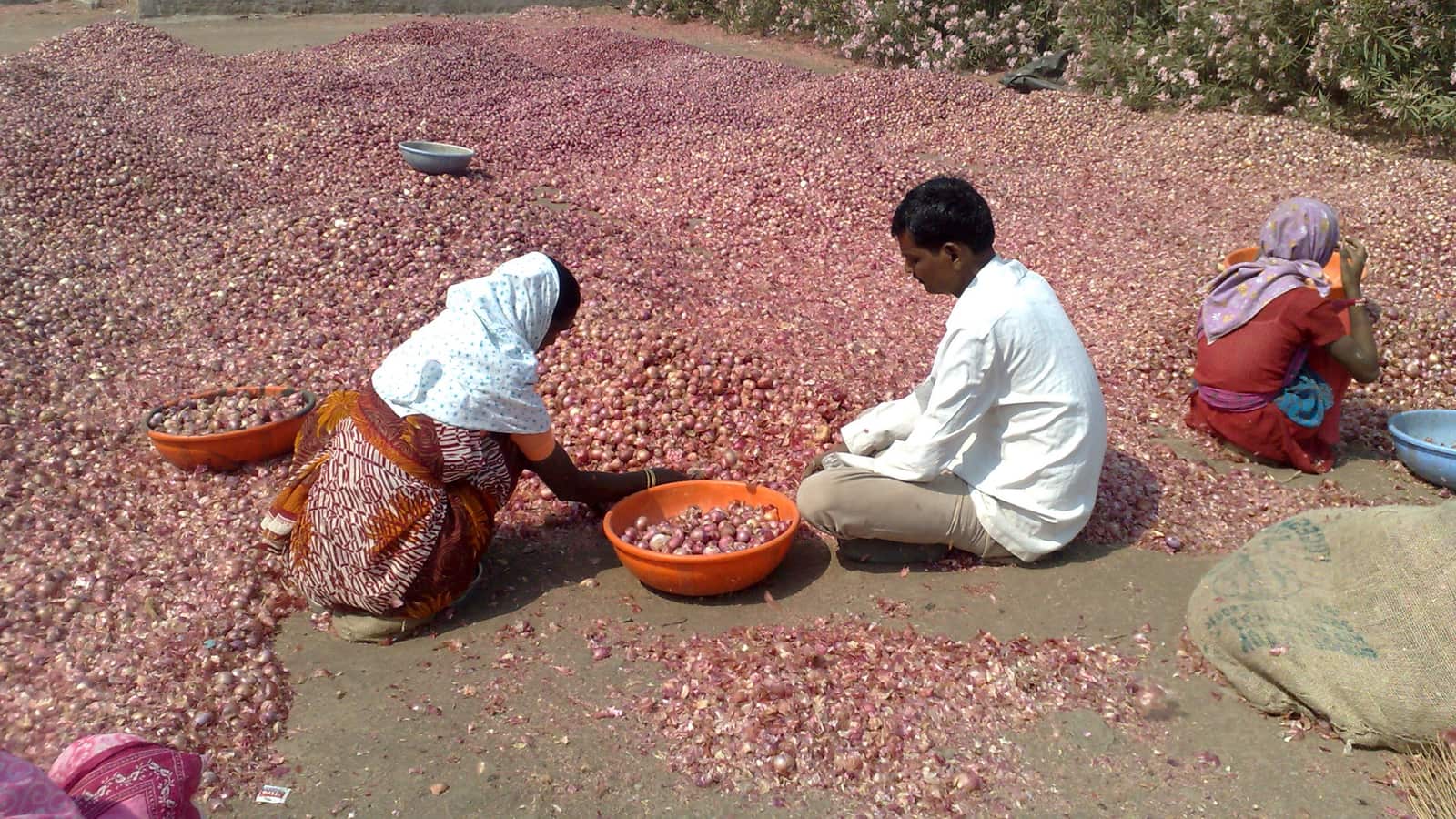
Skin matters as much as size. Onion keeps for months in storage only if its dry outer skin stays on, and buyers, particularly in export markets, mark down bulbs that have lost it. Producers and industry groups told BusinessLine that friction in mechanical handling can peel the thin skin of Indian varieties, shortening shelf life and affecting prices. That is a key reason most onion in India is still graded by hand, by people sitting at a heap with baskets.
Maharashtra grew 135.6 lakh tonnes of onion in 2024-25, 44.1% of India's 307.7 lakh tonnes (state figures below), and Nashik district, with the Lasalgaon and Pimpalgaon Baswant markets, is at the centre of that trade.
Pimpalgaon
What was installed at Pimpalgaon, and what the company claims
On 19 August 2026 BusinessLine reported that Agrograde, a Pune agri-tech company, had installed its GradePlus Pro automated onion grading system at a farmer producer company in Pimpalgaon, Nashik district. Rural Voice carried the same news the same day. Neither names the farmer producer company, and we found no statement on the install from the market committee or the company itself as of 23 October 2026. So every figure below is Agrograde's own:
| What Agrograde says | Figure |
|---|---|
| Throughput | Up to 10 tonnes of onion an hour |
| Labour for grading | Nearly 80% less than manual sorting |
| Size accuracy | Up to 99%, "according to company estimates" |
| Speed against hand grading | Three to five times the throughput |
| Also automated | Unloading and bagging |
| Grading cost | "Almost ₹0.05 per kg at speeds of up to 200 tonnes per day" (about ₹50 a tonne), co-founder Rakeshkumar Barai |
Table: figures as Agrograde stated them in its media statement, reported by BusinessLine on 19 August 2026. Not independently tested.
The machine uses what Agrograde calls WaveMotion: onions are moved along in a controlled wave instead of being dragged or shaken over rollers, to keep the skin on. Agrograde's release, as Rural Voice reported it, said even imported machines "costing around ₹1.25 crore" had caused skin damage and peeling in India. The company has also built a tractor-mounted version that can move between farms, packhouses, cold stores and mandis.
BusinessLine adds that Agrograde, founded in 2018, makes grading, sorting, weighing and packing systems for onion and potato, and says it has deployed more than 130 machines across 14 states.
For the full company picture, from the Vector optical sorter to the GradePlus graders, see IndianPotato's profile of Agrograde.
Machine types
Three ways to grade onion: by hand, by belt or roller, by camera
| Method | What it sorts by | What to watch | Makers and what they state |
|---|---|---|---|
| Hand grading at the heap or an inspection table | Size by eye; doubles, sprouted, rotten and skinless bulbs that people can see | Speed depends on the crew; grades drift over a long day | Goldin India Engineering, Vadodara, lists a sorting roller conveyor that turns produce so people can spot defects |
| Roller, belt or screen grader | Size only, into 2–4 grades | Friction can take the skin off; people still pick defects | Goldin: potato onion roller grader, 2 t/h, 4 grades; mobile grader, 20 t/h. Bharti Agro Food Engineers, Panchkula: onion sorting grading machine, 2,000–3,000 kg an hour |
| WaveMotion grader (Agrograde's own design) | Size, into 2–4 grades, with the onion carried on a moving wave | A newer design: ask for installs you can visit | Agrograde GradePlus Max, Pro and tractor-mounted MG, 4 to 10 MT an hour; GradeMini, 3,000 kg an hour |
| Optical or AI sorter (cameras, software decides, air or fingers reject) | Colour and visible defects: rot, sprouting, black mould (smut), damage, doubles; also size | Price; needs training and checking on your onions | Agrograde: Vector, 1–20 MT an hour, potato, onion and tomato; AI onion grading sorting machine, 1–10 MT an hour. TOMRA lists the TOMRA 5B and TOMRA 3A for onions, built for large packhouses and processors |
Table: capacities and features as each maker states them on its own site, read 23 October 2026. Real throughput depends on bulb size and how full the line runs.
"AI" here means the software has been trained on many thousands of pictures of good and bad bulbs, so it can tell black mould from a soil mark without someone writing a rule for each. It is still a camera: it sees the outside of the bulb, and it has to be checked on your own variety and season.
What it costs
Onion grading machine prices the makers publish
Most makers do not print a price. These are the ones that do, as listed on 23 October 2026:
| Machine | Capacity as listed | Listed price | Where listed |
|---|---|---|---|
| Agrograde GradeMini (onion, potato, garlic; 3 grades; single phase 220 V) | 3,000 kg an hour | ₹2,99,999 a piece | occipital.in |
| Goldin mobile grader (on its onion grading page) | 20 tonnes an hour | "Approx." ₹4,00,000 a piece | goldin.in |
| Agrograde movable grading machine for onion and potato (3 grades, 380 V) | 5 tonnes an hour | ₹7,50,000 a piece | occipital.in |
| Agrograde AI onion grading sorting machine (checks size, colour, doubles, black smut, rot, sprouting) | 1–10 MT an hour | ₹10,47,100 a unit | occipital.in |
| Agrograde high speed onion grader, GradePlus Pro (WaveMotion, 3 grades, 440 V) | 10,000 kg an hour | ₹14,50,000 a piece | occipital.in |
| Bharti Agro Food Engineers onion sorting grading machine | 2,000–3,000 kg an hour | Not published | bhartiagrofoodengineers.co.in |
| TOMRA 5B / TOMRA 3A | Not stated for onion | Not published | tomra.com |
Table: prices as printed on each maker's own website. occipital.in is the site of Occipital Technologies Private Limited, the company behind Agrograde. None of the listings says whether GST, freight or installation is included.
Treat these as a starting point, not a quote. The same Agrograde site lists two more onion graders whose descriptions also name the GradePlus Pro, at ₹4,00,000 for 4,000 kg an hour and ₹9,59,500 for 5,000 kg an hour, so ask the maker which model and which capacity a price is for, in writing, before you compare.
Before you buy
What an FPO or trader should check before buying
- A trial on your own onions. Not the maker's demo lot. Run a day's stored rabi onion and, if you handle it, fresh kharif onion too. Count the bulbs that lose their skin, not just the ones graded right.
- Check the grades yourself. Take 50 bulbs from each outlet and measure them across the widest point. Then you know what "99% accuracy" means on your line.
- Tonnes per hour at your bulb size. Capacity on a listing is the best case. Ask what it does with your mix of small and large bulbs, and with the heap full of soil.
- Power at the site. The listings above range from single-phase 220 V to three-phase 440 V. A farm or FPO shed may only have single phase.
- Who services it, and how fast. Ask for the nearest service person to Nashik (or your district), the price of common spares and how long they take to arrive in peak season.
- Installs you can visit. Ask for two buyers of the same model you can call or visit, and what their grading cost per tonne came to.
- A written quote that says GST, freight, installation, training and warranty, and which capacity it is for.
How the same machines are used for potatoes, with the official size grades, is in our guide to potato sorting and grading in India. For potato machines, makers and the prices they publish, see IndianPotato's buyer's guide to potato grading and sorting machines.
Planning an onion or potato grading line? Tell us your crop, tonnes per hour and site. We reply within 2 working days with what to ask the makers and what to check in a trial. Plan your grading line
IndianAgri sells no machines and takes no payment from the makers named here. We do not pass your enquiry to any maker.
The numbers
Where India's onions are grown
The six largest onion states grew 84.6% of India's crop in 2024-25. Maharashtra alone grew 44.1% of it, on 49.7% of the country's onion area. India's crop was 242.7 lakh tonnes in 2023-24.
| State | Onion production, 2024-25 (lakh tonnes) | Share of India's crop |
|---|---|---|
| Maharashtra | 135.6 | 44.1% |
| Madhya Pradesh | 44.4 | 14.4% |
| Karnataka | 25.8 | 8.4% |
| Gujarat | 25.4 | 8.3% |
| Rajasthan | 15.7 | 5.1% |
| Bihar | 13.3 | 4.3% |
| India | 307.7 | 100% |
Table: onion production by state, 2024-25, Final Estimates. Compiled by IndianAgri from the Horticulture Statistics Division, Department of Agriculture & Farmers Welfare, Ministry of Agriculture & Farmers Welfare, Government of India. Shares are each state's figure divided by the all-India total in the same release.
See the full onion series by state. Spotted a figure that has changed? Tell us.
Why it matters
Maharashtra grew 135.6 lakh tonnes of onion in 2024-25, and most of it is graded by hand at the heap. Whether a machine can grade without peeling the skin decides how long the onion stores and what it fetches.
Frequently asked
What is an onion grading machine?
An onion grading machine splits a lot of onions into size bands, usually two to four, so each bag holds bulbs of one size. Simple graders use rollers, belts or screens. Newer ones carry onions on a moving wave to protect the skin, and AI sorters add cameras that also reject rotten, sprouted and damaged bulbs.
What is the pyaj grading machine price in India?
Pyaj grading machine prices that makers publish start near ₹3 lakh: Agrograde lists its GradeMini (3,000 kg an hour) at ₹2,99,999 and Goldin a 20 t/h mobile grader at about ₹4 lakh. Agrograde lists a 10 t/h WaveMotion grader at ₹14.5 lakh. Prices were read on 23 October 2026; ask whether GST, freight and installation are included.
What onion grading machine was installed at Pimpalgaon market?
BusinessLine reported on 19 August 2026 that Agrograde installed its GradePlus Pro automated onion grading system at a farmer producer company in Pimpalgaon, Nashik district. Agrograde says it grades up to 10 tonnes an hour with up to 99% accuracy and needs nearly 80% less labour than hand grading. These are company figures.
Does a grading machine damage onion skin?
It can. Friction on rollers and belts can peel the thin dry skin of Indian onion varieties, which shortens storage life and lowers the price. That is one reason most onion is still graded by hand. Agrograde says its WaveMotion design reduces skin scuffing and peeling; test any machine on your own onions and count the skinless bulbs.
How does AI onion grading work?
Cameras photograph each onion as it passes, and software trained on thousands of images decides its size and whether it has defects such as rot, sprouting, black mould or doubles. Air jets or flaps then push each bulb into its grade or the reject line. It sees only the outside of the bulb.
Which state grows the most onion in India?
Maharashtra. It grew 135.6 lakh tonnes of onion in 2024-25, 44.1% of India's 307.7 lakh tonnes, according to the Final Estimates of the Department of Agriculture and Farmers Welfare. Nashik district, home to the Lasalgaon and Pimpalgaon markets, is the centre of its onion trade.
Source
- The Hindu BusinessLine: Agrograde's automated onion grading system installed at Pimpalgaon market (19 Aug 2026)
- Rural Voice: Automated onion grading system cuts manual labour by nearly 80% at Pimpalgaon market (19 Aug 2026)
- Agrograde: home page (read 23 Oct 2026)
- Agrograde: products (read 23 Oct 2026)
- Occipital Technologies (Agrograde): GradeMini onion grading machine listing (read 23 Oct 2026)
- Occipital Technologies (Agrograde): onion grading machine listings (read 23 Oct 2026)
- Occipital Technologies (Agrograde): movable and high speed grader listings (read 23 Oct 2026)
- Occipital Technologies (Agrograde): vegetable grading machine listings (read 23 Oct 2026)
- Goldin India Engineering: onion grading and sorting machinery (read 23 Oct 2026)
- Bharti Agro Food Engineers: onion sorting grading machine (read 23 Oct 2026)
- TOMRA: onion sorting and grading machines (read 23 Oct 2026)
- DA&FW Horticulture Statistics Division: horticulture estimates (state onion production, Final)
- Agmarknet: market prices (minimum, maximum, modal)
- Photo: "Onion grading and cleaning" (28 Jan 2010), Nishaexport, CC BY-SA 3.0, via Wikimedia Commons; cropped
Read on 23 October 2026. The Pimpalgaon install and its figures are from Agrograde's media statement as reported by The Hindu BusinessLine and Rural Voice on 19 August 2026; they are company figures, not tested by us. Capacities and prices are as each maker lists them on its own website. State production is from the DA&FW Horticulture Statistics Division's Final Estimates for 2024-25, computed from IndianAgri's fact store. IndianAgri sells no machines, takes no payment from the makers named and does not pass enquiries to them. Photo: Nishaexport, CC BY-SA 3.0, via Wikimedia Commons.
Edited by Devendra Kumar Jha. How we report, source and correct: editorial policy. Spotted an error? Tell us.