Pheromone Traps for Farmers: The Hyderabad Startup Built on Pledged Gold
Kavitha pledged her jewellery so the company could start. The traps it sells cost ₹15 to ₹40 a lure — and their real job is telling a farmer when not to spray.
The short answer
A pheromone trap is baited with a synthetic copy of an insect's mating signal, so it catches males of one pest species and nothing else. Farmers use it mainly to time sprays. ICAR advises 5 traps per hectare (about 2 an acre) to monitor pink bollworm in cotton from 45 days after sowing, with spraying justified once catches reach 8 moths per trap on three consecutive days. For mass trapping fall armyworm in maize, the Directorate of Plant Protection, Quarantine & Storage advises 15 traps an acre. Lures from Agri Phero Solutionz, a Hyderabad startup founded by Vishnu and A. Kavitha with capital raised against her gold, cost ₹15 to ₹40 each by the company's own pricing.
Start here
A pest-control company that began with a gold loan
Before they started a company, Vishnu and his wife A. Kavitha worked in agricultural pest management, and saw the same thing season after season: farmers spraying more, paying more for chemicals, and still losing crops to pests they had not seen coming. What was missing, they decided, was not another pesticide but a cheap way to see a pest early.
They had the idea and not the money. Kavitha pledged her gold jewellery to raise the first capital, and that loan became Agri Phero Solutionz, a Hyderabad firm that makes and sells pheromone lures, pheromone traps, sticky sheets and rolls, and solar insect traps. It has taken no outside funding. The company says it earned ₹2.5 crore in revenue in FY25.

Need lures for your crop?Tell us the crop, the pest and your acresWe will tell you which lure and trap fit, how many you need, and where to get genuine lures near you.Email usWhatsApp us
Their product is worth understanding on its own, because it is one of the cheapest tools a farmer has and one of the most misunderstood. A pheromone trap rarely kills enough insects to save a crop by itself. What it does is tell a farmer when to spray — and, just as often, that he does not need to.
The science
What a pheromone trap is and how it works
Insects talk in smell. A female moth ready to mate releases a sex pheromone, a chemical that males of her own species can pick up from a distance, and that no other species responds to. Chemists have copied many of these signals. A lure — a small rubber septum or vial loaded with the synthetic pheromone — is hung inside a trap, and the males of one pest fly in and cannot get out.
Three things follow from that:
- It is specific. A pink bollworm lure catches pink bollworm moths. Bees, ladybirds and spiders are not attracted, which is why traps sit comfortably inside integrated pest management (IPM).
- It catches adults, before the damage. The moth in the trap is the parent of the caterpillar that will bore into the boll or the fruit a week or two later. A rising catch is an early warning.
- It leaves nothing on the crop. The lure never touches the plant, so there is no residue on what is harvested.
Not every lure in a dealer's box is a sex pheromone. Fruit fly lures such as methyl eugenol and cue-lure are plant-derived attractants that draw male flies. Red palm weevil and rhinoceros beetle lures are aggregation pheromones, which pull in both males and females — and that is why they are used to catch beetles out of a coconut garden, not only to count them.
This company was never built on outside funding — it was built on trust, sacrifice, and the belief that farmers deserve a safer way to protect their crops.
Which lure
Pheromone lures for India's worst crop pests
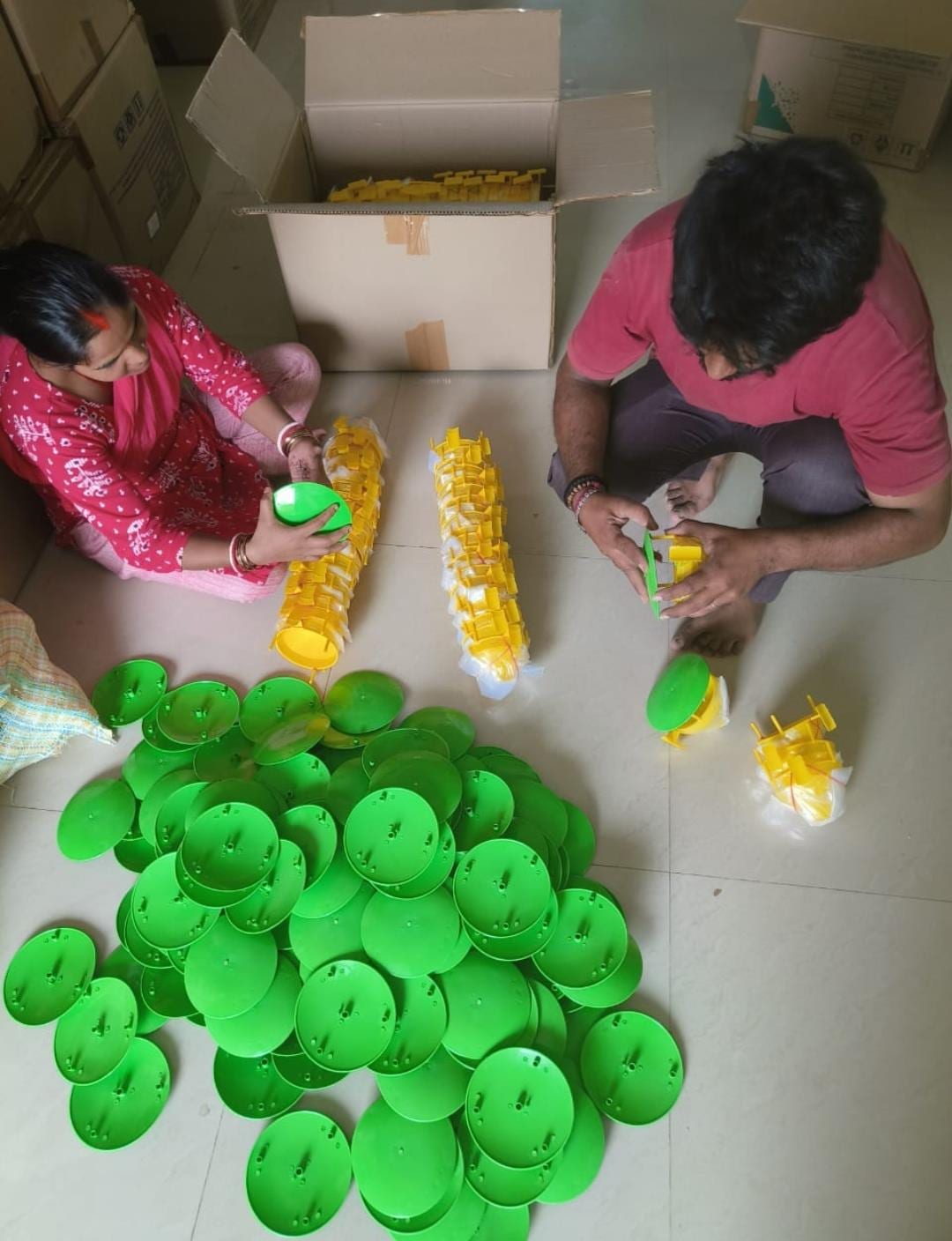
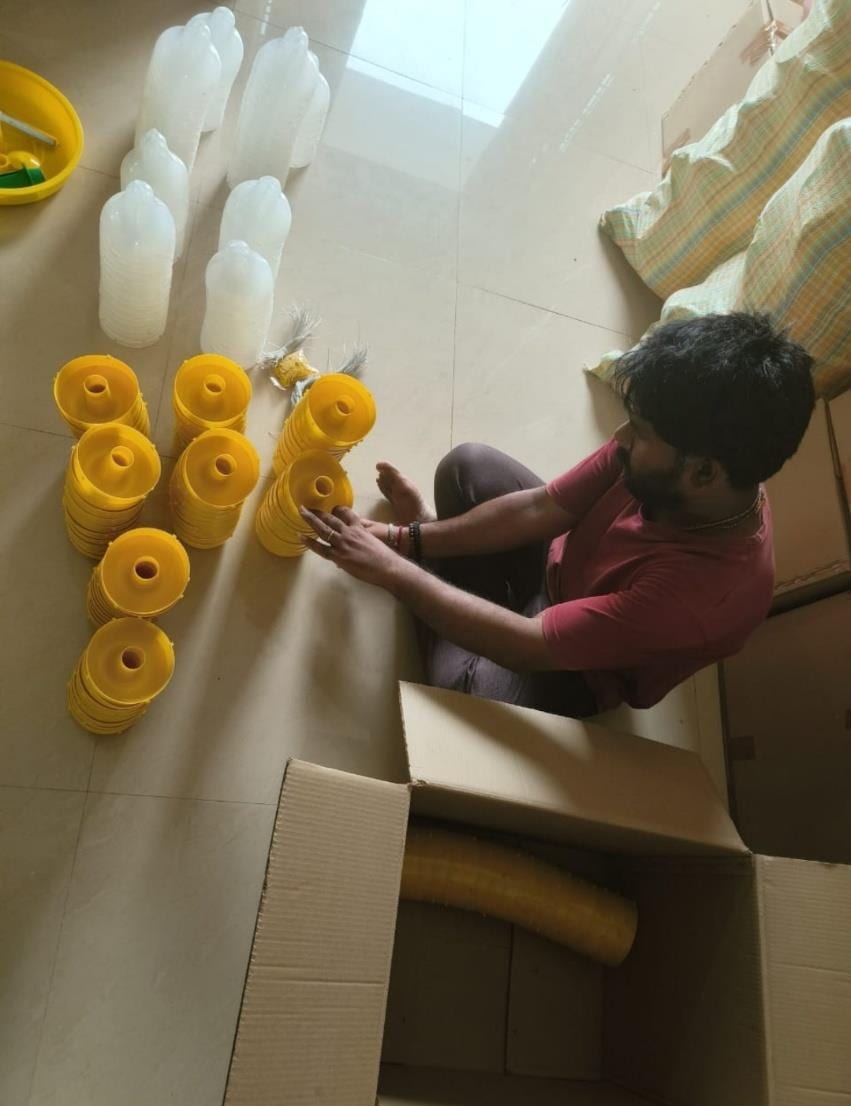
Agri Phero Solutionz lists lures for most of the pests that cause the heaviest losses in Indian fields. The trap shown is the type such lures are usually set in; a lure only works in a trap that suits how its insect flies.
| Pest | Main crops | Trap usually used |
|---|---|---|
| Pink bollworm | Cotton | Funnel or delta trap |
| Cotton bollworm (Helicoverpa armigera) | Cotton, chickpea, tomato, pigeon pea | Funnel trap |
| Fall armyworm (Spodoptera frugiperda) | Maize, sorghum | Funnel trap |
| Diamondback moth | Cabbage, cauliflower | Delta or sticky trap |
| Tomato leaf miner (Tuta absoluta) | Tomato | Delta or water trap |
| Brinjal fruit and shoot borer | Brinjal | Funnel or water trap |
| Melon fly and other fruit flies | Cucurbits, mango, guava | Bottle (fruit-fly) trap |
| Rice yellow stem borer | Paddy | Funnel trap |
| Red palm weevil | Coconut, date palm | Bucket trap |
| Rhinoceros beetle | Coconut, oil palm | Bucket trap |
Beside the lures, the company makes delta, bucket, funnel and water traps, yellow and blue sticky sheets and rolls, and a solar-powered light trap for night-flying insects.
How many
How many pheromone traps an acre needs, and when to spray
The number of traps depends on what the traps are for. There are two jobs, and the official advice is very different for each.
Monitoring — counting moths to time a spray. ICAR's pink bollworm strategy asks for 5 traps per hectare (2 an acre), set up 45 days after sowing. Its spray trigger, the economic threshold, is 8 moths per trap on three consecutive days, or 10% of flowers (rosette flowers) or green bolls damaged. Below that line, the spray can wait.
Mass trapping — catching enough males to cut mating. The Directorate of Plant Protection, Quarantine & Storage's fall armyworm advisory of 12 July 2024 asks for 15 traps per acre in maize, alongside egg parasitoids and approved sprays.
A few rules hold whatever the crop:
- Put traps in before the pest is expected, not after the damage shows.
- Hang them at or just above the crop canopy, and raise them as the crop grows.
- Change the lure at the interval on its packet. An old lure catches fewer moths and makes a rising pest look like a quiet one — ICAR's circular warns to buy authentic lures for the same reason.
- Empty and count the catch on fixed days, and write it down. A trap that is never read is decoration.
- Never put two different lures in one trap.
The cost
What pheromone traps cost a farmer per acre
Agri Phero Solutionz prices its lures at ₹15 to ₹40 each, by its own account. On the two official densities above, the lure bill per acre works out like this (our arithmetic):
| Job | Traps an acre | Lures, one round |
|---|---|---|
| Monitoring pink bollworm (ICAR, 5 a hectare) | 2 | ₹30–80 |
| Mass trapping fall armyworm (PPQS) | 15 | ₹225–600 |
Add the trap bodies, which last more than one season if they are washed and stored, and one lure change for every few weeks the trap is in the field. Set against a single insecticide round on an acre of cotton or maize — chemical, water and labour — a monitoring trap pays for itself the first time it tells a farmer that a spray can be skipped. Mass trapping costs more, and earns its keep where a pest arrives every season at numbers that a few traps cannot keep up with.
Buying for an FPO, a village or a project?Get a bulk quote for traps and luresSend the crop, the area and the season. We will come back with quantities and quotes from makers.Email usWhatsApp us
The numbers
What the official figures actually say
Cotton is where pheromone traps matter most in the company's home state: the pink bollworm, which bores into the boll unseen, is the pest ICAR's trap advice was written for.
Telangana produced 55.5 lakh bales (170 kg) of cotton in 2025-26 on the 3rd Advance Estimates, about 19.1% of the national crop and the third-largest of 15 reporting states.
That works out at 1.9 quintals an acre. It is an average across every grower; what one acre gives depends on variety, season, irrigation and soil.
| Measure | Telangana | Period |
|---|---|---|
| Production | 55.5 lakh bales (170 kg) | 2025-26 (3rd Advance Estimates) |
| Area | 2.05 million hectares | 2025-26 |
| Yield per acre | 1.9 quintals (460 kg/ha) | 2025-26 |
Compiled by IndianAgri from Directorate of Economics & Statistics, Department of Agriculture & Farmers Welfare, Ministry of Agriculture & Farmers Welfare, Government of India. Every figure on this page carries its originating department, its estimate round and the date we took it — see the full cotton series, six years deep, by state.
The company
From one pledge to a ₹2.5 crore business
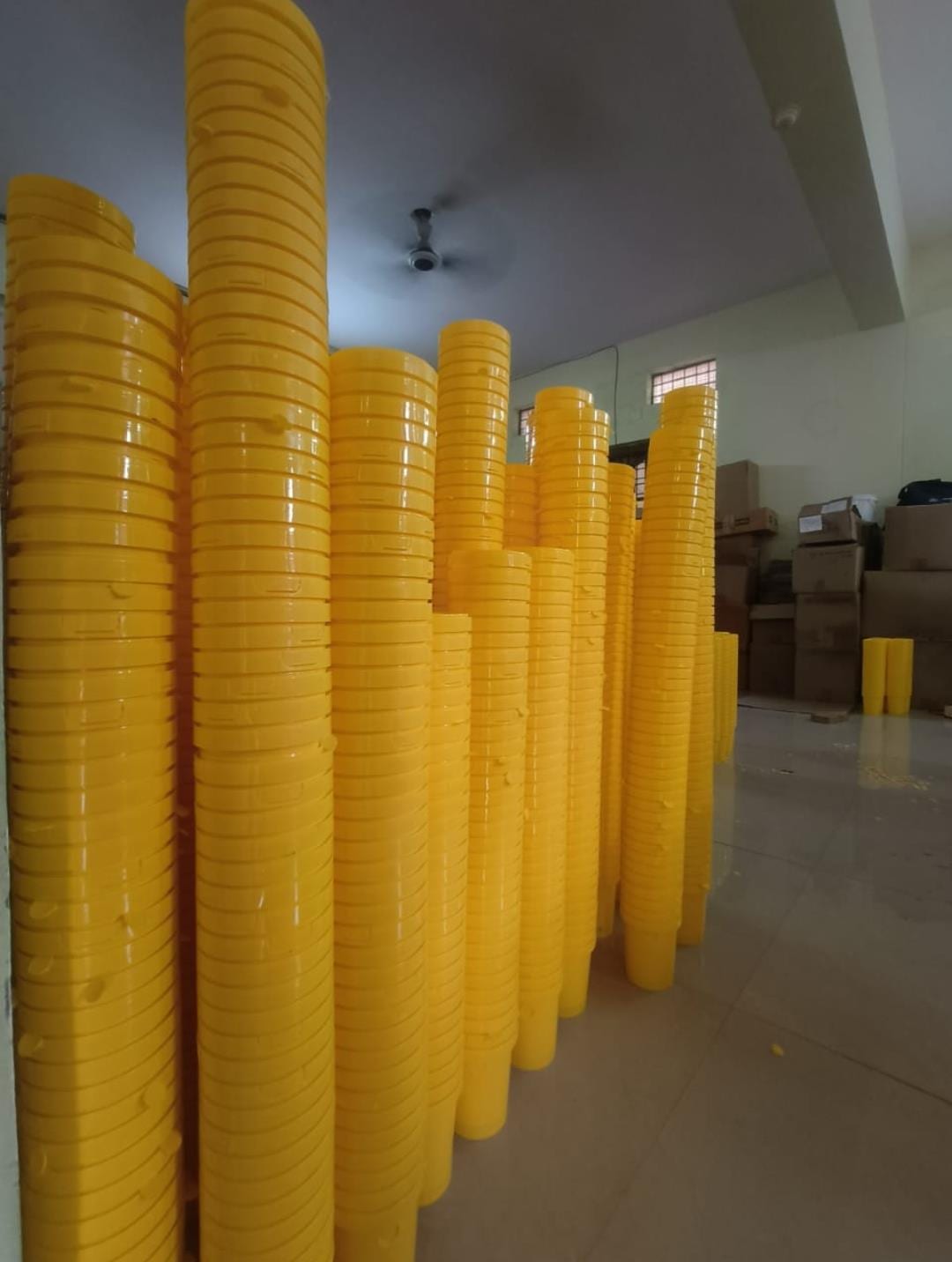
Agri Phero Solutionz sells both ways: to farmers directly, and through agri-dealers and institutions. It says it has worked with the Department of Horticulture, Andhra Pradesh, and with NGOs and government bodies, and that most of its growth has come by word of mouth among farmers and dealers who reorder because the lures work and the phone gets answered. Its customers are mostly in Telangana and Andhra Pradesh.
Kavitha's brother, A. Nitin Kumar, is the third member of the founding team. He took a master's degree in computer science in London and worked for companies in India before joining the business.
The company also publishes impact figures: more than 2 lakh acres under its IPM products, 4 lakh litres of pesticide spray avoided, 80 million litres of water saved, and about 2,000 tonnes of CO₂e not emitted, over more than 12 years of the team's work in pest management. These are the company's own estimates; IndianAgri has not checked them.
Dealer, distributor or IPM company?Stock pheromone traps, or get your products in front of farmersDealers looking for lures to stock, and makers who want to reach growers on IndianAgri, write to the desk.Email usWhatsApp us
Why it matters
Fewer sprays is the real product
India's farmers do not lack insecticides. What they lack is a reason to hold one back. A trap that is read every few days turns "spray because the neighbour sprayed" into a decision with a number behind it, and that is the core of what IPM has asked of farmers for decades.
The constraint has never been the science. It is a lure that is genuine, priced for a two-acre farmer, and on a dealer's shelf in the week it is needed. That is the gap a small Hyderabad company, started on a gold loan, has built a business on.
Why it matters
Indian farmers routinely spray on the calendar or because a neighbour did. A pheromone trap read every few days replaces that with a count and an official threshold, cutting sprays that were never needed — and at ₹15 to ₹40 a lure, it is within reach of a small farm. The constraint is not the science but genuine lures on a nearby dealer's shelf in time, which is the gap this self-funded company has built a business on.
Frequently asked
What is a pheromone trap?
A pheromone trap is a trap baited with a lure that carries a synthetic copy of an insect's own chemical signal, usually the sex pheromone a female releases to attract males. Males of that one species fly in and are caught. Farmers use the catch mainly to know when a pest is arriving and rising, so they spray only when it is needed.
How many pheromone traps are needed per acre?
It depends on the job. For monitoring pink bollworm in cotton, ICAR recommends 5 traps per hectare (about 2 an acre), from 45 days after sowing. For mass trapping fall armyworm in maize, the Directorate of Plant Protection, Quarantine & Storage recommends 15 traps per acre.
When should a farmer spray, going by pheromone trap catch?
For pink bollworm, ICAR's economic threshold is 8 moths per trap on three consecutive days, or 10% of flowers or green bolls damaged. Below that level the spray can usually wait.
What is the price of a pheromone trap lure in India?
Agri Phero Solutionz, a Hyderabad maker, prices its lures at ₹15 to ₹40 each. The trap body is bought separately and can be reused for more than one season; the lure has to be replaced at the interval printed on its packet.
Do pheromone traps replace pesticides?
Usually not on their own. Their main use is as an early-warning system: they show whether a pest is present and whether its numbers are rising, so that sprays are timed and unnecessary ones are skipped. Mass trapping can reduce some pests, but it works best with other IPM measures.
Are pheromone traps safe for bees and other beneficial insects?
Yes. Each lure attracts one species (or a few closely related ones), so bees, ladybirds and other natural enemies are not drawn in, and nothing is sprayed on the crop.
Who runs Agri Phero Solutionz?
Agri Phero Solutionz is a Hyderabad agri-startup founded by Vishnu and his wife A. Kavitha, who pledged her gold jewellery to fund it; her brother A. Nitin Kumar is on the founding team. It makes pheromone lures and traps, sticky traps and solar insect traps, and says it earned ₹2.5 crore in revenue in FY25.
Source
- ICAR — Pink bollworm management strategies (circular)
- Directorate of Plant Protection, Quarantine & Storage — Fall armyworm advisory, 12.07.2024
- IndianAgri Atlas — cotton, area and production by state
Company details — the founders, the pledged gold, ₹2.5 crore revenue in FY25, the products, the lure price range, the Horticulture Department work and the impact figures — are as stated by Agri Phero Solutionz in a press release of 22 October 2026, which IndianAgri has rewritten and checked against nothing else; the photographs were supplied by the company. Trap numbers and the spray threshold come from ICAR and the Directorate of Plant Protection, Quarantine & Storage, linked below. The per-acre lure costs are IndianAgri's arithmetic. IndianAgri has not tested these products and has no commercial relationship with the company.
Edited by Devendra Kumar Jha. How we report, source and correct: editorial policy. Spotted an error? Tell us.