How potatoes are sorted and graded in India, and where AI grading fits
India grew 585.7 lakh tonnes of potatoes in 2024-25. How that crop is graded before it is sold, what the official size grades are, and when a camera-based grader is worth it.
The short answer
Potatoes in India are graded by size and cleaned of green, rotten and cut tubers, mostly by hand and roller graders. Seed potato is graded to 30–55 mm in the plains. Optical and AI graders use cameras to judge each tuber and suit packhouses and processors. MIDH, AIF and PM-FME support grading units and pack houses, not single machines.
Why it matters
Why grading decides the price at the mandi and the cold store
Potatoes are not sold as one thing. A buyer pays for a size band and for how clean the lot is: no green, rotten, cut or badly shaped tubers, and no stones or clods. That is why Agmarknet reports a minimum, a maximum and a modal price for potato in each market: two lots in the same yard on the same day can sit at opposite ends of that range.
The cold store is where grading pays twice. A lot stays there for months, so a cut or rotting tuber loaded at the start is still sitting beside sound ones when the lot comes out. And the buyer at the end of storage, whether a wholesaler, a chips plant or a seed grower, asks for a size band. A graded lot can go straight to that buyer; an ungraded one is sold at the price of its worst part, or graded again later at someone else's cost.
India grew 585.7 lakh tonnes of potatoes in 2024-25, and Uttar Pradesh and West Bengal alone grew 58.3% of it (state figures below).
Sizes
The size grades used in trade, and the official ones
In everyday trade, "A grade" or a size name means different things to a processor, a wholesaler and a retail buyer, which is why "A grade" means different things in the potato trade argues for stating the size in millimetres or grams instead. The official standards that do give numbers are these:
| Standard | What it covers | Size rule |
|---|---|---|
| Indian Minimum Seed Certification Standards (Central Seed Certification Board, 2013) | Certified and foundation seed potato | Hill seed 30–60 mm (25–150 g); plains seed 30–55 mm (25–125 g); larger tubers are "large size". Off-size tubers not more than 5% by number |
| UNECE standard FFV-52 (text of 21 Aug 2009) | Ware (table) potatoes in international trade | Must not pass a 35 × 35 mm square mesh (30 × 30 mm for long varieties); must pass 80 × 80 mm (75 × 75 mm for long). 18–35 mm may be sold as "mids". 5% by weight may be off-size |
Table: size rules as printed in each standard. mm = the square mesh or measured width; g = tuber weight.
The same seed standard allows not more than 1% by weight of cut, bruised, misshapen or cracked tubers, and says green colour on a seed tuber is not a reason to fail certification. The UNECE text allows 6% by weight of ware tubers that miss the minimum quality rules, of which not more than 1% may have dry or wet rot.
India also has Agmark grade standards for fresh potato under the Fruits and Vegetables Grading and Marking Rules, 2004 (potato is on APEDA's list of Agmark fruits and vegetables). We could not open the potato schedule itself on 23 October 2026, so we do not quote its sizes here.
Methods
Hand grading, roller graders, and optical or AI graders
There are three ways to do the job, and most Indian cold stores and packhouses still use the first two together.
| Method | What it sorts by | What it misses | Throughput the makers state |
|---|---|---|---|
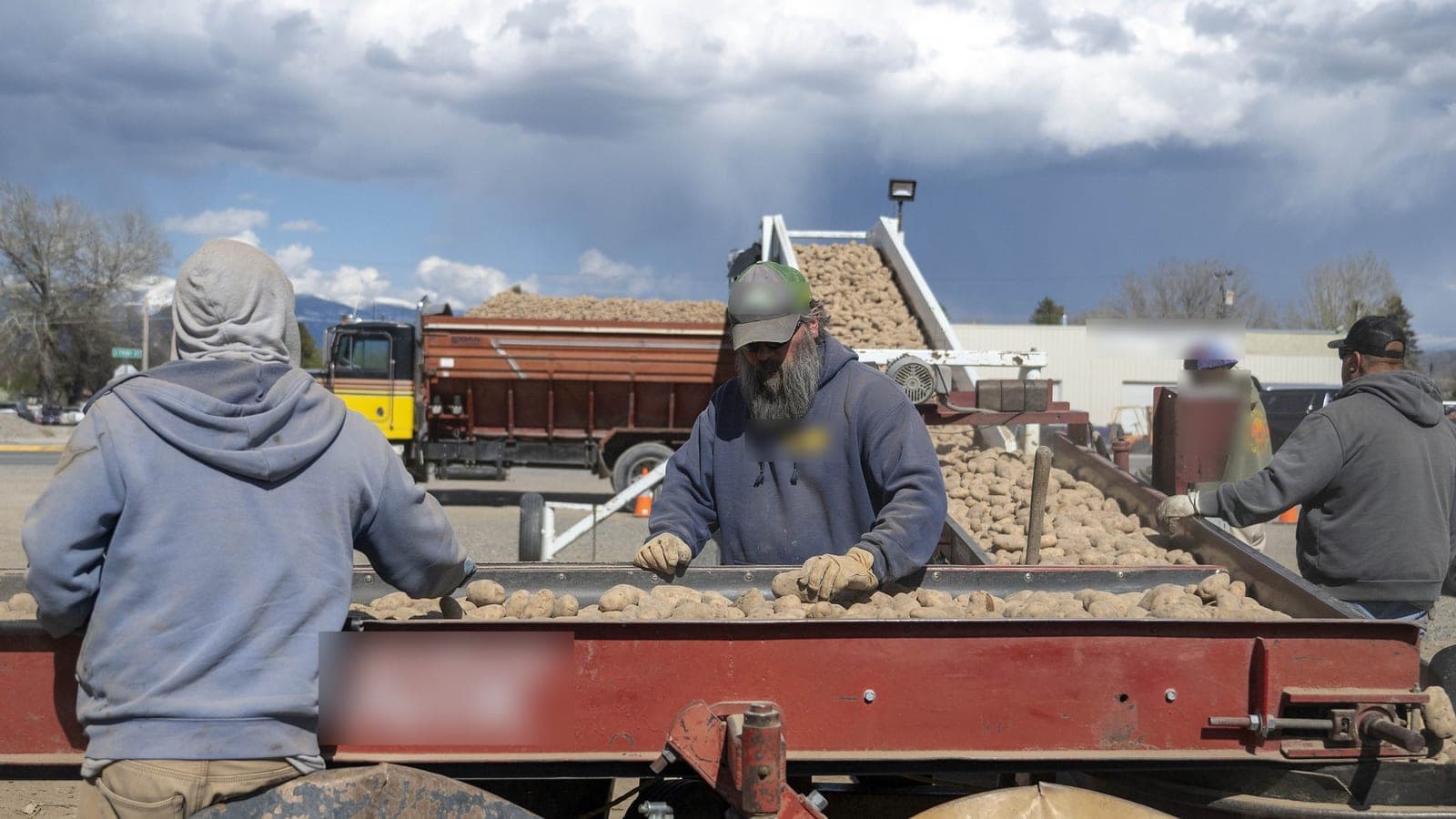
| Hand grading on the floor or at an inspection table | Size by eye; green, rotten, cut tubers and clods that people can see | The underside of each tuber; anything inside; speed depends on the crew | No standard figure |
| Roller or screen grader | Size only: tubers drop through gaps or holes of set width into 2–3 grades | Colour, rot, cuts, greening. People still pick defects off a belt | Goldin India Engineering, Vadodara: mini line 1 t/h; graders of 15 t/h with three grades and farm graders up to 20 t/h |
| Optical sorter (cameras on a belt or chute, air jets or fingers reject) | Colour and visible defects: rot, mould, discolouration, misshapes; foreign matter such as stones | Size grading is not its main job; most lines put a sizer before or after it | TOMRA 5A: "up to 50/tons per hour" |
| AI camera grader (each tuber in its own cup, photographed all round) | Size, shape, weight and visible defects tuber by tuber, including greening, scab and cracks; some models check inside with light | Cost; it is built for packhouses and processors | Ellips: up to 90 images a potato; 2–5 t/h a lane, 8 lanes up to 40 t/h |
Table: capacities as each maker states them on its own site, read 23 October 2026. Real throughput depends on tuber size and how full the line runs. None of these makers prints a price; they quote on request.
"AI" in a sorter means the software has been trained on thousands of pictures of good and bad tubers, so it can tell a scab from a soil mark without a person writing a rule for each. It is still a camera: it cannot see what the light cannot reach, and it has to be trained and checked on your variety.
For machine types, makers and the prices makers publish, see IndianPotato's buyer's guide to potato grading and sorting machines. How optical sorters work across crops, from nuts to fries, is set out in this guide to optical sorting machines.
What to buy
What a cold store, FPO or packhouse should buy at which scale
Start from two numbers: how many tonnes an hour you must grade in your busiest weeks, and what your buyer rejects. Then:
- A farmer group or small FPO grading a few tonnes a day: a small roller or screen grader plus an inspection table, where two or three people pick out green, cut and rotten tubers. One Indian maker lists a mini line of 1 t/h.
- A cold store at loading time: a field or yard grader that keeps up with the trucks, with a picking belt in front of it (one Indian maker lists 15–20 t/h graders). Removing rotten and cut tubers before they go into the chamber matters more than a fine size split.
- A packhouse selling washed, packed potatoes to retail or quick commerce: size grading plus an optical sorter, because these buyers reject on looks (greening, scab, marks) and a person cannot check every tuber at speed.
- A seed grower: size grading to the seed bands above matters most, because certified seed is sold by size; the seed standard does not fail a lot for greening.
- A chips or fries plant: an optical sorter on the incoming line and on the finished product. Internal defects and sugars matter here, which only some AI graders and lab checks catch.
Before you buy any machine, ask the maker for a trial run on your potatoes, not their demo lot, and count what it wrongly throws out as well as what it catches. Ask who services it in your state, and how long a spare part takes.
Get a free shortlist: tell us your crop, tonnes per hour and budget. We reply within 2 working days. Ask for a free shortlist
Support
Government support for grading machines and packhouses
We read each scheme's own guidelines on 23 October 2026. Only these three say in their text that sorting or grading facilities are eligible:
| Scheme | What the guidelines say is eligible | Support | Read from |
|---|---|---|---|
| MIDH (Mission for Integrated Development of Horticulture), item C.2 | "Integrated pack house" of 18 m × 22 m "with conveyor belt sorting, grading, washing, drying, weighing scale" and more | Cost norm up to ₹160 lakh per beneficiary; credit-linked back-ended assistance of 35% in general areas, 50% in NE and Himalayan states, scheduled areas, vibrant villages, Andaman & Nicobar and Lakshadweep | MIDH Operational Guidelines 2025 (dated 31.12.2024) |
| MIDH, item C.1 | "Farm gate packhouse" of 9 m × 6 m with a movable handling trolley, sorting table and farm-gate cold storage | Up to ₹25 lakh per unit; assistance 50% | Same document |
| Agriculture Infrastructure Fund (AIF) | "Sorting and grading units" are listed among eligible post-harvest projects | 3% a year interest subvention on loans up to ₹2 crore, for up to 7 years; credit guarantee for loans up to ₹2 crore, fee paid by the government | Revised scheme guidelines, September 2024 |
| PM-FME (PM Formalisation of Micro Food Processing Enterprises), common infrastructure | "Premises for assaying of agriculture produce, sorting, grading, warehouse and cold storage at the farm-gate", for FPOs, SHGs, cooperatives, government agencies or private firms; it must be hired out to others for a large part of its capacity | Credit-linked grant of 35% | Scheme guidelines (MoFPI) |
Table: wording quoted from each scheme's guidelines; ₹ amounts are the cost ceilings and rates printed there.
Three things to check before you count on any of them:
- MIDH says both pack house items must follow NCCD (National Centre for Cold-chain Development) guidelines, and that the cost norms are a ceiling; the actual cost is worked out from the parts you choose. FPOs and groups of at least 25 members registered with the district can take the subsidy without a bank loan if they can pay their share.
- AIF's September 2024 guidelines say loan disbursement under the scheme completes by the end of 2025-26. We found no notice on its portal extending that, so ask your bank whether it is still sanctioning new AIF loans.
- PM-FME's guidelines cover 2020-21 to 2024-25. Ask your state's PM-FME nodal agency whether it is taking new applications.
We could not open Operation Greens' pages on MoFPI's website on 23 October 2026, so it is not in the table. A loose grading machine is not a line item in any of them: MIDH funds pack houses, and AIF and PM-FME fund grading units and premises as projects, through a bank loan or a project report.
The numbers
Where India's potatoes are grown
The six largest potato states grew 90.9% of India's crop in 2024-25. That is where most grading capacity is needed, and where cold stores are busiest at loading time.
| State | Potato production, 2024-25 (lakh tonnes) | Share of India's crop |
|---|---|---|
| Uttar Pradesh | 203.8 | 34.8% |
| West Bengal | 137.6 | 23.5% |
| Bihar | 73.9 | 12.6% |
| Gujarat | 45.2 | 7.7% |
| Madhya Pradesh | 39.0 | 6.7% |
| Punjab | 33.1 | 5.7% |
| India | 585.7 | 100% |
Table: potato production by state, 2024-25, Final Estimates. Compiled by IndianAgri from the Horticulture Statistics Division, Department of Agriculture & Farmers Welfare, Ministry of Agriculture & Farmers Welfare, Government of India. Shares are each state's figure divided by the all-India total in the same release.
See the full potato series by state, six years deep. Spotted a figure that has changed? Tell us.
Why it matters
A graded lot sells at the top of the day's range; an ungraded one sells at the price of its worst part. With Uttar Pradesh and West Bengal growing 58.3% of the crop, grading at loading time decides what comes out of the cold stores months later.
Frequently asked
What is potato grading?
Potato grading is splitting a lot into size bands and taking out green, rotten, cut, misshapen tubers and stones. It is done by hand, by a roller or screen grader that sorts by size, or by an optical or AI grader that uses cameras to check each tuber's size, shape and visible defects.
What size is seed potato in India?
India's seed certification standards set seed size at 30–55 mm (25–125 g) for plains seed and 30–60 mm (25–150 g) for hill seed, measured by the tuber's mean length and widths or by weight. Not more than 5% of tubers in a seed lot, by number, may be outside the seed size.
What is the difference between a potato grader and an optical sorter?
A grader sorts by size: tubers fall through gaps or holes of set widths into two or three grades. An optical sorter uses cameras and lights to find colour and surface defects such as rot, greening and marks, and pushes those tubers out with air jets or fingers. Many lines use both, one after the other.
Is there a subsidy for a potato grading machine?
Yes, as part of a project rather than as a loose machine. MIDH supports integrated pack houses with conveyor sorting and grading (35%, or 50% in some areas, of up to ₹160 lakh), AIF gives 3% interest subvention on loans for sorting and grading units, and PM-FME a 35% grant for shared grading premises. Check each is still open.
Does a cold store need an optical sorter?
Usually not to load the store. A size grader with a picking belt, where people remove rotten, cut and green tubers, does the main job at loading time. An optical sorter pays when the store or its buyer packs potatoes for retail or processing, where every tuber is judged on looks.
Can AI grading find defects inside a potato?
Only some machines. A camera sees the skin. Ellips, for example, says its potato grader uses light passing through the tuber to check for internal browning and hollow heart. Ask any maker which internal defects it detects, and test it on your own variety before you buy.
Source
- DA&FW Horticulture Statistics Division: horticulture estimates (state potato production, Final 2024-25)
- Central Seed Certification Board: Indian Minimum Seed Certification Standards (2013), potato
- UNECE: potato standard FFV-52 text, ECE/TRADE/C/WP.7/2009/12 (21 Aug 2009)
- APEDA: fruits and vegetables under Agmark (list)
- MIDH Operational Guidelines 2025 (guidelines dated 31.12.2024), NHB copy
- Agriculture Infrastructure Fund: revised scheme guidelines (September 2024)
- Agriculture Infrastructure Fund: portal
- MoFPI: PM-FME scheme guidelines
- TOMRA: TOMRA 5A
- Ellips: potato grading machine
- Goldin India Engineering: potato grading and sorting machinery
- Goldin India Engineering: mini potato grading line
- Photo: "Montana's high-altitude seed potatoes" (29 Apr 2026), USDA, public domain, via Wikimedia Commons; cropped, maker and shop names blurred
Read on 23 October 2026. State production is from the DA&FW Horticulture Statistics Division's Final Estimates for 2024-25, computed from IndianAgri's fact store; shares use the all-India total from the same release. Size grades are quoted from the Indian Minimum Seed Certification Standards (2013) and the UNECE FFV-52 text of 21 Aug 2009. Machine capacities are as each maker states them on its own site; none publishes a price. Scheme terms are quoted from each scheme's own guidelines. IndianAgri sells no machines and takes no payment from the makers named. Photo: USDA, public domain, via Wikimedia Commons.
Edited by Devendra Kumar Jha. How we report, source and correct: editorial policy. Spotted an error? Tell us.