Prime Fresh Q1 FY27: Volumes Up 68%, EBITDA Up 51%, Margins Up 230 bps
Profit grew about three times faster than sales, and the margin came from the services side of the business — sourcing, cooling, grading and delivering produce, where the fee does not rise and fall with the mandi price.
The short answer
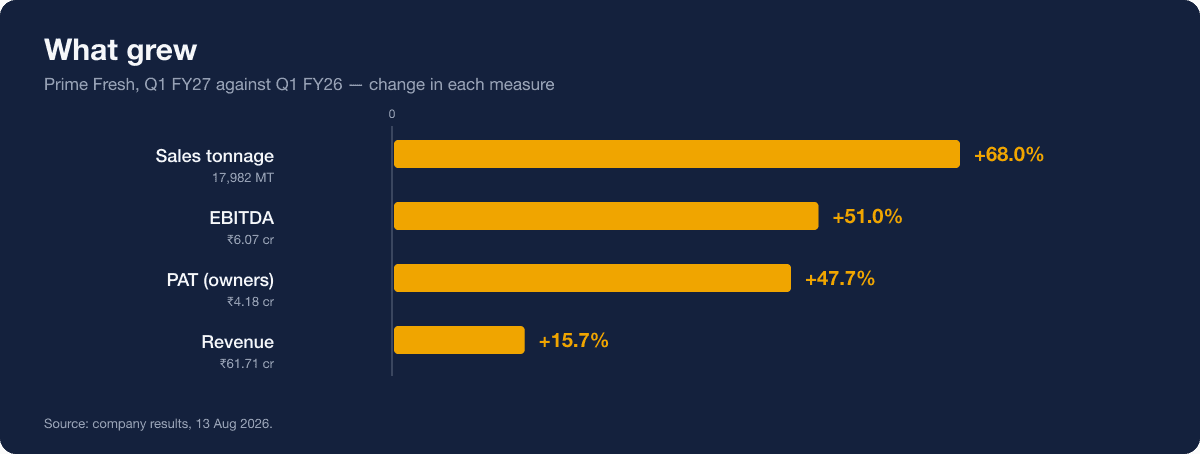
Prime Fresh Limited reported Q1 FY27 revenue from operations of ₹61.71 crore, up 15.7% year on year, with EBITDA up 51.0% to ₹6.07 crore and profit after tax attributable to owners up 47.7% to ₹4.18 crore. Sales tonnage rose 68% to 17,982 tonnes, led by onions, with mangoes and pomegranates adding to the value mix. EBITDA margin expanded 230 basis points to 9.83%, because the additional profit came from the services side of the business rather than from the trading spread on produce.
- Revenue +15.7% to ₹61.71 crore; EBITDA +51.0%; PAT (owners) +47.7% — profit grew about three times faster than sales.
- Tonnage +68% to 17,982 MT, led by onions, with mangoes and pomegranates adding to the value mix.
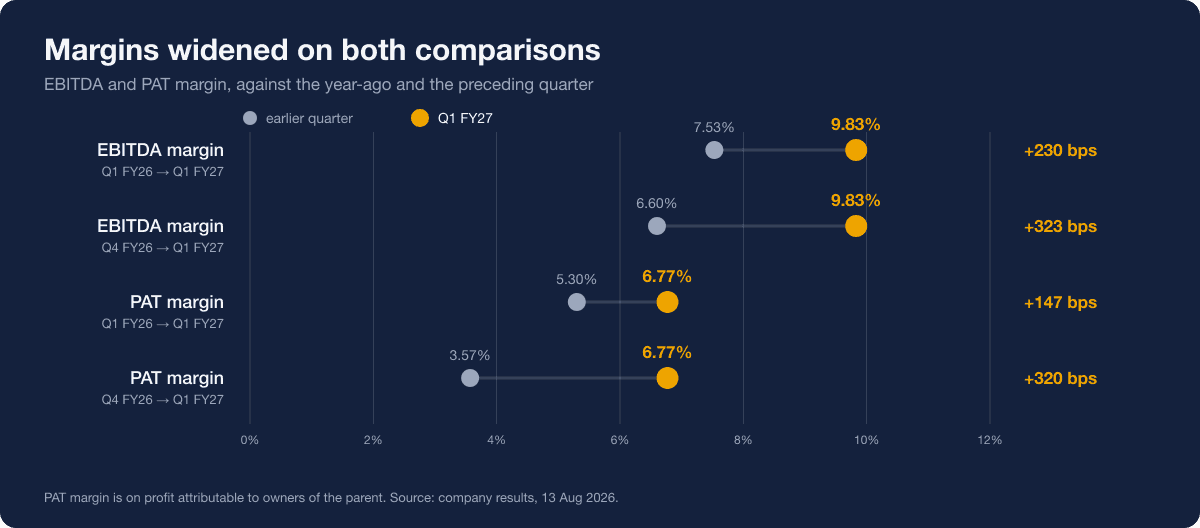
- EBITDA margin rose 230 bps year on year to 9.83%, and 323 bps against the preceding quarter.
- The margin came from the services business — handling produce — not from selling it dearer.
The quarter
Earnings grew three times faster than sales
Prime Fresh Limited, the Ahmedabad-based post-harvest supply-chain company listed on the BSE, reported consolidated results for the June 2026 quarter on 13 August. Revenue from operations rose 15.7% year on year to ₹61.71 crore. Below that line, the numbers move much faster: EBITDA was up 51.0% to ₹6.07 crore, and profit after tax attributable to the owners of the parent rose 47.7% to ₹4.18 crore, with earnings per share at ₹2.94.
That pattern — profit growing at roughly three times the rate of sales — is the whole story of the quarter, and it is not what a produce-trading business usually looks like. Margin in fresh fruit and vegetables is conventionally thin and conventionally comes from buying well and selling quickly. Something else is happening here.
The mix
Onions drove a 68% jump in tonnage
The operational disclosure is where the quarter becomes legible. Sales tonnage reached 17,982 metric tonnes, up 68% year on year and 7.5% on the preceding quarter. Set that against revenue growth of 15.7% and the arithmetic is worth doing.
Working back from the two growth rates, the company shifted roughly 10,700 tonnes in the June 2025 quarter for about ₹53.3 crore, and roughly 17,982 tonnes in the June 2026 quarter for ₹61.71 crore. Blended realisation per tonne therefore fell from around ₹49,800 to around ₹34,300 — a drop of about 31%.
The company names the reason: onions were the primary volume driver, while mangoes and pomegranates contributed to the value mix. Onions are a high-tonnage, low-value commodity. Move a great deal more of them and your average revenue per tonne falls mechanically, even though nothing has gone wrong.
This figure is a blend, not a price. Revenue from operations includes service income as well as traded produce, so realisation per tonne mixes two different businesses. It is still the right number to look at, because it shows that the extra profit did not come from selling produce dearer.
Traction across key categories and margin improvement in the Services Business.
Where the margin came from
Not the trading spread — the services line
If realisation per tonne fell by roughly a third and margins still expanded, the improvement has to be coming from somewhere other than the produce itself. Prime Fresh says as much. Whole-time Director Hiren Ghelani attributed the quarter to operating momentum "supported by traction across key categories and margin improvement in the Services Business".
The margin movement is unusually clean. EBITDA margin rose 230 basis points year on year, from 7.53% to 9.83%. Sequentially it is starker still: 6.60% in the March 2026 quarter to 9.83%, a gain of 323 basis points in three months. PAT margin on the owners' share improved 147 basis points year on year to 6.77%, and 320 basis points sequentially.
Read together with the tonnage, this is a business being paid increasingly for handling produce rather than for owning it — sourcing, pack-house work, cold storage, third-party logistics and distribution, where the fee does not rise and fall with the mandi price. That is a structurally different and far less volatile way to earn from fruit and vegetables than trading them.
A note on the two profit figures
₹4.18 crore or ₹4.35 crore?
Both numbers are in circulation for the same quarter, and both are correct.
₹4.35 crore is total consolidated profit after tax, up 50.8%, giving a PAT margin of 7.05%. ₹4.18 crore is the portion attributable to the owners of the parent company, up 47.7%, giving 6.77%. The ₹0.17 crore between them belongs to minority shareholders in a subsidiary and is not the parent's to claim.
The company's own investor graphic uses the lower, stricter figure and footnotes exactly why. Several summaries of the results use the higher one. Neither is wrong, but they are not interchangeable, and a reader comparing quarters should make sure they are comparing the same one.
What to watch
What to watch from here
Prime Fresh has been in post-harvest management since 2007 and works across sourcing, processing, packaging, warehousing, logistics and distribution, serving modern trade, exporters and institutional buyers alongside its wholesale business.
Three things are worth following from here. Whether the services share of revenue keeps rising, because that is what turned a shifting mix into a 230 basis point margin gain. Whether the tonnage growth carries into a normal onion year. And whether the value categories the company credits for mix, mangoes and pomegranates, broaden into a year-round basket.
For Indian agriculture more broadly, the interesting part is not one small-cap's quarter. It is the demonstration that the money in fruit and vegetables is moving from the spread to the service — that being paid to move, cool, grade and deliver produce is becoming a better business than being paid to own it.
Why it matters
Fruit and vegetable businesses in India have historically earned a thin, volatile margin on the spread between what they pay a farmer and what they charge a buyer, which is why so few of them scale. A quarter in which margins expand while the mix shifts towards high-volume commodities is evidence of a different model: being paid a fee to source, cool, grade, store and deliver produce, rather than a margin on owning it. If that holds, it is a more durable way to build post-harvest infrastructure than trading — and post-harvest infrastructure is precisely what India's ₹1.53 lakh crore of annual post-harvest losses are waiting on.
Frequently asked
What were Prime Fresh's Q1 FY27 results?
For the quarter ended June 2026, reported on 13 August 2026, Prime Fresh Limited posted consolidated revenue from operations of ₹61.71 crore, up 15.7% year on year. EBITDA rose 51.0% to ₹6.07 crore and profit after tax attributable to owners of the parent rose 47.7% to ₹4.18 crore, with EPS of ₹2.94. Total consolidated PAT, including minority interest, was ₹4.35 crore, up 50.8%. Sales tonnage was 17,982 metric tonnes, up 68%.
Why did Prime Fresh's volumes grow faster than its revenue?
Because the extra volume came largely from a low-value commodity. Tonnage rose 68% while revenue rose 15.7%, which implies blended revenue per tonne fell roughly 31%, from about ₹49,800 to about ₹34,300. The company identifies onions as the primary volume driver; onions are high-tonnage and low-value, so moving substantially more of them pulls average revenue per tonne down mechanically even though nothing has gone wrong.
How did Prime Fresh expand margins while realisation per tonne fell?
The improvement came from services rather than from the trading spread. The company attributes the quarter to operating momentum and margin improvement in its Services Business — sourcing, pack-house work, cold storage, third-party logistics and distribution, where earnings are fees for handling produce rather than a margin on owning it. EBITDA margin rose 230 basis points year on year to 9.83% and 323 basis points against the preceding quarter.
Why do two different PAT figures appear for the same quarter?
₹4.35 crore is total consolidated profit after tax (margin 7.05%, up 50.8%); ₹4.18 crore is the share attributable to the owners of the parent company (margin 6.77%, up 47.7%). The ₹0.17 crore difference is minority interest in a subsidiary. Both are correct measures of different things, and they should not be compared with one another across quarters.
What does Prime Fresh Limited do?
Prime Fresh Limited is a BSE-listed post-harvest management company for fresh fruits and vegetables, founded in 2007 and headquartered in Ahmedabad. It operates across sourcing, processing, packaging, warehousing, third-party logistics and distribution, supplying modern trade retailers, exporters and institutional buyers alongside a wholesale business, and works through a network of APMC mandis.
Source
- Prime Fresh Limited — company website
- DSIJ — Prime Fresh reports strong Q1 FY27 performance
- ScanX — Prime Fresh Q1 FY27 revenue up 15.7% to ₹61.71 crore
Figures are as reported by Prime Fresh Limited for the quarter ended June 2026 (consolidated, announced 13 August 2026) and as carried in trade coverage of that release; IndianAgri has not audited them. Revenue per tonne is IndianAgri's own derivation from the disclosed revenue and tonnage growth rates, and is a blended figure across traded produce and service income rather than a unit price for any commodity. Prior-quarter revenue and tonnage are worked back from the stated growth percentages and are therefore approximate. The images are the company's own investor graphics, reproduced with attribution. IndianAgri holds no position in and no commercial relationship with any company named here, and nothing here is investment advice.