Onion
Allium cepa · Amaryllidaceae (alliums)
India's most politically sensitive vegetable — the bulb whose price swings move retail inflation, trigger export bans, and decide livelihoods across the Nashik belt.
Production · Onion
30.77 MT
30,767 thousand tonnes — 2024-25 Final Estimates
Source: Horticulture Statistics Division, DA&FW
2024-25
In the IndianAgri Data Atlas
India's onion production, 2024-25 — with the state-by-state series behind it, every figure dated and sourced.
30.8 million tonnes
Top producing states
All onion data, by state and year →Key figures
Yield
≈15,633 kg/ha
about 63 quintals per acre — derived: production ÷ area
Top state
Maharashtra
13.56 MT — 44% of the national crop
Horticulture Statistics Division, DA&FW · 2024-25
About onion
Onion is grown across three overlapping seasons — kharif, late kharif and rabi — which is what allows India to supply the bulb almost year-round from a crop that is otherwise highly perishable. The rabi crop, harvested in spring, is the one that stores; it carries the market through the lean months until the next kharif arrival.
That storage window is the hinge of the whole onion economy. Rabi onion is held in ventilated chawls for months, and losses over a storage season are substantial, so the quantity that reaches a September mandi is far smaller than the quantity harvested in April. A poor rabi crop or a wet spell during storage shows up as a price spike months later.
India is the world's second-largest onion producer after China and among its largest exporters. Because the bulb is both a kitchen staple and a political symbol, the government intervenes more directly here than in almost any other vegetable — through buffer procurement, export duties and outright export bans.
Where it’s grown
Leading producing states
- 1Maharashtra13.56 MT
- 2Madhya Pradesh4.44 MT
- 3Karnataka2.58 MT
- 4Gujarat2.54 MT
- 5Rajasthan1.57 MT
Maharashtra alone grows 44% of India's onion, which is why a single state's weather or mandi strike can move the national price. Its yield, though, runs below the national average — about 13.9 tonnes a hectare against 15.6 nationally — while Gujarat and Bihar clear 23-24 tonnes.
How it’s grown
- Season
- Kharif, late kharif and rabi
- Sowing
- Kharif May-Jun; late kharif Aug-Sep; rabi Oct-Nov
- Harvest
- Kharif Oct-Dec; rabi Mar-May
- Climate
- Mild, dry weather; rain at harvest or in storage causes heavy loss
- Water
- Largely irrigated; sensitive to waterlogging
Major varieties
Bhima Super
A kharif and late-kharif variety from ICAR-DOGR, widely grown for its dark-red bulbs.
Bhima Red
Suited to kharif, late kharif and rabi across several states.
Bhima Shakti
A late-kharif and rabi variety bred for better storage life.
Bhima Kiran
A rabi variety selected for storage, the season on which the market depends.
Agrifound Light Red
A long-established rabi variety of the Nashik belt.
Widely grown released varieties (not an area-ranked list). The Bhima series comes from ICAR-DOGR at Rajgurunagar, the national institute for onion and garlic. ICAR-DOGR — Directorate of Onion and Garlic Research.
Economics & trade
Onion has no MSP. Unlike wheat, rice or cotton, there is no announced support price for onion. What exists instead is buffer procurement: government agencies buy a stock in the rabi season and release it later to cool prices, which sets a soft floor rather than a guaranteed rate. IndianAgri has tracked the buffer price and who it reaches in this season's procurement.
Yield per acre. India's average onion yield works out to about 15,633 kg per hectare — roughly 63 quintals, or 6.3 tonnes, an acre. The spread between states is unusually wide for an irrigated crop: Gujarat and Bihar clear 23-24 tonnes a hectare while Maharashtra, which grows nearly half the national crop, averages under 14.
The 2024-25 record came from area, not yield. Production jumped 27% in a single year, from 24.27 MT to 30.77 MT. Almost all of that came from planting more — area rose 27.7%, from 1.54 to 1.97 million hectares — while yield actually slipped slightly. A record built on acreage rather than productivity is exactly the kind that turns into a price collapse for growers.
What it costs to grow. There is no national cost-of-cultivation series for onion of the kind CACP publishes for MSP crops. The closest published work is farm-level: a study of 75 growers in Jaipur district priced the crop end to end and found small farms producing at about 32% higher cost per quintal than large ones while selling at the same rate — see IndianAgri's breakdown of onion cost, yield and profit per acre.
Uses
- A base ingredient in almost every Indian cuisine, consumed fresh year-round.
- Processed into dehydrated flakes and powder, a significant export in its own right from Gujarat.
- Exported as fresh bulbs to Bangladesh, Malaysia, the Gulf and Sri Lanka.
Notable facts
- Maharashtra alone accounts for about 44% of India's onion production; the Nashik belt is the reference market for national prices.
- The rabi crop is the one that stores — it is what supplies the market through the monsoon months until kharif onion arrives.
- India is the world's second-largest onion producer after China, and among its largest exporters.
- Onion is one of the few crops where the government has repeatedly used export bans and duties as a domestic price tool.
- The 2024-25 record crop came almost entirely from a 27.7% expansion in area, not from higher yields.
Frequently asked
- What is the onion yield per acre in India?
- India's average onion yield is about 15,633 kg per hectare, which is roughly 63 quintals — 6.3 tonnes — per acre, derived from 30.77 million tonnes grown on 1.97 million hectares in 2024-25. State averages vary widely: Gujarat and Bihar clear 23-24 tonnes a hectare, while Maharashtra averages under 14.
- How much onion does India produce?
- India produced 30.77 million tonnes of onion in 2024-25 according to the Final Estimates, up from 24.27 million tonnes the previous year. India is the world's second-largest producer after China.
- Which is the largest onion-producing state in India?
- Maharashtra, with 13.56 million tonnes in 2024-25 — about 44% of the national crop. Madhya Pradesh, Karnataka, Gujarat and Rajasthan follow.
- Is there an MSP for onion?
- No. Onion has no Minimum Support Price. The government instead builds a buffer stock through agencies such as NAFED and NCCF, buying in the rabi season and releasing later to cool retail prices, which acts as a soft floor rather than a guaranteed rate.
- In which season is onion grown in India?
- Onion is grown in three seasons — kharif (sown May-June, harvested October-December), late kharif, and rabi (sown October-November, harvested March-May). The rabi crop is the one that stores and carries the market through the monsoon.
Latest onion coverage
Updated automatically as new onion coverage is published.
Prime Fresh Q1 FY27: Volumes Up 68%, EBITDA Up 51%, Margins Up 230 bps
17 August 2026

If Farming Keeps Getting Smarter, Why Does Food Keep Getting Dearer?
17 August 2026
Monsoon Crunch: Tomato, Onion & Potato Drive July Thali Costs Up, Though Annual Food Bills Remain Softer
10 August 2026
Sixth Hike This Season: Onion Buffer Stock Price Raised to ₹2,335/Quintal, But Small Farmers Left Out
31 July 2026
TNAU Forecasts ₹30-35/kg Farm-Gate Price for Small Onions Ahead of Harvest Season
20 July 2026
Quality Crunch and Monsoon Uncertainty Cloud India's Onion Outlook
3 July 2026
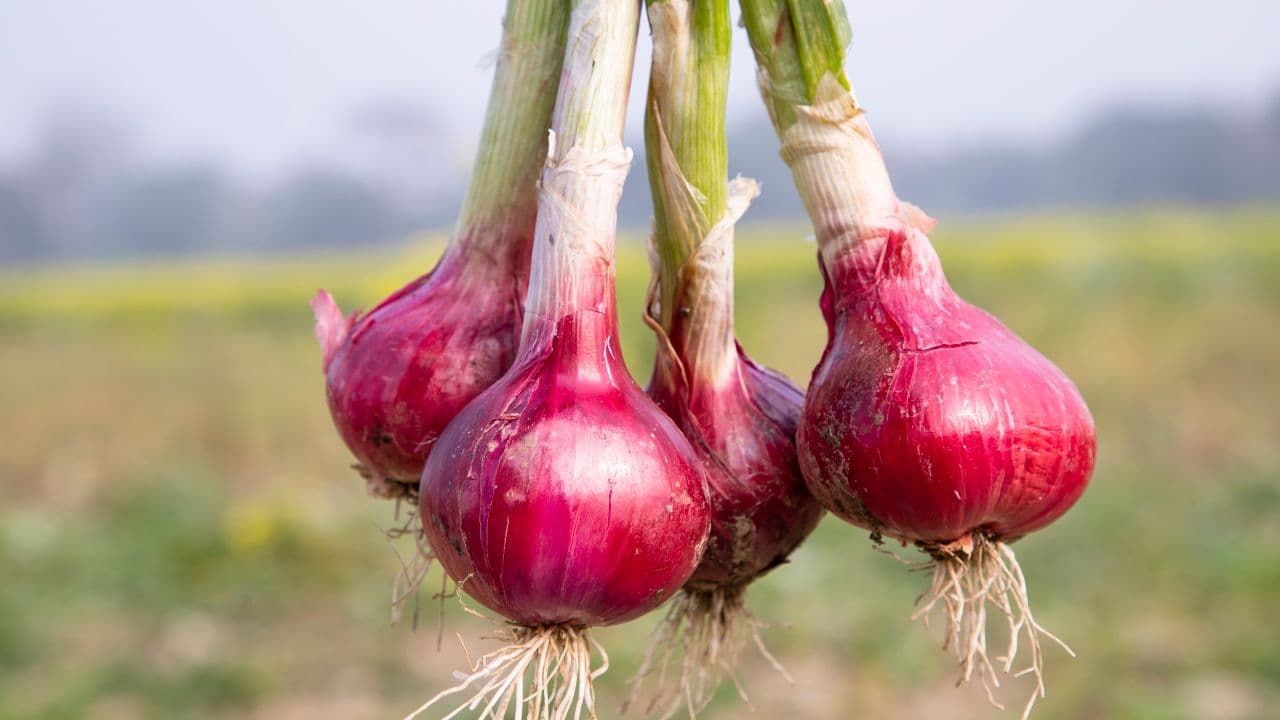
Onion Farming in Jaipur: The Real Cost, Yield and Profit Per Acre
16 August 2026
996 Kilograms of Mandarins: Why the North East Grows So Much and Exports So Little
19 August 2026