Tengin's 80/20 Model: Keeping Coconut Value Where It Grows
Karnataka-based Tengin pays farming families 2.1–2.5x market rates and routes 20% of every product's value directly to growers — challenging decades of value leakage in India's coconut supply chain.

About the Leader
Madhu Kargunda · Founder, Tengin
Madhu Kargunda is the founder of Tengin, India's first all-coconut brand and a 2023 Elevate Startup Winner recognised by the Government of Karnataka.
The short answer
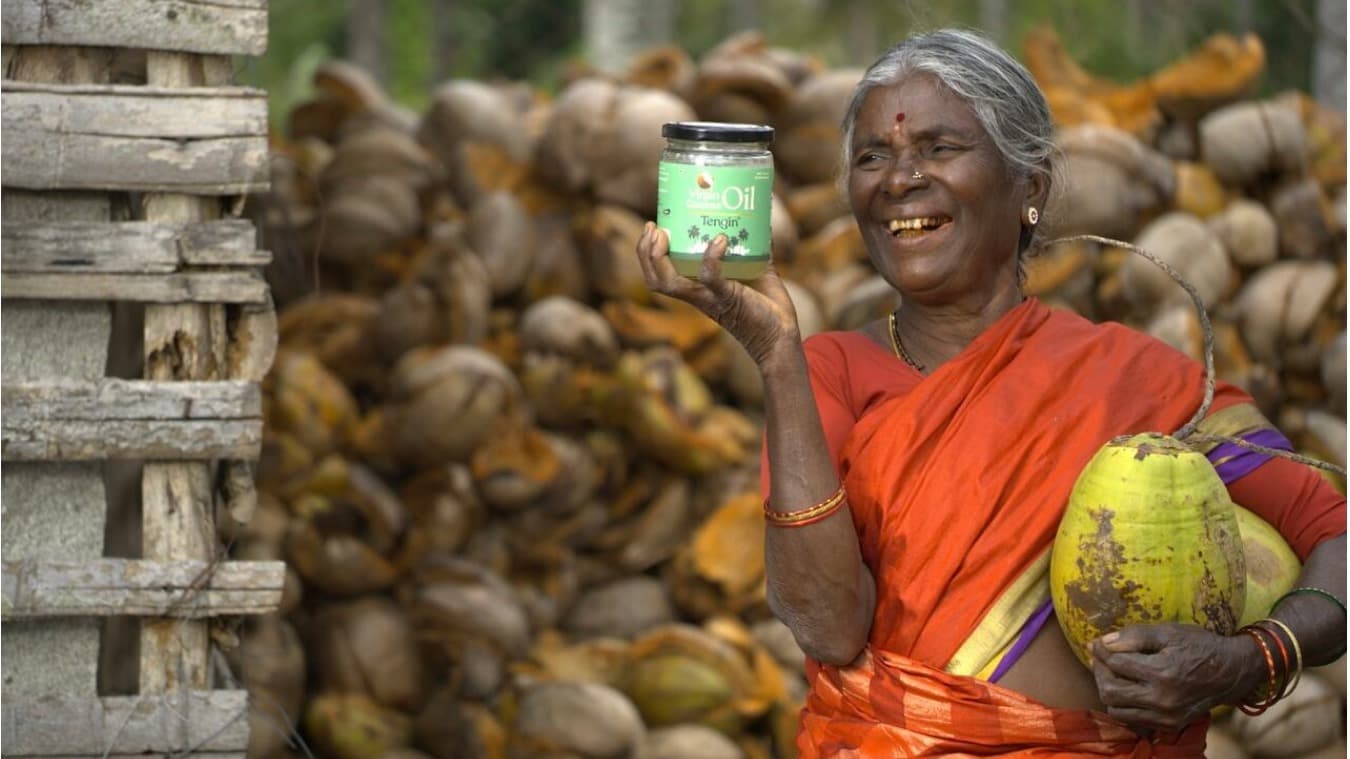
Tengin, India's first all-coconut brand, has built a farm-first business model in which 20% of every product's value flows directly back to the more than 30 farming families it works with across Karnataka, at 2.1–2.5x the prevailing local market rate. The brand converts a single coconut into multiple products — oil, sugar, chips, coir, and shell art — using chemical-free, traditional farming methods with zero waste. With India's coconut products market expanding at roughly 8% annually through 2030 and consumers shifting toward clean-label plant-based goods, Tengin is positioning itself at the intersection of farmer welfare and mainstream market demand.
The core idea
A Supply Chain Built Around the Farm, Not the Refinery
For decades, the economics of the global coconut trade have worked against the grower. India, Indonesia, and the Philippines together account for more than 70% of the world's coconut output, yet the margins that matter — those embedded in refining, branding, and retail — have consistently been captured far from the plantation.
Tengin, Karnataka's all-coconut brand, was founded on a deliberate counter-argument to this dynamic. The brand's operating philosophy rests on an 80/20 principle: 80% of the value embedded in every product is directed toward quality for the end consumer, while the remaining 20% flows straight back to the farmer — not as a subsidy or a social transfer, but as a structural feature of the business model itself.
The framing is pointed: if France can anchor the global identity of wine, there is no reason India cannot do the same for coconut.
On the ground
Thirty-Plus Families, Zero Waste, Chemical-Free Cultivation
Tengin currently works with more than 30 farming families spread across Karnataka, paying them 2.1 to 2.5 times the prevailing local market rate through direct procurement — bypassing the layers of commission agents and aggregators that typically erode farm-gate prices.
The product portfolio is designed to extract maximum value from a single coconut: oil, sugar, chips, coir, and hand-crafted shell art are all derived from the same raw material, with nothing discarded. All cultivation is carried out using traditional, chemical-free methods — a deliberate choice that aligns with the clean-label positioning the brand is building toward export and premium domestic markets.
The approach is more operationally intensive than simply exporting raw copra, but the logic is straightforward: farmers who have grown high-quality coconuts for generations should capture a proportionate share of the value those coconuts eventually command on the shelf.
Market tailwinds
An 8% Growth Curve and the Clean-Label Shift
Tengin's timing is not incidental. India's coconut products market is expanding at approximately 8% per year through 2030, driven in significant part by a broad consumer pivot away from processed goods and toward plant-based, clean-label alternatives.
That structural demand shift — evident across both domestic premium retail and international markets — creates a commercial runway for origin-led, traceable brands. Tengin's multi-product model, grounded in direct farmer relationships and zero-waste processing, is designed to sit precisely at that intersection.
For traders and agri-businesses, the implication is clear: value-added coconut products, particularly those with verifiable provenance and chemical-free credentials, are moving from niche to mainstream. Brands that have locked in farmer supply networks early are likely to hold a durable sourcing advantage as the category scales.
The bigger argument
Farmer Welfare and Business Viability as a Single Equation
One of the more consequential claims embedded in Tengin's model is the rejection of the conventional trade-off between social impact and commercial return. The argument is not that paying farmers more is a cost worth bearing — it is that doing so is the correct business decision.
By integrating farmer premiums into the cost architecture of the product rather than treating them as a margin sacrifice, the model creates alignment between supply quality, brand integrity, and grower income. Recognition from the Government of Karnataka as an Elevate Startup Winner (2023) has added institutional validation to an approach that has historically been viewed with scepticism by mainstream agri-business.
As India's coconut belt looks to move beyond raw commodity exports, Tengin's framework — origin branding, zero-waste processing, direct procurement at above-market rates — offers a template worth examining at scale.
Why it matters
India, Indonesia, and the Philippines collectively supply over 70% of the world's coconuts, yet the bulk of the value has historically been captured in refining, branding, and retail far from the farm gate. Tengin's vertically integrated, multi-product model demonstrates that farm-first economics and commercial viability can be the same objective — not competing ones. With the domestic coconut products market on an 8% annual growth trajectory through 2030, replicable models like this could reshape how value is distributed across India's coconut belt. Policymakers and agri-businesses watching the clean-label and plant-based shift should take note of how traceability and direct farmer linkages are becoming a competitive advantage, not merely a social commitment.
Frequently asked
What is Tengin's 80/20 principle?
Under Tengin's model, 80% of every product's value is directed toward quality for the customer, while 20% goes directly back to the farming families who grow the coconuts — structured as a core part of the business model, not a charitable add-on.
How much does Tengin pay its farmer partners above market rates?
Tengin pays the more than 30 farming families it works with across Karnataka between 2.1 and 2.5 times the prevailing local market rate, through direct procurement.
What products does Tengin make from a single coconut?
Tengin converts one coconut into multiple products — including oil, sugar, chips, coir, and hand-crafted shell art — using traditional, chemical-free farming methods and a zero-waste processing approach.
How fast is India's coconut products market growing?
India's coconut products market is growing at approximately 8% per year through 2030, supported by rising consumer demand for clean-label and plant-based products.
This is an original IndianAgri report. The analysis and India context are IndianAgri's own.
Edited by Devendra Kumar Jha. How we report, source and correct: editorial policy. Spotted an error? Tell us.