UP Agricultural Scientist Award 2026-27: 20 Awards, ₹6.94 Lakh, Apply by 12 November
Twenty awards, from ₹11,000 for a Ph.D. thesis to ₹1.21 lakh for a lifetime's work. The application is long, the scorecard is exact, and the papers must be in Lucknow by 12 November.
The short answer
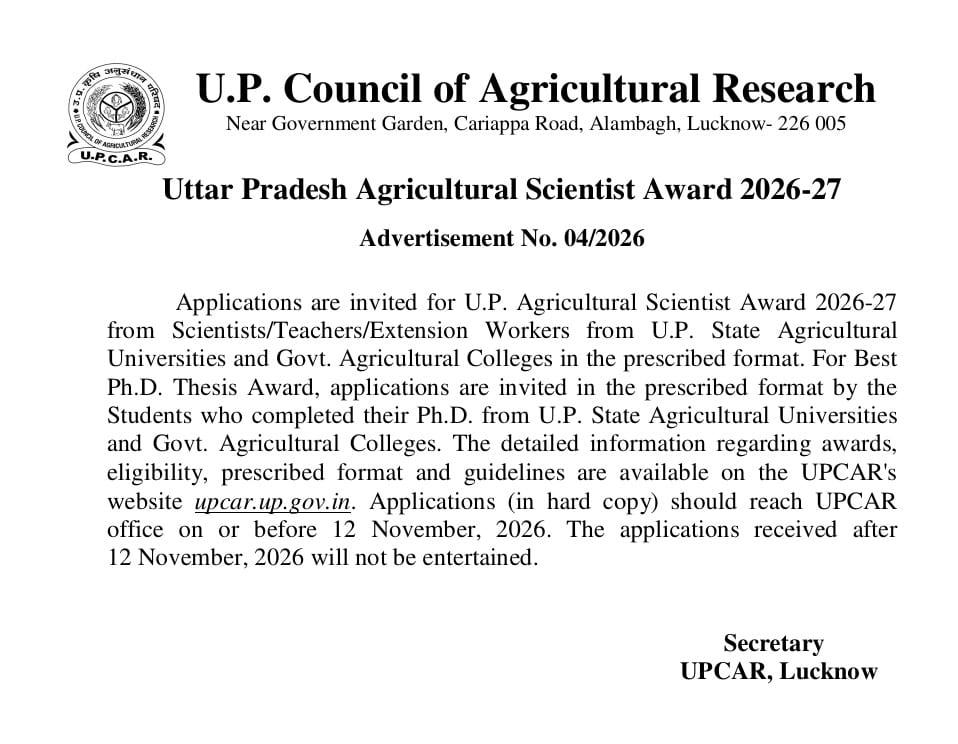
The U.P. Council of Agricultural Research (UPCAR), Lucknow, has invited applications for the Uttar Pradesh Agricultural Scientist Award 2026-27. Hard copies must reach UPCAR by 12 November 2026. There are 20 awards: one Lifetime Achievement Award (₹1,21,000, by nomination only, maximum age 62), six Best Scientist Awards (₹51,000 each, Ph.D. holders over 45), one Best Female Scientist Award (₹51,000), six Young Scientist Awards (₹25,000 each, under 45) and six Best Ph.D. Thesis Awards (₹11,000 each). They are open to scientists, teachers and extension workers of Uttar Pradesh's state agricultural universities and government agricultural colleges, and their Ph.D. graduates. Applications are marked out of 100 and need 50 to qualify.
Start here
Twenty awards, ₹6.94 lakh, and three weeks to apply
The Uttar Pradesh Council of Agricultural Research (UPCAR), Lucknow, has invited applications for the Uttar Pradesh Agricultural Scientist Award 2026-27 (Uttar Pradesh Krishi Vaigyanik Samman Yojana). It is open to scientists, teachers and extension workers of the state agricultural universities and government agricultural colleges of Uttar Pradesh, and, for the Best Ph.D. Thesis Award, to students who completed their Ph.D. at one of them.
The deadline is short and strict. Hard copies must reach the UPCAR office on or before 12 November 2026; applications that arrive later "will not be entertained", the advertisement says. Posting on the 12th is not enough — the papers have to be in Lucknow.
There are 20 awards in five classes, worth ₹6.94 lakh in all, across six subject areas: agricultural science; vegetable and horticultural science; animal husbandry, veterinary and fisheries science; agricultural engineering, post-harvest technology and food processing; biotechnology; and social sciences (extension education, agricultural economics, home science and agricultural statistics).
The official documentU.P. Agricultural Scientist Award 2026-27, completeUPCAR's advertisement, the scheme note in Hindi, both application formats, both scorecards, the general guidelines and the NAAS journal score list used for marking.Download the document
The awards
Who can win what
| Award | How many | Amount each | Who is eligible |
|---|---|---|---|
| Lifetime Achievement Award | 1 | ₹1,21,000 | Any of the six areas; maximum age 62; at least 25 years' work in agriculture and allied sectors in Uttar Pradesh; nominated only |
| Best Scientist Award | 6 (one per area) | ₹51,000 | Ph.D. holders over 45, for the last five years' work |
| Best Female Scientist Award | 1 | ₹51,000 | Women Ph.D. holders over 45, any area, for the last five years' work |
| Young Scientist Award | 6 (one per area) | ₹25,000 | Ph.D. holders under 45, for the last five years' work |
| Best Ph.D. Thesis Award | 6 (one per area) | ₹11,000 | Students who completed a Ph.D. in the state in the year concerned |
Three rules decide more applications than the marks do:
- The Lifetime Achievement Award cannot be applied for. Vice-Chancellors of the agricultural universities and principals of the agricultural colleges send the bio-data of the scientists they nominate, with their recommendation.
- One award per category per lifetime. Someone who has already won, say, the Young Scientist Award cannot win it again.
- A separate application for each award. Applying for two awards means two complete sets.
The numbers
What the official figures actually say
UPCAR's scheme note opens with the state's record: by its account Uttar Pradesh contributed 20% of India's 357.73 million tonnes of foodgrains in 2024-25, ranking first, with 35% of the wheat (first) and 14% of the rice (second), and leads the country in mango, potato, pea, sugarcane and milk. Our own count uses the latest official wheat estimates, for 2025-26, so the share differs from UPCAR's 2024-25 figure.
Uttar Pradesh produced 35.9 million tonnes of wheat in 2025-26 on the 3rd Advance Estimates, about 29.7% of the national crop and the largest of 17 reporting states.
That works out at 15.1 quintals an acre. It is an average across every grower; what one acre gives depends on variety, season, irrigation and soil.
| Measure | Uttar Pradesh | Period |
|---|---|---|
| Production | 35.9 million tonnes | 2025-26 (3rd Advance Estimates) |
| Area | 9.61 million hectares | 2025-26 |
| Yield per acre | 15.1 quintals (3,732 kg/ha) | 2025-26 |
Compiled by IndianAgri from Directorate of Economics & Statistics, Department of Agriculture & Farmers Welfare, Ministry of Agriculture & Farmers Welfare, Government of India. Every figure on this page carries its originating department, its estimate round and the date we took it — see the full wheat series, six years deep, by state.
How the marks work
Fifty out of a hundred, and most of it is not papers
Scientist applications are marked out of 100, and 50 is the minimum to qualify. Publications carry only 15 of those marks:
| Criterion | Maximum marks |
|---|---|
| Publications | 15 |
| Concepts, processes, products, technologies, patents and books | 20 |
| Teaching, research, extension, coordination and management | 25 |
| Scientific leadership, awards and honours | 15 |
| New initiatives | 25 |
Some details from the scorecard that are easy to miss:
- Publications are listed in two blocks of ten — the ten best at up to 1 mark each, the next ten at up to 0.5 — in descending order of NAAS score and impact factor, with the NAAS journal ID against each. Every co-author gets full marks for a paper.
- A product, variety or technology adopted on a large scale by farmers or clients scores 2 marks; one adopted by ICAR, CSIR or ICMR institutes or universities, or in multi-location trials, scores 1. Proof of adoption must be attached. In outstanding cases the committee may go higher; the document's own examples are the Swarna and Mahsuri rice varieties and the zero-till drill.
- Books count only with at least 150 pages and an ISBN, from a reputed publisher: 2 marks authored, 1 edited.
- External projects count only above ₹5 lakh: 2 marks as principal investigator, 1 as co-PI. Revenue earned for the institution scores 2 marks for ₹5–10 lakh and 5 above ₹10 lakh.
The Best Ph.D. Thesis Award has its own 100-mark card: course work 20 (15 if the Ph.D. was done without course work), thesis presentation 20, research achievements 20, publications 20 (up to 4 marks a paper), duration 10 (a three-year Ph.D. scores 10, four years 8, five years 6) and awards 10. Again, 50 qualifies.
Applying
Five copies, an affidavit, and the citation you would like read out
The checklist, from UPCAR's general guidelines:
- Fill in the prescribed format — one for the four scientist awards, a separate one for the thesis award — with a passport-size colour photograph.
- Attach one set of supporting documents: testimonials, publications, proof of acceptance for papers in press, proof of adoption for technologies.
- Get the certificate from the head of your institution (for the thesis award, from your supervisor) on the form itself.
- Add a summary of contributions — about 750 words for scientists, 150 for the thesis award — with a photograph and a draft citation. Thesis applicants also send a copy of the thesis.
- Swear an affidavit on ₹100 non-judicial stamp paper, attested by a notary, that the information is true and that no vigilance or disciplinary proceedings are pending.
- Send five copies to the Director General, U.P. Council of Agricultural Research, Near Government Garden, Cariappa Road, Alambagh, Lucknow 226005, so that they arrive by 12 November 2026.
- Send soft copies of the application, citation and photograph as well.
The document warns that incomplete applications, or ones not made as the guidelines say, "are likely not to be considered". The full guidelines and formats are also on UPCAR's website, upcar.up.gov.in.
The official documentBoth application formats and scorecardsPages 3–15 hold the scientist and thesis formats, their scorecards and the guidelines; pages 16–56 are the NAAS journal scores (effective 1 January 2026) you need for the publication columns.Get the forms
Why it matters
Uttar Pradesh is the country's largest producer of wheat, potato and sugarcane, and UPCAR credits the state's agricultural scientists for part of that. These awards are among the few state-level recognitions for scientists, teachers and extension workers in its universities and colleges, and the scorecard rewards technologies farmers adopt, external projects and revenue earned — not only papers. With a hard-copy deadline of 12 November and an affidavit, five copies and an institutional certificate to arrange, an applicant who starts late is likely to miss it.
Frequently asked
What is the last date for the UP Agricultural Scientist Award 2026-27?
Hard copies of the application must reach the U.P. Council of Agricultural Research office in Lucknow on or before 12 November 2026. Applications received after that date will not be considered.
Who can apply for the UPCAR scientist award?
Scientists, teachers and extension workers of Uttar Pradesh's state agricultural universities and government agricultural colleges. The Best Ph.D. Thesis Award is for students who completed their Ph.D. at those institutions in the year concerned. The Lifetime Achievement Award is by nomination from Vice-Chancellors and principals only.
How much prize money does the UP Agricultural Scientist Award carry?
₹1,21,000 for the Lifetime Achievement Award, ₹51,000 each for the six Best Scientist Awards and the Best Female Scientist Award, ₹25,000 each for six Young Scientist Awards and ₹11,000 each for six Best Ph.D. Thesis Awards: 20 awards and ₹6.94 lakh in all.
What is the age limit for the Young Scientist Award in Uttar Pradesh?
The Young Scientist Award is for Ph.D. holders under 45. The Best Scientist and Best Female Scientist Awards are for Ph.D. holders over 45, and the Lifetime Achievement Award has a maximum age of 62.
Where do I send the UPCAR award application?
Five copies to the Director General, U.P. Council of Agricultural Research, Near Government Garden, Cariappa Road, Alambagh, Lucknow 226005, with soft copies of the application, citation and photograph, and a notarised affidavit on ₹100 non-judicial stamp paper.
How are UPCAR award applications marked?
Out of 100, with 50 needed to qualify. For scientists: publications 15, concepts, products, technologies, patents and books 20, teaching, research, extension and management 25, leadership and honours 15, and new initiatives 25. Publications are scored by NAAS score and impact factor.
Source
- U.P. Council of Agricultural Research — U.P. Agricultural Scientist Award 2026-27: advertisement, scheme, formats, scorecards and guidelines
- U.P. Council of Agricultural Research (UPCAR)
- IndianAgri Atlas — wheat, area and production by state
Every detail of the awards — classes, amounts, eligibility, scorecards, documents and the 12 November 2026 deadline — is taken from UPCAR's own 56-page document, linked above in full. The scheme note is in Hindi and is summarised here in English; award names follow the English forms UPCAR uses in the same document. The total of ₹6.94 lakh is IndianAgri's sum of the published amounts. UPCAR's statements about the state's share of national foodgrain, wheat and rice production are attributed to UPCAR; the wheat figures in the section on official figures are IndianAgri's own, from the Ministry of Agriculture & Farmers Welfare. IndianAgri has no role in the awards. This guide is dated 22 October 2026; check upcar.up.gov.in for any change before applying.
Edited by Devendra Kumar Jha. How we report, source and correct: editorial policy. Spotted an error? Tell us.