A Controlled Room in Bastar Cut Graft Mortality by More Than a Quarter
Graft healing in India is normally done in a polyhouse, which buffers the weather rather than controlling it. A facility in Chhattisgarh moved the step into a fully controlled room and reports more than a quarter fewer plant deaths.

Expert insights
Vishal Bhosale · CEO and Founder, Nexsel Tech
Founder and CEO of Nexsel Tech, which builds horticulture lighting — plant grow lights, tissue-culture lighting and speed-breeding systems — for controlled-environment growing.
The short answer
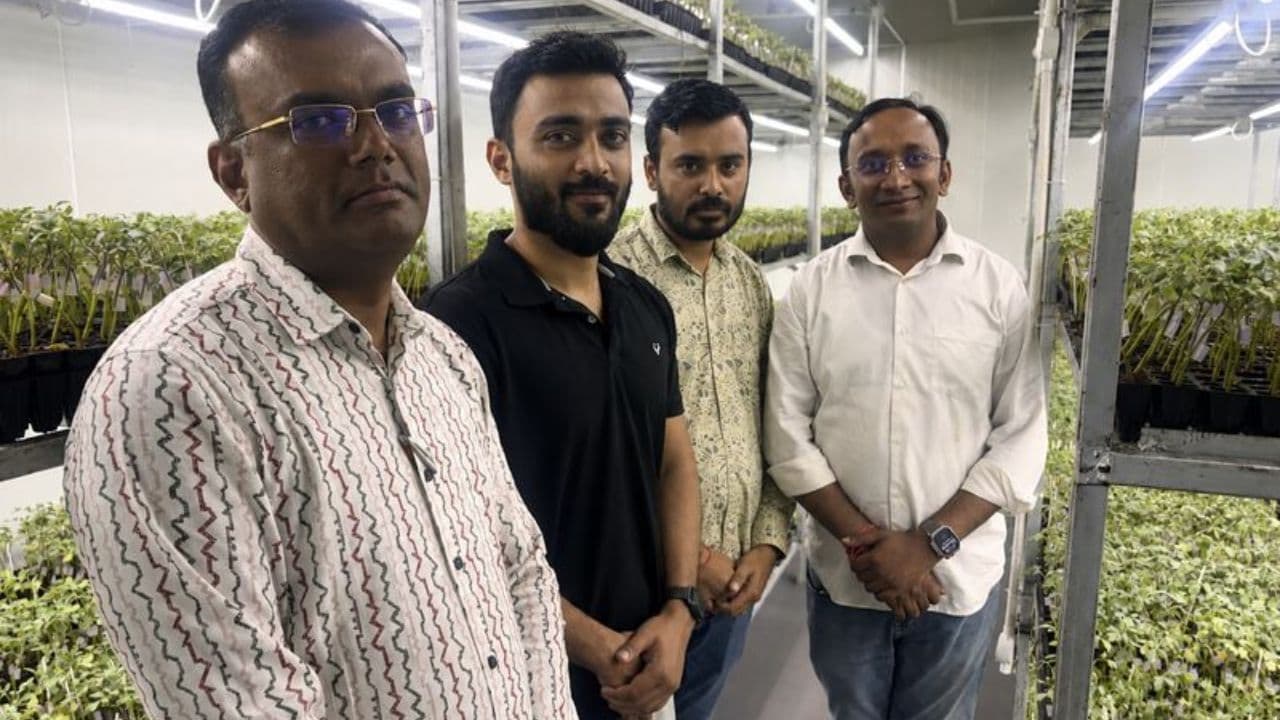
A graft healing facility in the Bastar–Jagdalpur belt of Chhattisgarh, run by SKF, MKF and RKF Nurseries, has moved the healing stage from a polyhouse into a fully controlled room. Its early comparison against its own conventional method shows more than a 25% reduction in mortality and better plant quality. The room is held at 28°C day, 25°C night, around 90% humidity and about 100 PPFD for 14 hours — light is only one of seven parameters being controlled.
The nursery problem
Where a horticulture crop actually begins
Most of the attention in Indian horticulture goes to what happens in the field. A large share of the outcome, though, is decided before a plant ever reaches one — in the nursery, during the days after a graft is made and the union either takes or fails.
Graft healing in India is conventionally done inside a polyhouse, and a polyhouse is only as good as the weather it is buffering. When conditions inside drift outside the narrow band a fresh graft union needs, three things follow together: mortality rises, the plants that do survive are of poorer quality, and results stop being consistent from batch to batch.
That inconsistency is the part growers rarely see and always pay for. A nursery prices its plants to cover the ones that died, so mortality upstream shows up as the cost and availability of grafted planting material downstream — for tomato and brinjal growers, and for anyone buying fruit saplings.
The Bastar facility
What changed in Chhattisgarh
A graft healing facility in the Bastar–Jagdalpur belt of Chhattisgarh has moved that step out of the polyhouse and into a fully controlled room. The unit is operated by SKF, MKF and RKF Nurseries, and it is a purpose-built installation rather than a retrofit — high automation, and environmental control across several parameters at once. The commercial enquiry behind it came in May 2026, and the facility has only recently begun operating.
The early comparison against conventional polyhouse grafting at the same operation is striking: more than a 25% reduction in mortality, with better plant quality.
Two caveats belong with that number, and they are the operator's own framing rather than a criticism. It is initial feedback from a facility in its first months, not a season-long dataset, and it is a comparison between one operation's old method and its new one rather than a controlled trial. What makes it worth reporting is the size of the gap, not its precision.
Not just light
Light is one variable among seven
The obvious reading of a controlled-environment room — that it swaps sunlight for LEDs — is the wrong one, and it is the misreading that has slowed adoption. Light is one input in a set that has to hold together.
The parameter set this facility runs to:
- Temperature: 28°C day, 25°C night
- Relative humidity: around 90%
- Light intensity: about 100 PPFD
- Light spectrum: Nx4.1
- Photoperiod: 14 hours
- Wind velocity: about 30 cm per second
- CO₂: around 600 ppm, treated as optional and variable
Read as a group rather than a list, those numbers describe a room kept deliberately warm, close to saturated, gently moving and dimly lit — conditions aimed at keeping a cut union from drying out while it knits, rather than at driving photosynthesis. A polyhouse can hit some of these on a good day. Holding all of them, every day, is the thing that is hard to do without control.
Why it matters commercially
A quarter fewer deaths changes the unit economics
Nursery mortality is an unusually leveraged cost. Every graft that fails has already absorbed the rootstock, the scion, the skilled labour of making the union and the weeks of space and energy spent trying to heal it. The loss lands at the end of the process, when the plant is at its most expensive.
Cutting that loss by a quarter therefore does more than trim a line item: it changes the cost per surviving plant, which is the only number a nursery actually sells on. It also changes capacity, because the same floor area yields more saleable plants per cycle.
The wider context is that India's horticulture area keeps expanding — the sector's production and area data show a crop base that has grown for years — and every hectare added needs planting material from somewhere. Nursery capacity, not field area, is frequently the constraint on how fast a high-value crop can scale.
What to watch
Whether it travels beyond one facility
One well-run installation is an existence proof, not a trend. The questions that would turn this into one are specific, and they are answerable within a year.
Does the mortality gap hold across a full season and across species, or is the early result partly the attention a new facility gets? Does the cost per surviving plant beat the polyhouse once capital and running energy are counted, not just the mortality rate? And does the parameter set transfer, or does each crop and each rootstock–scion combination need its own recipe?
For nurseries weighing the same investment, the useful move is to ask the operators of a running facility for their numbers rather than a supplier for a specification. The evidence that matters here is operational, and it is starting to exist in India rather than only in journals.
Why it matters
Nursery mortality is a cost growers never see itemised but always pay, because a nursery prices its plants to cover the ones that died. Cutting deaths by a quarter changes the cost per surviving plant and the number of saleable plants a given floor area produces — and planting-material capacity, not field area, is often what limits how fast a high-value horticulture crop can expand. What would turn one facility into a trend is unglamorous: whether the gap holds across a full season and several species, and whether cost per surviving plant beats the polyhouse once capital and energy are counted.
Frequently asked
What is graft healing?
Graft healing is the period just after a scion is joined to a rootstock, when the union either knits together or fails. It is the most fragile stage in producing a grafted plant, and it is usually done in a polyhouse in India.
Why move graft healing out of a polyhouse?
Because a polyhouse buffers the weather rather than controlling it. When conditions drift outside the narrow band a fresh graft union needs, mortality rises, plant quality falls and results vary between batches. A controlled room holds the conditions steady every day rather than on good days.
What conditions does graft healing need?
The facility in Bastar runs at 28°C day and 25°C night, around 90% relative humidity, about 100 PPFD of light on a 14-hour photoperiod with an Nx4.1 spectrum, air movement of roughly 30 cm per second, and CO₂ near 600 ppm treated as optional. Light is only one of those variables.
Does controlled-environment grafting reduce plant mortality?
At the Bastar facility the early comparison against its own conventional polyhouse grafting showed more than a 25% reduction in mortality along with better plant quality. That is initial feedback from a recently commissioned unit rather than a season-long controlled trial, so treat the size of the gap as the signal rather than the precise figure.
This is an original IndianAgri report, developed from expert insights shared with us following a site visit. The figures are the operating facility's own early feedback, not a controlled trial. The analysis and India context are IndianAgri's own.