Honey Price in India per kg: Dabur, Patanjali and More
A dated price table read from each brand's own online shop, what makes one kilo of honey cost several times another, and what the FSSAI honey standard actually tests.
The short answer
On 21 October 2026, a 1 kg jar of everyday branded honey in India cost ₹430 to ₹495 on the brands' own online shops: Patanjali Honey ₹430, Baidyanath Madhu (baidyanath.com) ₹475, Dabur Honey ₹495, Baidyanath Madhu Honey (baidyanath.co.in) ₹495. Amul's multi-flora honey worked out to ₹400 a kg in 250 g jars. Forest, wild and single-flower honey ran from ₹453 (Basha Honey, 4 × 1 kg, taxes and shipping extra) to ₹1,599 a kg. Saffola, Apis Himalaya and Hamdard showed no price on their own sites.
Start here
What 1 kg of honey costs, in one paragraph
A 1 kg jar of everyday branded honey cost ₹430 to ₹495 on 21 October 2026, going by the prices on the brands' own online shops: Patanjali Honey ₹430, Baidyanath Madhu (baidyanath.com) ₹475, Dabur Honey ₹495, Baidyanath Madhu Honey (baidyanath.co.in) ₹495. Across all 18 packs we read, from 12 brands, the price per kg ran from ₹275 (Lion Kashmir Honey, a struck-through price; offered at ₹297) to ₹1,599 (Farm Naturelle Multi Flora Honey, a struck-through price; offered at ₹899). Forest, wild and single-flower honey sat around ₹1,190 a kg, against about ₹475 for everyday honey.
Prices were read on 21 October 2026 from each brand's own website, not from Amazon, Flipkart or quick-commerce apps. They are not a live rate. Shops often sell below the printed price, and prices change. IndianAgri does not sell honey and was not paid by any brand listed.
Read on 21 Oct 2026
Honey price list: brand by brand
Read on 21 October 2026 from each brand's own shop and sorted by ₹ per kg within each type. The type is how the brand labels the honey. We used the MRP where the shop labels one, and otherwise the price it shows, marked.
Everyday branded honey
| Brand, product, pack | ₹ per kg (shop price) |
|---|---|
| Lion Kashmir Honey · Kashmir honey, 1.2 kg (1 kg + 200 g free) | ₹275 (₹330 for 1.2 kg)‡† |
| Amul Honey, 3 × 250 g · Multi-flora, 750 g | ₹400 (₹300 for 750 g) |
| Patanjali Honey · Blend of honeydew and blossom honey, 1 kg | ₹430* |
| Baidyanath Madhu (baidyanath.com), 1 kg | ₹475 |
| Dabur Honey, 1 kg | ₹495 |
| Baidyanath Madhu Honey (baidyanath.co.in), 1 kg | ₹495 |
| Zandu Pure Honey, 500 g | ₹520 (₹260 for 500 g)*† |
Organic honey
| Brand, product, pack | ₹ per kg (shop price) |
|---|---|
| 24 Mantra Organic Wild Honey · Organic, wild, Himalayan multiflower, 500 g | ₹580 (₹290 for 500 g)* |
| Dabur Organic Honey · Organic (NPOP certified, the shop says), 300 g | ₹1,100 (₹330 for 300 g) |
Forest, wild, raw and single-flower honey
| Brand, product, pack | ₹ per kg (shop price) |
|---|---|
| Basha Honey, 4 × 1 kg · Raw, 4 kg (4 bottles) | ₹453 (₹1,810 for 4 kg)*† |
| Organic India Multi Floral Honey · Multi-floral, raw and unprocessed, 500 g | ₹900 (₹450 for 500 g)‡ |
| Zandu Sundarban Forest Honey · Forest (Sundarbans), 500 g | ₹998 (₹499 for 500 g)‡ |
| Last Forest Wild Origins Honey · Wild (giant rock bee hives), 500 g | ₹1,180 (₹590 for 500 g)* |
| Two Brothers Forest Honey · Forest, multi-floral, 500 g | ₹1,190 (₹595 for 500 g) |
| Two Brothers Acacia Honey · Raw, single-flower (acacia), 350 g | ₹1,243 (₹435 for 350 g) |
| Dabur Sundarbans Honey · Forest (Sundarbans mangrove), 500 g | ₹1,250 (₹625 for 500 g) |
| Last Forest Jamun Honey · Wild, single-flower (jamun), 500 g | ₹1,440 (₹720 for 500 g)* |
| Farm Naturelle Multi Flora Honey · Multi-flora (jungle flowers), 1 kg | ₹1,599‡ |
No mark: the shop labels the figure MRP. * One price shown, no MRP label. ‡ Struck-through price on the shop, not labelled MRP. † Zandu Pure Honey: sold out that day; Lion Kashmir Honey: per kg worked out on the 1.2 kg in the jar, free 200 g included; Basha Honey, 4 × 1 kg: taxes and shipping extra, the shop says. Each product name links to the brand's own shop page we read.
₹ per kg is worked out from the pack weight and the price, nothing else. Amul's price was shown after choosing a Delhi delivery pin code (110001). Two Baidyanath shops, baidyanath.com and baidyanath.co.in, both name Shree Baidyanath Ayurved Bhawan and showed different MRPs for 1 kg (₹475 and ₹495); we show both.
Brands whose own site showed no honey price that day: Saffola (its honey pages list pack sizes and send buyers to Amazon); Apis Himalaya (its site is a company site that links to an Amazon store); Hamdard (we found no own shop selling its honey). We leave them out rather than borrow a retailer's figure.
Are you one of these brands, or did we read a price wrong? Send us the correct price with a link to your shop and we will update the table.
Why the gap
Why one kilo of honey costs more than twice another
The table itself shows what moves the price.
- Where the honey comes from. Everyday branded honey sat around ₹475 a kg. Honey sold as forest, wild, raw or from one flower cost more, about ₹1,190 a kg in the middle of the range. Dabur's own shop shows the gap inside one brand: Dabur Honey at ₹495 a kg against ₹1,250 a kg for its Sundarbans forest honey.
- Organic or not. Dabur's organic honey works out to ₹1,100 a kg in a 300 g jar, while 24 Mantra's organic wild honey was ₹580 a kg in 500 g: the two organic packs differ by brand and by pack size.
- Pack size. Small jars cost more per kg. Dabur Honey, the same honey in every pack on its shop, ran from ₹485–495 a kg in packs of 650 g to 1.3 kg, ₹500 a kg in 500 g and 250 g jars, and ₹700 a kg in the 100 g jar.
- Glass or plastic. Farm Naturelle's shop lists its 1.45 kg multi flora honey at ₹2,249 in glass and ₹1,859 in a PET bottle (list prices, before its offers).
- The printed price is not the selling price. 5 of the 8 MRP-labelled packs were offered below MRP on the brand's own shop that day. Dabur Honey 1 kg, MRP ₹495, was offered at ₹382, 23% below.
Why one honey is priced above another is the seller's own case to make; this page records the prices and how each brand labels its honey. For another kitchen staple compared the same way, see our ghee price table.
The standard
How honey is tested in India
Any honey sold in a pack in India must meet the honey standard in the Food Safety and Standards (Food Products Standards and Food Additives) Regulations, 2011, regulation 2.8.3. It defines honey as the natural sweet substance bees make from nectar or plant secretions, and says honey sold as such may have nothing added to it, not even a food additive. It must not be heated or processed so much that its make-up changes or its quality suffers.
The standard then sets limits that a laboratory checks. The main ones:
| Test | FSSAI limit |
|---|---|
| Moisture | 20.0% max |
| Total reducing sugars | 65.0% min (60.0% for honeydew honey) |
| Sucrose | 5.0% max (10.0% for honeydew honey) |
| Fructose to glucose ratio | 0.95 to 1.50 |
| Hydroxymethylfurfural (HMF) | 80.0 mg/kg max |
| Diastase activity | 3.0 Schade units/g min |
| C4 sugar | 7.0% max |
| Rice syrup marker (2-AFGP) | Absent |
| Foreign oligosaccharides | 0.7% max (peak area) |
| Proline | 180 mg/kg min |
| Pollen count | 5,000 per gram min |
There are also carbon-isotope (δ13C) limits and limits for specific gravity, ash, acidity, water-insoluble matter and electrical conductivity.
The same regulation governs the words on the label. A honey may be called monofloral, from one flower, only if at least 45% of its pollen comes from that plant; otherwise it is multi floral. Honey from pressed combs must say "pressed honey".
What this means for you: a claim on a jar is the seller's; the standard is the law. If you buy honey in bulk, ask the supplier for a recent test report against these parameters from a laboratory, and check the FSSAI licence number on the label. (FSSAI regulations, compendium Version XXV, 23 September 2022.)
The bigger picture
India's honey, in numbers
India produced 151.69 thousand tonnes of honey in 2024-25, according to the Department of Agriculture and Farmers Welfare's Final Estimates of horticulture production, up 3.7% from 146.26 thousand tonnes in 2023-24. The department publishes an all-India figure for honey but no state totals, so we do not rank states. See the figures and their source on our honey data page.
India exported 1,14,570.24 tonnes of natural honey in 2025-26, worth US$206.47 million, according to APEDA, using DGCIS trade data. The main buyers that year were the United States, the UAE, Saudi Arabia, Portugal and Bangladesh (APEDA, Natural Honey).
The two figures are for different years and from different sources, so we do not divide one by the other.
For business buyers
Buying in bulk, for a business, or as powder?
Buying for a bakery, a sweet shop or a food factory? Retail jars are the wrong unit for a business, and some food makers use honey dried, as a powder for dry premixes, cereals and seasonings. Our sister site explains honey powder: what it is, why most of it is honey on a carrier, and how to get quotes from makers.
Thinking of processing honey yourself? Our machinery site's guide to the honey processing machine line walks through extraction, settling, moisture reduction, filtering and filling, and what to ask the makers.
Or tell us what you need and we will point you to the right supplier.
Honey brands
Correct a price or feature your brand
We re-read this table every month and update it only when a price has changed.
Is your brand missing, or is a price out of date? Send us the correct price with a link to your own shop. We list brands whose own site shows a price; we do not charge for that, and paying does not change a row.
Want your honey in front of IndianAgri's readers? Ask about featuring your brand, or see our partner offer. Paid placements are always labelled and never change the order of the price table.
Our team replies within one working day.
Why it matters
Honey is one of the most searched food prices in India, yet most answers are a single brand's shop page or a marketplace listing. A dated, sourced comparison lets a household see the real spread, and lets a shop, caterer or food maker see where everyday, organic and forest honey sit before buying in bulk.
Frequently asked
What is the price of 1 kg honey in India?
On 21 October 2026, a 1 kg jar of everyday branded honey cost ₹430 to ₹495 on the brands' own shops (Patanjali Honey ₹430, Baidyanath Madhu (baidyanath.com) ₹475, Dabur Honey ₹495, Baidyanath Madhu Honey (baidyanath.co.in) ₹495). Forest, wild and single-flower honey cost more, about ₹1,190 a kg in the middle of the range. Shops often sell below the printed price.
What is the price of Dabur honey 1 kg?
Dabur's own shop showed Dabur Honey 1 kg at an MRP of ₹495 on 21 October 2026, offered at ₹382. The 500 g jar's MRP was ₹250 and the 1.3 kg jar's ₹635. Dabur Sundarbans Honey was ₹625 for 500 g.
Which branded honey had the lowest price per kg?
Of the packs we read on 21 October 2026, the lowest per kg was Lion Kashmir Honey: ₹330 (struck-through price) for a 1.2 kg jar that includes 200 g free, or ₹275 a kg. Among plain 1 kg jars, Patanjali Honey was lowest at ₹430. We make no claim about which honey is better.
Why is forest or organic honey costlier?
Sellers price forest, wild, single-flower and certified organic honey as premium products, and the table bears that out: about ₹1,190 a kg against ₹475 for everyday honey. Small jars also cost more per kg. IndianAgri records the prices and makes no health claim for any kind of honey.
What is the price of manuka honey in India?
None of the Indian brands' own shops we read on 21 October 2026 sold manuka honey, which comes from New Zealand and Australia. We did not read a price for it, so we do not quote one.
How do I know honey meets the standard?
Packaged honey in India must meet FSSAI's honey standard (regulation 2.8.3): nothing added, moisture at most 20%, sucrose at most 5%, HMF at most 80 mg/kg, C4 sugar at most 7%, no rice syrup marker, at least 5,000 pollen grains per gram, and other limits. Check the FSSAI licence number on the label, and for bulk buying ask for a recent lab report against these tests.
How often do honey prices change?
Brands revise prices from time to time, and their shops run offers almost every day. This table was read on 21 October 2026; we re-read it every month and show the date of the last reading next to the table.
How much honey does India produce?
151.69 thousand tonnes in 2024-25, up from 146.26 thousand tonnes in 2023-24, according to the Department of Agriculture and Farmers Welfare's Final Estimates. India exported 1,14,570.24 tonnes of natural honey worth US$206.47 million in 2025-26 (APEDA, DGCIS data).
Source
- Dabur — own online shop, Honey, read 21 October 2026
- Patanjali — own online shop, Honey, read 21 October 2026
- Baidyanath — own online shop, Madhu (baidyanath.com), read 21 October 2026
- Baidyanath — own online shop, Madhu Honey (baidyanath.co.in), read 21 October 2026
- Zandu — own online shop, Pure Honey, read 21 October 2026
- Amul — own online shop, Honey, 3 × 250 g, read 21 October 2026
- Lion — own online shop, Kashmir Honey, read 21 October 2026
- Dabur — own online shop, Organic Honey, read 21 October 2026
- 24 Mantra Organic — own online shop, Wild Honey, read 21 October 2026
- Dabur — own online shop, Sundarbans Honey, read 21 October 2026
- Zandu — own online shop, Sundarban Forest Honey, read 21 October 2026
- Basha — own online shop, Honey, 4 × 1 kg, read 21 October 2026
- Organic India — own online shop, Multi Floral Honey, read 21 October 2026
- Last Forest — own online shop, Wild Origins Honey, read 21 October 2026
- Last Forest — own online shop, Jamun Honey, read 21 October 2026
- Two Brothers — own online shop, Forest Honey, read 21 October 2026
- Two Brothers — own online shop, Acacia Honey, read 21 October 2026
- Farm Naturelle — own online shop, Multi Flora Honey, read 21 October 2026
- FSSAI, Food Safety and Standards (Food Products Standards and Food Additives) Regulations 2011, reg. 2.8.3 Honey, compendium Version XXV (23.09.2022)
- Department of Agriculture & Farmers Welfare, Horticulture Statistics Division, 2024-25 (Final Estimates): Area and Production of Horticulture Crops
- APEDA, "Natural Honey" (export figures for 2025-26, source DGCIS), read 21 October 2026
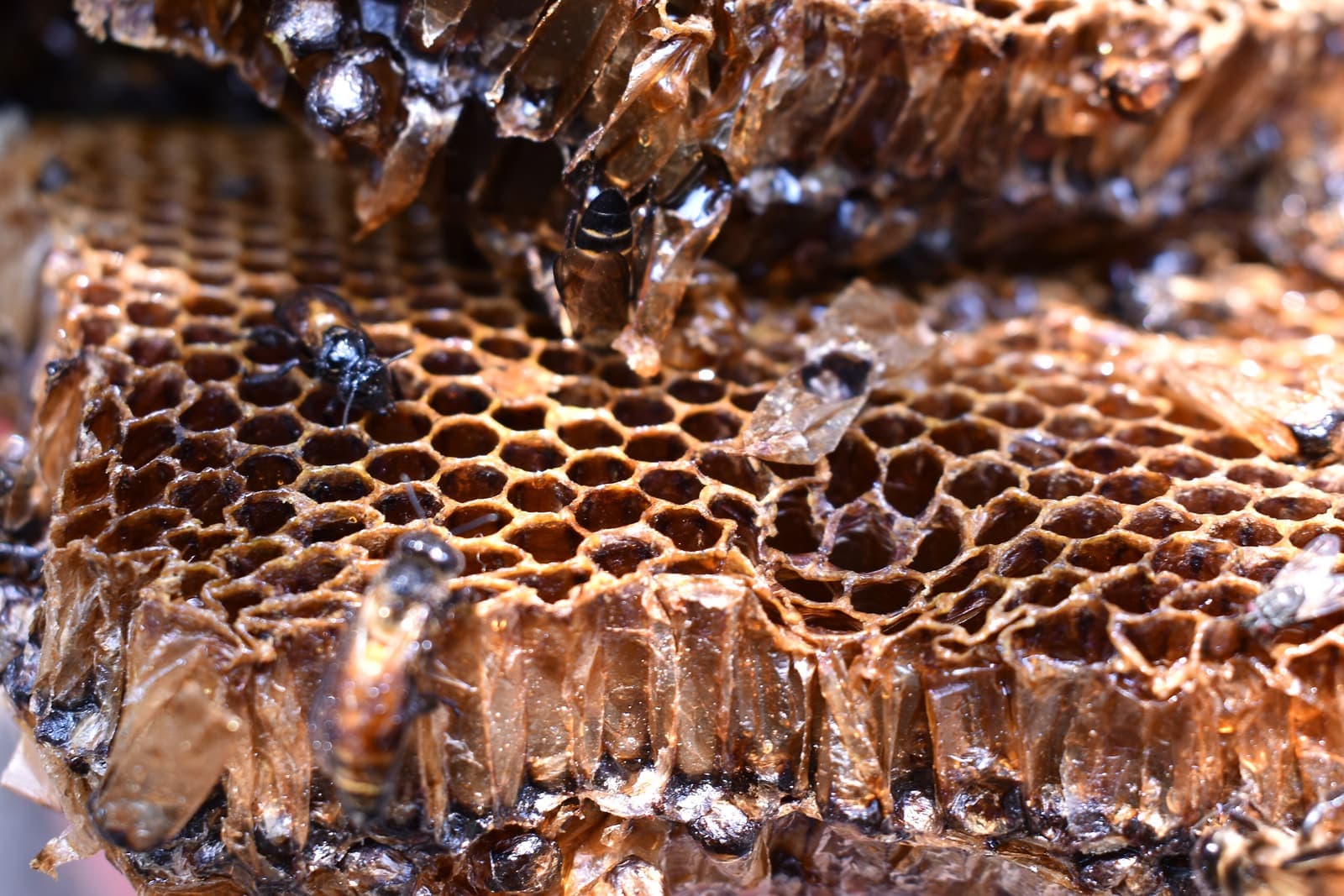
- Photo: "Giant honey bees and Honeycomb", West Bengal, Pinakpani, Wikimedia Commons, CC BY-SA 4.0
Every price in this article was read by IndianAgri on 21 October 2026 from the brand's own website (links in the table and in Sources); none comes from a marketplace or quick-commerce app. "MRP" is used only where the shop labels the figure MRP; other figures are marked as the price shown or as a struck-through list price. Amul's price was shown for a Delhi pin code. ₹ per kg is computed from pack weight and price. Brands whose own site showed no price are named and left out. The testing section summarises FSSAI regulation 2.8.3 and names no brand. Production figures are the Department of Agriculture and Farmers Welfare's 2024-25 Final Estimates; export figures are APEDA's (DGCIS data, 2025-26). IndianAgri does not sell honey and was not paid by any brand listed. Photo: Pinakpani, Wikimedia Commons, CC BY-SA 4.0.
Edited by Devendra Kumar Jha. How we report, source and correct: editorial policy. Spotted an error? Tell us.