Why India Is Quietly Rethinking How It Grows Rice
Puddled transplanting still grows most of India's rice — at a steep cost in water, labour and methane. Direct-seeded rice cuts all three, yet India has adopted it on barely a tenth of its rice area.

Expert insights
Dr. S. Vijayakumar · Scientist (Agronomy), ICAR-Indian Institute of Rice Research, Hyderabad
A rice agronomist whose research on direct-seeded rice, mechanisation, drone application, and drip irrigation has shaped ICAR's climate-resilient rice strategy.
The short answer
India still grows most of its rice by puddled transplanting — flooding and churning the field, raising seedlings in a nursery, then transplanting them by hand — a method that is heavy on water and labour and turns paddies into a major methane source, a gas 28–34 times more warming than CO2 over a century. Direct-seeded rice (DSR), which sows seed straight into the field and skips flooding and transplanting, is the resource-efficient alternative, yet India has brought only about 13.6% of its rice area under it, far behind Cambodia's 98%.
The flooded default
Why puddled transplanting became the problem
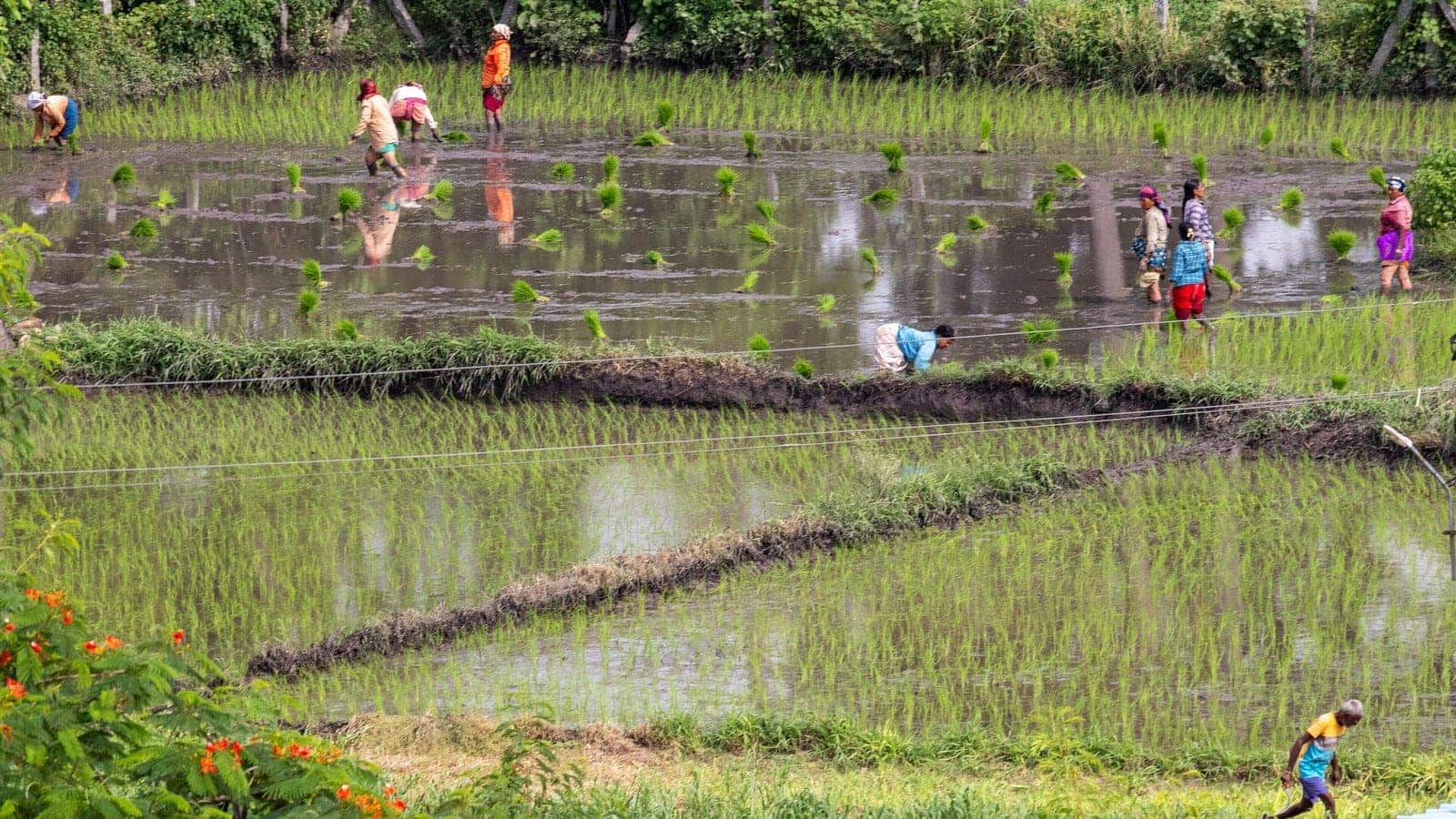
Rice feeds more than half the global population and anchors food security and rural livelihoods across Asia, but the way most Indian rice gets grown has quietly become unsustainable. Puddled transplanting means flooding a field, churning the soil into a fine slurry, raising seedlings separately in a nursery, and then transplanting each one by hand once the field is ready. Every step of that chain is resource-intensive — it demands large volumes of water, heavy manual labour, and considerable energy, making it increasingly precarious in regions already facing water scarcity. Labour for transplanting has also grown harder and costlier to find, as rural workers increasingly move toward non-farm employment — compounding the water and energy pressures already built into the method.
The environmental cost runs deeper than water and labour. Flooded rice paddies are a significant source of methane (CH4), a greenhouse gas with a global warming potential 28–34 times higher than carbon dioxide over a hundred years. That leaves rice cultivation in an uncomfortable dual role: the crop is highly vulnerable to climate-induced stress such as droughts, floods and extreme temperature variability, while the dominant way of growing it actively contributes to the warming driving those very stresses. The vulnerability plays out on both ends of the crop calendar — delayed monsoon onset threatens the very water puddling depends on, while unseasonal floods can wipe out a nursery before it is ever transplanted.
The alternative
What direct-seeded rice changes
Direct-seeded rice (DSR) sows seed straight into the field, bypassing the labour-intensive process of raising and transplanting seedlings from a nursery. By eliminating puddling altogether, DSR significantly cuts the labour, water and time a rice crop demands, making it a more resource-efficient alternative to conventional flooded cultivation. That efficiency compounds across a farm's full cropping calendar: because DSR needs no nursery period and no puddling window, the field is free for the next crop sooner — a real advantage in the double- and triple-cropped systems common across much of India, where every week of turnaround time between crops adds up.
The gains go beyond the immediate resource savings. DSR addresses systemic problems in rice systems — cutting methane emissions from flooded soil and preventing the delayed sowing of the crop that follows in rotation. Its practicality has been strengthened further by newer technologies such as seed priming and mechanization, which build climate resilience by allowing earlier planting. Government support through carbon and water credit policies has added an economic case on top of the agronomic one, positioning DSR as a viable, productive method rather than just an experimental alternative. None of this makes DSR a drop-in replacement for transplanting everywhere, though — its advantages show up in full only once the technological pieces covered later in this series, from weed control to precise seeding to water management, are in place alongside it.
As the world seeks to balance food security with resource scarcity, direct-seeded rice has emerged as a promising alternative for climate adaptation and mitigation.
The Asia gap
India lags while its neighbours lead
DSR adoption varies sharply across Asia. Cambodia leads with 98% of its rice area under DSR, followed closely by Sri Lanka and Malaysia at 95% each. Vietnam and Thailand both sit at 69%, Myanmar at 63%. The Philippines, China and India trail behind at 36%, 30% and 13.6% respectively — a clear divide between Southeast Asian nations that have embraced DSR widely and the larger rice-producing giants that have not.
Southeast Asia's adoption, however, leans heavily on wet-DSR with high seed rates of 150–350 kg/ha and broadcast sowing methods that remain largely non-mechanized and imprecise, leading to uneven crop establishment and higher seed costs. In South Asia, adoption remains low outside Sri Lanka, held back by the same core constraints: uneven crop establishment, poor weed control, and limited access to suitable technology.
India's own footprint
Where DSR already stands inside India
DSR currently covers approximately 6.7 million hectares, or 14.0% of India's total rice-growing area, concentrated mostly in central and southern India. Kerala leads the country by a wide margin at 91.5% adoption, primarily wet-DSR. Chhattisgarh follows at 71.6% — the largest single-state footprint at over 2.7 million hectares of broadcast direct seeding.
The picture is starkly uneven elsewhere. Odisha (28.0%), the North East region (28.2%), Tamil Nadu (25.5%) and Puducherry (24.4%) show meaningful reliance on DSR methods. But among India's largest rice producers, adoption is minimal: West Bengal sits at just 1.0%, Uttar Pradesh at 1.3%, and Bihar at 2.0% — despite all three ranking among the country's biggest rice-growing states. Nationally, adoption is hindered by high weed pressure, nutrient deficiencies, difficulty establishing a uniform crop stand, and consequently lower yields.
A caveat on the numbers
Why India still doesn't have official DSR statistics
India's DSR picture is harder to pin down than it should be, for a simple reason: only a limited number of states officially report rice cultivation area by establishment method. The state-by-state figures on DSR area are compiled from a mix of state government data, expert opinion, and research literature — drawing on collaborators from the All India Coordinated Rice Improvement Project (AICRIP), state extension officers, university professors, and department officials — rather than a single uniform national survey. That doesn't undermine the broad picture; Kerala's lead and West Bengal's lag show up consistently across every source that has tried to measure them. But it is a reminder that closing India's official data gap on establishment method is itself a modest, low-cost step toward better-targeted DSR policy — it is hard to fix an adoption problem at scale in a state whose actual DSR area has never been precisely measured.
What comes next
A roadmap already taking shape
None of this makes DSR a lost cause — it makes it an unfinished transition. Recent years have brought a wave of technological breakthroughs aimed squarely at the barriers holding India back: herbicide-tolerant rice varieties that solve the weed-control problem, mechanized seeders and drones that fix uneven crop establishment, drip irrigation systems that manage water precisely, and simple techniques like seed priming and soil mulching that improve early crop stand. Together, these innovations are what is turning DSR from a promising alternative into a credible, scalable standard for Indian rice — and each is a story in its own right, covered through the rest of this series.
Why it matters
Rice sits in a precarious position as both a victim of climate stress and a contributor to it, and the conventional way India grows the crop makes both problems worse. Closing the DSR adoption gap would ease pressure on water and labour exactly as both grow scarcer, while shrinking rice's methane footprint — the technologies making that shift possible are what the rest of this series covers.
Frequently asked
What is direct-seeded rice (DSR)?
DSR is a method of growing rice by sowing seed directly into the field — dry or into standing water — instead of raising seedlings in a nursery and transplanting them by hand into a puddled, flooded field.
Why is puddled transplanted rice considered unsustainable?
It requires heavy water, labour and energy inputs, and flooded paddies are a major source of methane — a greenhouse gas with 28–34 times the warming potential of CO2 over 100 years.
How much of India's rice area is under direct-seeded rice?
About 13.6% of India's rice area is under DSR (roughly 6.7 million hectares, or 14.0% by area share) — far behind Cambodia (98%), Sri Lanka and Malaysia (95% each).
Which Indian states have adopted DSR the most?
Kerala (91.5%) and Chhattisgarh (71.6%, the largest footprint at 2.7 million hectares) lead. West Bengal (1.0%), Uttar Pradesh (1.3%) and Bihar (2.0%) lag badly despite being major rice producers.
Source
This article summarises and analyses findings from the cited review. The analysis and India context are IndianAgri's own.
Edited by Devendra Kumar Jha. How we report, source and correct: editorial policy. Spotted an error? Tell us.