Crop rotation: meaning, benefits and examples from Indian farms
Growing a different crop after the last one is the oldest soil practice there is. Here is what Indian field trials say it does, which rotations work where, and why the rice–wheat belt finds it hardest.
The short answer
Crop rotation means growing different crops one after another on the same field, season after season, instead of the same crop every time. In India that usually means following a cereal with a pulse, oilseed or vegetable across kharif, rabi and zaid. A global review of 462 field experiments found main crops yielded 20% more after a legume.
Meaning
What is crop rotation?
Crop rotation means growing different crops one after another on the same piece of land, season after season, in a planned order, instead of growing the same crop every time. In Hindi it is called फसल चक्र (fasal chakra), the "crop cycle".
In India the order is set by the three seasons: kharif (sown with the monsoon, June–July), rabi (sown after the monsoon, October–December) and zaid (the short summer window, roughly March–June). A rotation is written as the crops in that order, so rice–wheat means rice in kharif and wheat in rabi on the same field, and rice–wheat–mungbean adds a summer moong crop in zaid.
Three terms are often mixed up:
| Term | What it means | Example |
|---|---|---|
| Crop rotation | Different crops one after another on the same field | Soybean in kharif, chickpea in rabi |
| Monocropping | The same crop on the same field every season or year | Rice after rice after rice |
| Intercropping | Two or more crops at the same time on the same field, in rows | Pigeonpea rows between soybean rows |
Table: definitions by IndianAgri.
Rotation works because crops differ. They take different nutrients from different depths, they leave different residues, and each one feeds its own pests and diseases. Changing the crop breaks that chain; repeating it builds it up.
Benefits
Benefits of crop rotation, with the numbers from field trials
The benefits are well measured, but the size of each one depends on the soil, the water and the crops in the sequence. These are the clearest numbers from published research. None of them is a promise for any one farm.
| Benefit | What the research found | Where |
|---|---|---|
| Higher yield after a legume | Main crops yielded 20% more after legumes; the gain was 32% in low-yielding fields and 7% in high-yielding ones, and it shrank as nitrogen fertiliser rates rose | Zhao et al. 2022: 11,768 yield observations from 462 field experiments worldwide |
| Nitrogen left for the next crop | A preceding pulse may add 18–70 kg of nitrogen per hectare to the soil | Review by ICAR-IARI scientists, Kaur et al. 2018, citing Ali and Mishra (2000) |
| Less irrigation water | Maize in place of rice used 84% less irrigation; a maize–wheat–mungbean rotation used 64% less than farmers' rice–wheat, with 11% higher system productivity | Jat et al. 2020, ICAR-CSSRI research platform, Karnal (both under conservation agriculture) |
| More output and income | Maize–mustard–mungbean gave 15.01 t/ha against 9.83 t/ha for conventional rice–wheat (+52.6%) and 63.2% more net income | Bijarniya et al. 2025, on-farm trials in Vaishali and Samastipur, Bihar, 2016–19 |
| More soil carbon kept | Carbon loss from the stable soil pool was 15.7–23.5% under soybean–wheat and soybean–chickpea against 30.2% under rice–wheat | Vassanda Coumar et al. 2020, ICAR-IISS, farmers' fields in Sehore and Vidisha, Madhya Pradesh |
| Fewer soil pests | Radish grown between potato crops cut potato cyst nematode cysts by 19.6–21.0%, garlic by 15.9–17.7% | Bairwa et al. 2017, ICAR-Central Potato Research Station, the Nilgiris |
| Lower emissions, better soil | Diversified rotations gave up to 38% more yield (in wheat equivalent), 39% less nitrous oxide and 8% more soil organic carbon | Yang et al. 2024, six-year trial in the North China Plain |
Table: compiled by IndianAgri from the papers linked, read 23 October 2026. Each figure is from one study or review under its own conditions.
Two cautions from the same research. First, the legume gain is biggest where yields are low and fertiliser is scarce; on a heavily fertilised field it is smaller. Second, rotation alone rarely clears a pest. In the Nilgiris trial the break crops cut nematode numbers by about a fifth, which helps but does not end the problem.
Types
Types of crop rotation farmers use
There is no single official list of types. These are the ways Indian agronomists usually group rotations, with an example of each from the trials above:
- Cereal followed by a pulse. The pulse feeds nitrogen back to the next cereal. Example: rice followed by lentil or chickpea in the rice fallows of eastern India.
- Two crops a year (double cropping). The common pattern on irrigated land. Example: rice–wheat in Punjab and Haryana, soybean–wheat in Madhya Pradesh.
- Three crops a year. A short zaid crop is fitted between rabi and kharif. Example: rice–wheat–summer mungbean, or maize–mustard–mungbean in Bihar.
- Deep-rooted after shallow-rooted. A crop that feeds from deeper soil follows one that feeds near the surface. Example: pigeonpea or cotton after a cereal.
- Break crops for pests and diseases. A crop from a different plant family is grown to starve a pest of its host. Example: radish or garlic between potato crops in the Nilgiris.
- Cash-crop rotations. High-value vegetables in the sequence. Example: maize–potato–onion, which gave almost 150% higher system productivity than maize–mustard–mungbean in trials at ICAR-IARI, New Delhi (Kumar et al. 2021).
Examples
Crop rotation examples from India, region by region
India does not have one rotation. A satellite map of the Indo-Gangetic Plains by ISRO's Space Applications Centre and the Project Directorate of Cropping Systems Research, Modipuram, built from 2004-05 data (Panigrahy et al.), found rice–wheat the largest system, at about 9.64 million hectares, followed by rice–fallow–fallow and maize–wheat, then sugarcane-based, pearl millet–wheat, rice–fallow–rice and cotton–wheat. Its survey of 1,000 farmers in 103 villages found 77 different cropping systems.
These are sequences that Indian research has tested or recommends, by region:
| Region | Common now | Rotations tried or recommended | Source |
|---|---|---|---|
| Punjab, Haryana (north-west) | Rice–wheat | Maize–wheat–mungbean; rice–wheat–summer mungbean; maize, sunflower, cotton, vegetables, bajra and summer moong in place of paddy | Jat et al. 2020; Kaur et al. 2018; CGWB 2024 |
| Delhi and western UP | Rice–wheat | Maize–potato–onion; fodder maize + cowpea–wheat–mungbean; rice–potato–summer mungbean | Kumar et al. 2021; Kaur et al. 2018 |
| Bihar (eastern plains) | Rice–wheat, rice–fallow | Maize–mustard–mungbean; maize–wheat | Bijarniya et al. 2025 |
| Rice fallows: Assam, West Bengal, Bihar, Odisha, eastern UP, Chhattisgarh, Jharkhand | Rice, then the field left empty in rabi | Rice followed by lentil; lathyrus (khesari) in the tal areas; pea; chickpea; mustard | Kaur et al. 2018, Table 2 from NAAS (2013) |
| Coastal Andhra Pradesh, Tamil Nadu, Karnataka, Odisha | Rice, then fallow | Rice followed by urdbean or mungbean; clusterbean and lablab in AP, TN and Karnataka | Kaur et al. 2018, from NAAS (2013) |
| Madhya Pradesh (Vertisols) | Soybean–wheat, soybean–chickpea | Keep the legume in the sequence: both held more soil carbon than rice–wheat | Vassanda Coumar et al. 2020 |
| Nilgiris (hill potato) | Potato after potato | Radish or garlic as a break crop between potato crops | Bairwa et al. 2017 |
Table: compiled by IndianAgri from the studies linked. "Recommended" means named in the source as an option, not a government order. Your state agricultural university's package of practices has the varieties and dates for your district.
Farmer or FPO?Want a rotation plan for your fields?Tell us your district, the crops you grew in the last three seasons, your water source and where you sell. We will reply with rotation options tried in your region and what to check first.Email usWhatsApp us
Rice–wheat
Why Punjab and Haryana find it hard to break the rice–wheat rotation
Rice–wheat is a rotation, two crops a year, but it repeats the same two cereals every year. In the north-west that has cost water and soil. The state figures show how little room the other crops have:
| Crop, 2024-25 | Punjab (lakh ha) | Haryana (lakh ha) |
|---|---|---|
| Rice | 32.43 | 16.09 |
| Wheat | 35.12 | 23.88 |
| Maize | 0.86 | 0.04 |
| Moong | 0.33 | 0.50 |
Table: crop area, 2024-25, Final Estimates. Compiled by IndianAgri from the Directorate of Economics & Statistics, Department of Agriculture & Farmers Welfare, Ministry of Agriculture & Farmers Welfare, Government of India. The same field usually carries rice in kharif and wheat in rabi, so the two rows overlap.
Punjab sowed about 38 times as much rice as maize in 2024-25. The water cost shows in the Central Ground Water Board's 2024 assessment of Punjab: the state draws 27.66 billion cubic metres of groundwater a year against 17.63 billion that can be drawn sustainably, a stage of extraction of 156.87%, and 115 of its 153 assessment units are over-exploited. The Board's own advice is crop diversification: maize, sunflower, cotton, vegetables, bajra and summer moong in place of paddy.
The trials say it can work. At Karnal, maize in place of rice cut irrigation by 84% with similar or better profit (Jat et al. 2020). The same paper names the reason farmers stay with rice: adoption of maize "is not widespread due to uneven market demand and assured price guarantees for rice". A rotation has to sell, not only grow.
Years of puddled rice also leave a hard layer under the topsoil that holds back the wheat that follows; we explain it in why wheat yields fall after paddy.
Pulses
Pulses in the rotation: the nitrogen the next crop gets
Pulses carry bacteria in their root nodules that take nitrogen from the air. When the crop is harvested and its roots and leaves rot, part of that nitrogen stays for the next crop. The ICAR-IARI review by Kaur and colleagues (2018) puts it at 18–70 kg of nitrogen per hectare from a preceding pulse.
Summer moong between wheat and rice. Short varieties of 60–70 days fit the gap between the wheat harvest and rice transplanting; the review lists SML 668, SML 832, Samrat, Pusa 9531 and Pusa Vishal. A study it cites (Sekhon and colleagues, 2006) measured what the extra crop added:
| Rotation | Total yield (t/ha) | Net return over variable costs (₹/ha) |
|---|---|---|
| Rice–wheat | 11.8 | 38,116 |
| Rice–wheat–summer mungbean | 12.96 | 48,316 |
| Rice–potato–summer mungbean | 32.75 | 53,150 |
Table: Sekhon et al. (2006), as reproduced in Kaur et al. (2018), Table 8. Total yield adds the tonnes of each crop; potato weighs far more per hectare than grain. Rupees are at that study's prices.
Pulses after rice in the rice fallows. About 11.65 million hectares of rice land in India is left empty after the kharif harvest (NAAS 2013, in the same review), and about 82% of it lies in Assam, Bihar, Chhattisgarh, Jharkhand, Madhya Pradesh, Odisha and West Bengal. Lentil, chickpea, pea and khesari can grow there on the moisture the rice leaves behind. The review lists what stops farmers: too little moisture after the rice harvest, no quality seed, and no assured market. One answer it reports is sowing chickpea into the standing rice about 10 days before harvest (the utera method), which gave 45% more yield than sowing after preparing the field.
For scale: India grew moong on 59.0 lakh hectares and gram (chickpea) on 91.2 lakh hectares in 2024-25, against 512.7 lakh hectares of rice (Final Estimates). See the moong and gram pages for every state.
How to plan
How to plan a crop rotation for your field
- Write down the last three seasons for each field: what grew, what it yielded, which pests and weeds came back.
- Follow a cereal with a pulse or oilseed at least once in the cycle: moong, urad, lentil, chickpea or mustard, whichever fits your season and water.
- Change the plant family, not just the crop. Potato, tomato, brinjal and chilli are one family and share pests; wheat, rice and maize are another. A break crop works only if it is from a different family.
- Fit the calendar. Count the days between your harvest and the next sowing. A 60–70 day moong fits between wheat and rice; a long-duration crop may push the next sowing late.
- Match the water. Where groundwater is falling, a crop that needs less irrigation in kharif (maize, bajra, pulses, cotton) does more than any change in rabi.
- Check the market before you sow. Ask the nearest mandi, FPO or buyer who will take the new crop, at what price, and whether the government buys it at MSP in your area.
- Test the soil at your district soil testing lab or Krishi Vigyan Kendra before and after a full cycle, so you can see what changed.
- Start small. Try the new sequence on one field for one full cycle before changing the farm.
Seed, input or machinery company?Reach farmers who are planning their next cropPulse and oilseed seed companies, input makers and machinery firms that want to be in front of farmers and FPOs reading about rotation: write to the desk.Email usWhatsApp us
Mistakes
Common crop rotation mistakes
- Rotating within one family. Tomato after potato is not a break: both carry the same soil pests.
- Changing the crop without a buyer. The Karnal trial's maize did well; farmers still grow rice because rice has an assured price. Settle the sale first.
- Expecting rotation alone to clear a pest. In the Nilgiris trial, break crops cut nematode cysts by about a fifth. Combine rotation with resistant varieties and clean seed.
- Leaving the summer field empty. Where water allows, a short moong crop between wheat and rice adds a crop and nitrogen; the Sekhon study measured ₹10,200 a hectare more net return.
- Sowing the rabi pulse too late after rice. In rice fallows the moisture goes fast; late sowing is the most common reason the second crop fails.
- Judging it after one season. Soil carbon and pest numbers change over several cycles. Compare like with like over at least two to three years.
Agronomist, KVK or university scientist?Add your region's rotation, or correct oursIf a sequence that works in your district is missing, or a figure here has been superseded, send it with the source. We credit every contribution.Email usWhatsApp us
Why it matters
Punjab sowed 32.4 lakh hectares of rice in 2024-25 and draws 156.87% of the groundwater it can replace. Which crop follows which decides how much water, fertiliser and soil a farm has left in ten years.
Frequently asked
What is crop rotation?
Crop rotation is growing different crops one after another on the same field, in a planned order across seasons, instead of the same crop every time. In India it follows the kharif, rabi and zaid seasons, for example soybean in kharif followed by chickpea in rabi.
Crop rotation को हिंदी में क्या कहते हैं?
Crop rotation को हिंदी में फसल चक्र कहते हैं। मतलब एक ही खेत में हर सीज़न अलग फसल लगाना, जैसे खरीफ में धान और रबी में चना या मसूर। इससे मिट्टी को नाइट्रोजन मिलता है और कीड़े-बीमारी कम टिकती है।
What are the benefits of crop rotation?
Higher yields after legumes (20% on average across 462 field experiments in one global review), 18–70 kg of nitrogen per hectare left by a preceding pulse, less irrigation when a dry crop replaces rice, more soil carbon kept, and fewer soil pests. The size of each benefit depends on the field.
What are examples of crop rotation in India?
Rice–wheat in Punjab and Haryana; maize–wheat–mungbean and rice–wheat–summer mungbean as alternatives there; soybean–wheat and soybean–chickpea in Madhya Pradesh; rice followed by lentil, khesari or chickpea in eastern India; rice followed by urad or moong in coastal Andhra Pradesh and Tamil Nadu.
What are the types of crop rotation?
Agronomists usually group them as cereal followed by a pulse, two crops a year, three crops a year with a short zaid crop, deep-rooted after shallow-rooted crops, break crops from another plant family to starve pests, and cash-crop rotations with vegetables such as maize–potato–onion.
What is the difference between crop rotation and intercropping?
Crop rotation grows different crops one after another on the same field. Intercropping grows two or more crops at the same time on the same field, usually in alternate rows, such as pigeonpea rows between soybean. Many farms use both.
Why don't Punjab farmers move away from rice–wheat?
Mainly price and market. Rice has an assured price, and a Karnal trial found maize adoption low for that reason even though maize used 84% less irrigation. Punjab sowed 32.4 lakh hectares of rice and only 0.86 lakh hectares of maize in 2024-25, while it draws 156.87% of its sustainable groundwater.
Which crops add nitrogen to the soil?
Pulses and other legumes: moong, urad, lentil, chickpea, pea, pigeonpea, khesari, soybean, groundnut and cowpea. Bacteria in their root nodules fix nitrogen from the air, and a preceding pulse may leave 18–70 kg of nitrogen per hectare for the next crop.
Source
- Zhao et al. (2022), Global systematic review with meta-analysis reveals yield advantage of legume-based rotations, Nature Communications 13: 4926
- Yang et al. (2024), Diversifying crop rotation increases food production, reduces net greenhouse gas emissions and improves soil health, Nature Communications 15: 198
- Jat et al. (2020), Designing profitable, resource use efficient and environmentally sound cereal based systems for the Western Indo-Gangetic plains, Scientific Reports
- Bijarniya et al. (2025), Conservation agriculture-based crop diversification options in the Eastern Gangetic Plains of India, Frontiers in Agronomy
- Kumar et al. (2021), Diversification of rice-wheat cropping system to sustain the productivity and profitability, Indian Journal of Agricultural Sciences 91(4)
- Kaur et al. (2018), Increasing area under pulses and soil quality enhancement in pulse-based cropping systems, Indian Journal of Agricultural Sciences 88(1)
- Vassanda Coumar et al. (2020), Soil carbon dynamics under different cropping systems in Vertisols of Central India, Indian Journal of Agricultural Sciences 90(1)
- Bairwa et al. (2017), Effect of cultural practices on potato cyst nematode population dynamics, Indian Journal of Horticulture 74(1)
- Central Ground Water Board: Dynamic Ground Water Resources of Punjab, 2024
- Panigrahy et al. (SAC-ISRO, PDCSR Modipuram): A spatial database of cropping system and its characteristics, ISPRS Archives XXXVIII-8/W3
- Directorate of Economics & Statistics, DA&FW: crop area by state (Final Estimates)
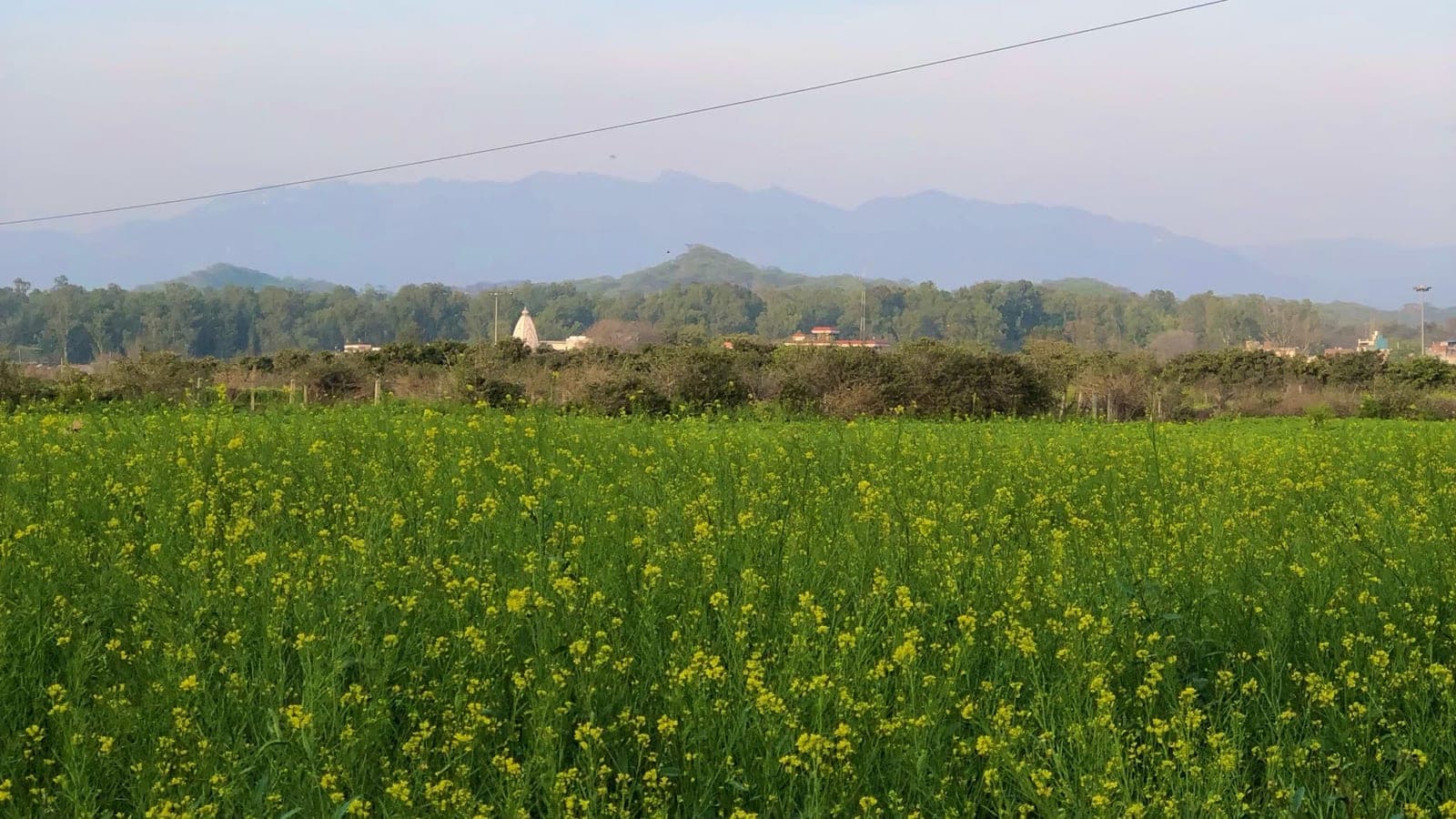
- Photo: "Mustard field near Chandigarh" (2 Mar 2022), UnpetitproleX, CC BY-SA 4.0, via Wikimedia Commons
Read on 23 October 2026. Research figures are from the peer-reviewed papers and the CGWB report linked in the text, each under its own conditions; the global and North China Plain results are labelled as such. Crop areas are from the Directorate of Economics & Statistics' Final Estimates for 2024-25, computed from IndianAgri's fact store. IndianAgri sells no seed or inputs and is paid by no company named or implied here. Photo: UnpetitproleX, CC BY-SA 4.0, via Wikimedia Commons.
Edited by Devendra Kumar Jha. How we report, source and correct: editorial policy. Spotted an error? Tell us.