Why Wheat Yields Fall After Paddy: The Hardpan Under India's Rice Fields
The layer that makes flooded rice work is the same layer the following wheat crop has to push through. India builds it deliberately, every season, across roughly 10 million hectares — and it is also why direct-seeded rice succeeds on one field and fails on the next.

Written by
Devendra Kumar Jha · Founder, Agpro Consulting
Devendra Kumar Jha is an agricultural engineer and founder of Agpro Consulting, with over 25 years bridging corporate strategy and the Indian agri-sector.
The short answer
A plough pan is a dense compacted layer below tillage depth. In India's rice-wheat belt it is created deliberately by puddling, because it slows percolation out of a flooded field — cutting water losses by roughly 14–16%. Trials on sandy loam recorded bulk density of about 1.74 Mg/m³ at 14–20 cm under normal puddling against 1.57 where puddling was shallow. The cost lands on the next crop: wheat after puddled transplanted rice yields about 8% less than wheat after direct-seeded rice, and the same layer obstructs the deep rooting that direct-seeded rice depends on. Whether to break it depends entirely on what the field will grow next.
The paradox
The pan British farmers dread, India builds every season
In British arable farming a plough pan — what Indian extension material calls a hardpan — is damage. It is what heavy machinery and untimely cultivation leave behind, and the remedy is an argument about how deep to loosen and whether to loosen at all. Professor Dick Godwin, who has spent a career on the engineering of it, puts the cost plainly: a compact soil restricts root development, impedes air and water movement and raises the risk of anoxic conditions — and if nothing is done, soil health deteriorates and yields follow it down.
Now cross to the Indo-Gangetic Plains, where the same layer is not an accident. It is the objective.
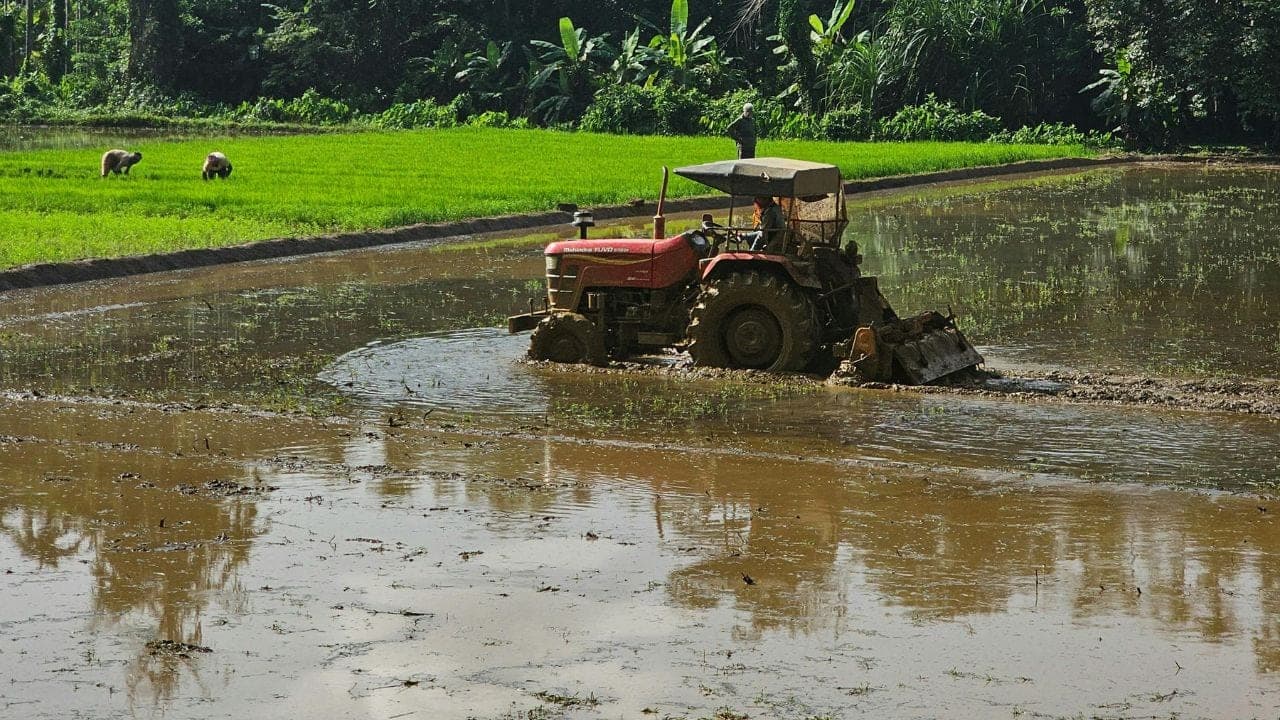
Puddling — working the soil wet until its structure collapses into slurry — is done deliberately before transplanting rice, precisely because the dense layer it leaves stops water draining away. It cuts percolation losses by roughly 14–16% and crop water demand by something like 10–25%. On about 10 million hectares of Indian farmland it is repeated every kharif, and has been for decades.
So the question a Punjab or eastern UP farmer faces is not the British one. It is not "how did this pan get here and how do I remove it". It is harder: the layer that makes flooded rice work is the same layer that penalises everything that follows it.
What it does
Fifteen centimetres down, the soil stops behaving like soil
The pan sits just below the depth the implement reaches, and it is dense enough to measure easily. In a multi-year trial on sandy loam in the rice-wheat belt, soil in the 14–20 cm layer of normally puddled plots reached an average bulk density of 1.74 Mg/m³, against 1.57 in shallow-puddled plots after three years. Raising puddling intensity alone pushed the 16–18 cm layer from 1.63 to 1.67, and the 18–20 cm layer from 1.61 to 1.66.
Those look like small numbers until you consider what they describe. Bulk density is mass per unit volume of soil — as it climbs, the pore space that roots, air and water occupy is what disappears. A layer at 1.74 is not soil that a root pushes through slowly. In large part it is soil a root does not enter at all, and one that water crosses only very slowly, which is exactly why the technique works for a flooded crop.
This is also why the pan is durable. It was not made by one pass of one machine; it is the cumulative product of many seasons of working wet soil at roughly the same depth, and a single dry-season cultivation does not undo it.
The bill
Wheat pays for the rice crop's water
The cost does not appear in the rice season. It appears in rabi, when wheat is drilled into the same field and its roots reach the layer the rice crop needed.
Published comparisons put wheat yields about 8% lower after puddled transplanted rice than after direct-seeded rice. The rice saved water in kharif; the wheat pays for it in rabi. Because the same field grows both, the honest accounting is the net of the two — and that netting is almost never done, because the two crops are planned, costed and subsidised as separate enterprises.
The scale makes this worth getting right. The rice-wheat system covers roughly 10 million hectares in India, producing on the order of 130 million tonnes of rice and 106 million tonnes of wheat — around three-quarters of the country's cereal output. An 8% penalty on the second crop of that system is not an agronomic footnote. It sits underneath the same rotation that ICAR now wants capped and diversified.
Why it decides DSR
You cannot direct-seed into a pan built for flooding
This is where the pan stops being a soil-science curiosity and becomes the practical question of the decade.
Direct-seeded rice asks the crop to do the opposite of what puddled rice does. Instead of sitting in standing water, the plant must send roots down to find moisture. The water case for it is strong — trial plots have used around 924 mm of irrigation under DSR against 1,441 mm under transplanting, a difference of over 500 mm — and that is before the labour and the puddling operation itself are counted.
But a field carrying a decade of puddling has a dense layer sitting exactly where those roots need to go. It is a large part of why DSR results vary so much between neighbouring fields with the same seed, the same drill and the same herbicide plan: what the previous ten years left at 15 cm is not the same in both. Our own map of which states are leading and lagging on DSR tracks the adoption; the pan is one of the reasons the map looks patchy even inside a single district, and it is worth reading alongside Chhattisgarh's DSR advisory.
A farmer switching to DSR on a long-puddled field is not merely changing an establishment method. He is asking a soil profile built for one system to serve the opposite one.
The engineering
Deeper is not better, and there is a hard reason why
If the pan has to be broken, the instinct is to go deep. The engineering says otherwise, and the reason is worth understanding before anyone hires a subsoiler.
As a tine is pulled through soil, it lifts and fractures the soil forward and upward along failure planes spreading from the tip. Work deeper and the resistance to that upward movement grows, until a point where it becomes easier for soil to flow sideways around the foot than to be lifted at all. Past that point — the critical depth for that tine in that soil — the compacted zone is left essentially undisturbed and the machine has cut a channel and burned diesel. Going deeper does not achieve more; past a certain depth it achieves nothing.
Two related warnings from the same body of work travel well to India. Tillage where it is not required does more harm than good, disrupting root and water pathways that were working. And inadequate or badly adjusted equipment can re-compact the loosened soil on the very next pass, leaving the field worse than before it was treated.
That matters here more than in Britain, because in much of India the decision is not made by the person who owns the soil. Subsoiling is bought as a custom-hire service, priced by the hour or the acre, from an operator with one machine set one way. The incentive is to run deep and move on.
What to do
Dig a hole before you hire a machine
The first step costs nothing. Godwin's position, after decades of measuring this, is that nothing yet beats a visual assessment with the crop actively growing — as he puts it, we have yet to master the digital spade.
Walk the patches where the crop is visibly poorer in the growing season and dig. What you are looking for is restricted rooting, large slabs of soil that are hard to prize apart, and water that will not move down the profile. That tells you whether a pan exists, at what depth, and how thick — and those three answers determine the treatment. Surface problems from trafficking or slumping need gentle loosening. A discrete pan needs fissuring at its own depth, not below it. A deep, massive, structureless zone is a much harder problem and rarely fixed in one pass.
Then the decision that is specific to India, and it is a decision rather than a technique. If the field is staying in puddled transplanted rice, the pan is an asset and breaking it will cost irrigation water for no return. If the field is moving to DSR, to a diversified rotation, or to any crop that has to root deep, the pan is the first obstacle and should be broken once, properly, at the right depth — and then protected from the traffic that will rebuild it.
The layer itself is neither good nor bad. It is the physical record of a choice that was made every season, by people who mostly were not thinking about the crop that follows.
Why it matters
The rice-wheat system covers about 10 million hectares and produces roughly three-quarters of India's cereals, so a penalty carried by its second crop is a national number, not a field-level one. It also sits underneath two policies pulling in the same direction — the push to direct-seeded rice to save water, and the push to diversify the rotation. Both ask roots to go deeper than a puddled profile allows. Treating the pan as an accident to be subsoiled away misreads it; it was built on purpose, it is still doing the job it was built for, and the real decision is which crop the soil is being maintained for.
Frequently asked
What is a plough pan or hardpan in rice fields?
A dense, compacted layer that forms just below the depth tillage reaches. In India's rice belt it is created deliberately by puddling — working soil wet until its structure collapses — because that layer slows water draining out of a flooded field, cutting percolation losses by roughly 14–16%. Measured on sandy loam in the rice-wheat belt, the 14–20 cm layer of normally puddled plots reached a bulk density of about 1.74 Mg/m³ against 1.57 where puddling was shallow.
Does the hardpan reduce wheat yields after rice?
Published comparisons put wheat yields about 8% lower when sown after puddled transplanted rice than after direct-seeded rice. The dense layer restricts rooting and slows water movement for the following crop. Because rice and wheat are usually planned and costed separately, the water the rice crop saves and the yield the wheat crop loses are rarely netted against each other, even though the same field carries both.
Should I break the hardpan in my field?
Only after establishing that one exists, at what depth, and what you intend to grow. If the field stays in puddled transplanted rice, the pan is doing useful work and breaking it will cost irrigation water for no return. If you are moving to direct-seeded rice or a deeper-rooting rotation, it is the first obstacle. Dig in the patches where the crop looks poorest during the season and look for restricted roots, slabs that will not prize apart, and water that will not drain — that tells you the depth to work at.
Is deeper subsoiling more effective?
No, and there is a physical reason. A tine lifts and fractures soil upward along failure planes from its tip, but as it works deeper the resistance to lifting rises until soil simply flows sideways around the foot instead. Beyond that point — the critical depth for that tine in that soil — the compacted layer is left largely undisturbed while fuel is still being burned. Poorly adjusted equipment can also re-compact loosened soil on the following pass, leaving the field worse than before.
Source
- Crop Production Magazine, August 2026 — Soil loosening (Prof Dick Godwin on deep loosening and critical depth)
- Soil & Tillage Research — Puddling depth and intensity effects in rice–wheat system on a sandy loam soil: development of subsurface compaction
- Rice–wheat system in the northwest Indo-Gangetic plains: issues and technological interventions (review)
- Frontiers in Plant Science — Emerging Issues and Potential Opportunities in the Rice–Wheat Cropping System of North-Western India
The diagnostic framing — the consequences of compaction, the critical-depth limit on subsoiling, and the warning that badly set equipment re-compacts loosened soil — is from Crop Production Magazine's August 2026 soils issue, where it is presented for UK arable conditions. None of that magazine's figures appear here. The Indian figures are from published rice-wheat research: the bulk density values are from a multi-year trial on one sandy loam soil and should be read as indicative of the mechanism rather than as national averages, since the pan's depth and density vary with texture, puddling practice and years under the system. The 8% wheat penalty and the irrigation comparison are likewise trial results under specific conditions, not universal constants. Area and production figures for the rice-wheat system are widely cited approximations drawn from review literature rather than a single official release.