India Burns 60% of Its Sugarcane Trash: A ₹-Billion Bioeconomy Opportunity Going Up in Smoke
India generates 17.9 million tonnes of sugarcane trash annually, yet more than 60% is openly burned — destroying soil nutrients, releasing greenhouse gases, and squandering a renewable resource that could anchor rural bioeconomy enterprises

Expert insights
Kailash Chaudhary · Renewable Energy and Circular Economy Lead, Chesta Bio Energy
Kailash Chaudhary leads renewable energy and circular economy initiatives at Chesta Bio Energy, drawing on 32 years across military service, project management, and ESG.
The short answer
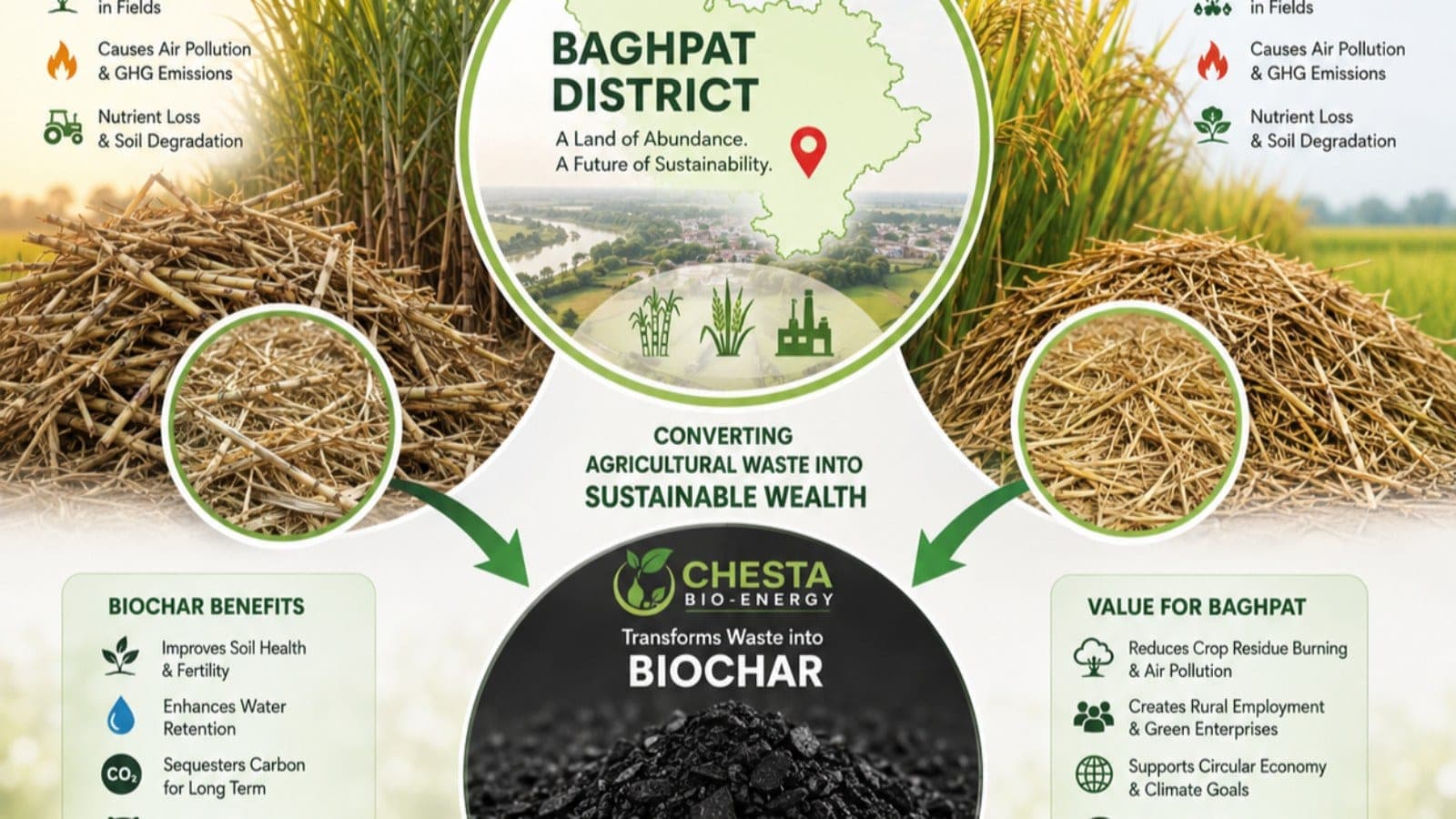
India produces nearly 17.9 million tonnes of sugarcane trash every year, but over 60% is openly burned in fields, releasing greenhouse gases and stripping soils of nitrogen, phosphorus, and potassium. Chesta Bio Energy's assessment argues this residue can instead be converted into biochar, renewable energy, and carbon credits. The missing piece, according to the assessment, is an integrated ecosystem connecting farmers, sugar mills, entrepreneurs, policymakers, and researchers to build viable biomass value chains.
The scale of waste
17.9 Million Tonnes of Sugarcane Trash — and Most of It Burns
While national debate on crop residue burning largely centres on paddy stubble in Punjab and Haryana, sugarcane trash has quietly become one of India's most neglected biomass challenges. A recent assessment by Chesta Bio Energy places the annual generation of sugarcane trash at nearly 17.9 million tonnes — a figure that dwarfs many other agricultural residue streams.
More than 60% of this volume is openly burned in fields after harvest. Each tonne consigned to the flame releases carbon dioxide and other greenhouse gases into the atmosphere while simultaneously destroying the nitrogen, phosphorus, and potassium that the soil needs for the next crop cycle. The twin losses — environmental and agronomic — make field burning of cane trash a costly habit that farmers, sugar mills, and the broader agri-sector can ill afford to continue.
The value chain case
From Field Burning to Biochar, Energy, and Carbon Credits
The core argument from Chesta Bio Energy's assessment is that sugarcane trash is not a disposal problem — it is a misclassified asset. The residue that farmers currently burn could, with the right infrastructure, be converted into:
- Biochar — a soil amendment that improves fertility and permanently sequesters carbon in the ground
- Renewable energy — displacing fossil fuels in industrial and rural applications
- Carbon credits — generating additional income streams for farmers and biomass aggregators
- Circular bioeconomy products — creating rural employment while cutting emissions
The assessment notes that the technology required for these conversions already exists, and the raw material is in abundant supply. What is currently absent is a structured ecosystem that connects all the relevant actors — farmers, sugar mills, entrepreneurs, researchers, policymakers, and industry — into functional biomass value chains.
India's biomass challenge is not a shortage of resources — it is a shortage of value creation.
The ecosystem gap
Technology Exists — But the Value Chain Does Not
The diagnosis from Chesta Bio Energy is pointed: India's biomass challenge is not a shortage of resources, but a shortage of value creation. The country has the feedstock and the technical know-how; what is missing is coordination.
Building a viable sugarcane trash value chain would require sugar mills — which sit at the natural aggregation point for cane residue — to act as anchors, working alongside rural entrepreneurs, women-led clean-energy enterprises, and policymakers who can provide enabling regulation. The assessment positions regenerative agriculture as both the end-goal and the selling point: biochar returned to cane fields can rebuild the very soil nutrients that burning destroys, creating a closed loop where residue management becomes soil investment.
For commodity traders and agri-businesses, the carbon credit dimension adds a financial layer beyond farm-gate savings — one that could make biomass aggregation commercially attractive even before accounting for energy or product revenue.
The policy read
A Residue Crisis That Policy Has Yet to Fully Address
India's residue management policy has largely focused on paddy-growing states, with schemes incentivising happy-seeder technology and ex-situ biomass use in power plants. Sugarcane trash has received comparatively little structured attention, even though it represents a significant and annually recurring biomass surplus concentrated around sugar mill catchment areas — making it logistically easier to aggregate than paddy straw.
For policymakers, the Chesta Bio Energy assessment implicitly points to several levers: biomass procurement obligations for sugar mills, carbon credit facilitation for smallholder cane farmers, and rural enterprise support for biochar producers. Without policy scaffolding, the economics of sugarcane trash valorisation remain challenging for individual farmers to act on alone. The climate imperative — reducing agricultural greenhouse gas emissions ahead of India's NDC commitments — adds urgency to getting this framework right.
Why it matters
With paddy stubble burning already under intense regulatory scrutiny, sugarcane trash represents a parallel — and largely unaddressed — residue crisis across India's cane-growing belts. If even a meaningful fraction of the 17.9 million tonnes currently burned were redirected into biochar or energy applications, it could simultaneously improve soil health, generate carbon credit income for farmers, and seed rural clean-energy enterprises. Policymakers designing the next phase of crop-residue management policy would do well to look beyond paddy and bring sugar mills, smallholder farmers, and bioeconomy entrepreneurs into a structured value chain — before another season's worth of nutrients and carbon go up in smoke.
Frequently asked
How much sugarcane trash does India generate every year?
According to a Chesta Bio Energy assessment, India generates nearly 17.9 million tonnes of sugarcane trash annually.
What percentage of India's sugarcane trash is openly burned?
More than 60% of India's sugarcane trash is openly burned in fields, releasing greenhouse gases and destroying soil nutrients such as nitrogen, phosphorus, and potassium.
What can sugarcane trash be converted into instead of being burned?
The Chesta Bio Energy assessment identifies biochar for soil health and carbon sequestration, renewable energy to replace fossil fuels, carbon credits for additional farmer income, and circular bioeconomy products that generate rural employment as viable alternatives to burning.
What is the key barrier to building a sugarcane trash value chain in India?
According to the assessment, the technology and biomass supply both exist. The missing element is an integrated ecosystem connecting farmers, sugar mills, entrepreneurs, policymakers, and researchers into viable biomass value chains.
Source
This report summarises and analyses coverage from linkedin.com. The analysis and India context are IndianAgri's own.