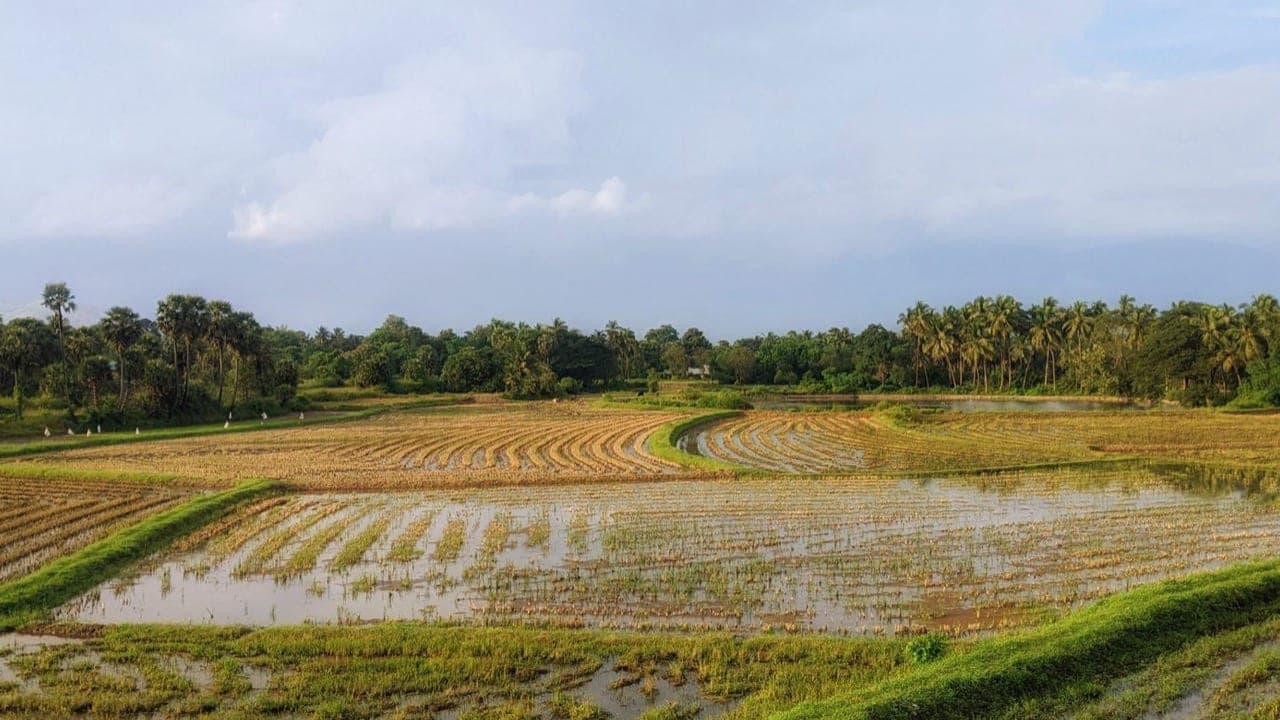
Kharif Sowing Slumps 23% as Delayed Monsoon and Dry Reservoirs Squeeze India's Cropping Season
Total kharif acreage fell to 182.72 lakh hectares by late June — 23% below last year — as a 42% rainfall deficit and El Niño conditions stall sowing across paddy, pulses, oilseeds, and cotton.
The short answer
India's kharif sowing is sharply behind schedule, with total acreage at 182.72 lakh hectares as of June 25 — down 23% from 236.46 lakh hectares a year ago — driven by a sluggish, below-normal southwest monsoon. Oilseeds have taken the hardest hit, with area plunging over 53%, while cotton, pulses, and paddy also lag well behind year-ago levels. Reservoir storage in 166 key water bodies stands at just 26.37% of full capacity, adding further pressure on an already stressed sowing season.
Season snapshot
Acreage Across Kharif Crops Falls Well Short of Last Year's Pace
Agriculture Ministry data released on June 30 shows total kharif sowing at 182.72 lakh hectares as of June 25, against 236.46 lakh hectares at the same point in 2025 — a shortfall of 23%. Only sugarcane and jute-mesta bucked the trend, posting marginal year-on-year gains to 57.31 lakh hectares and 6.25 lakh hectares respectively.
Every other major crop category is lagging:
- Paddy: 25.75 lakh ha vs 34.41 lakh ha (–25.17%)
- Pulses: 14.92 lakh ha vs 21.46 lakh ha (–30.47%)
- Oilseeds: 16.99 lakh ha vs 36.41 lakh ha (–53.33%)
- Coarse cereals: 31.84 lakh ha vs 36.07 lakh ha
- Cotton: 29.66 lakh ha vs 45.36 lakh ha (–34.61%)
The breadth of the decline — spanning staple cereals, protein crops, edible oils, and fibre — underscores that this is not a crop-specific issue but a season-wide disruption rooted in rainfall failure.
Crop watch
Oilseeds and Pulses Bear the Sharpest Sowing Losses
Within the two most affected categories, the sub-crop breakdown reveals where supply risks are concentrating most acutely.
Oilseeds recorded the steepest overall fall, driven by dramatic retreats in the two dominant crops:
- Soybean area collapsed to 6.92 lakh hectares from 19.97 lakh hectares a year ago — a loss of nearly 13 lakh hectares that will weigh heavily on central India's soy belt.
- Groundnut area fell to 8.87 lakh hectares from 15.29 lakh hectares.
Pulses are similarly stressed, with tur/arhar — India's most price-sensitive pulse — sown on just 3.56 lakh hectares versus 8.45 lakh hectares last year, less than half the year-ago level. Given that tur prices have remained elevated through recent seasons, any further output compression will intensify pressure on retail dal prices and may prompt early government intervention on imports or stock limits.
Monsoon deficit
A 42% Rainfall Shortfall and El Niño Put the Entire Season at Risk
The India Meteorological Department (IMD) reported that the southwest monsoon was running 42% below normal as of June 24 — the direct cause of delayed and depressed sowing activity nationwide.
The regional picture reveals stark internal disparities:
- Central India: 59% deficit — the worst affected zone and home to major soybean and cotton belts
- East and Northeast India: 41% deficit, impacting early paddy transplanting
- South Peninsula: 28% deficit
- Northwest India: 22% deficit
Compounding the concern, El Niño conditions are currently active over the equatorial Pacific Ocean and, according to IMD, are expected to intensify through the June–September monsoon period. El Niño years have historically been associated with weaker Indian summer monsoons, suggesting that a sharp mid-season rainfall recovery — the traditional safety valve — cannot be assumed this year.
Water stress
Reservoir Storage at 26% of Capacity, Well Below Year-Ago Levels
With rainfall scarce, water storage data from the Central Water Commission (CWC) adds another layer of risk. Live storage across 166 important reservoirs stood at 48.405 billion cubic metres (BCM) as of June 25 — equivalent to 26.37% of full reservoir level (FRL) capacity.
While this figure is 105.67% of the long-term normal for this time of year, it represents only 73.21% of last year's storage at the same date, pointing to a meaningful year-on-year decline in available water.
At the reservoir level, the distribution is uneven:
- 111 of 166 reservoirs held more than 80% of normal storage
- 55 reservoirs were at 80% or below normal storage
- Of those 55, 29 reservoirs were at 50% or less of normal storage
Reservoirs in deficit zones will be critical for supplemental irrigation once the monsoon eventually advances, and their current state limits the buffer available to compensate for ongoing rainfall gaps.
Why it matters
A 23% acreage shortfall at this stage of the kharif season raises serious concerns about domestic food and oilseed supply in the second half of 2026 — particularly for tur dal and soybean, which are already in structurally tight markets. The confirmation of El Niño conditions strengthening through June–September means rainfall recovery cannot be taken for granted, and policymakers may need to act early on import duty adjustments or strategic reserve deployment. Commodity traders should watch reservoir levels and August sowing data closely as leading indicators for crop-year output revisions.
Frequently asked
By how much has kharif sowing fallen compared to last year?
Total kharif acreage stood at 182.72 lakh hectares as of June 25, 2026 — down 23% from 236.46 lakh hectares recorded at the same point in 2025, according to agriculture ministry data.
Which kharif crop has seen the sharpest sowing decline?
Oilseeds recorded the steepest fall, with sown area down 53.33% to 16.99 lakh hectares from 36.41 lakh hectares a year earlier. Within oilseeds, soybean area fell from 19.97 lakh hectares to 6.92 lakh hectares.
How far below normal is the southwest monsoon this season?
According to the India Meteorological Department, the southwest monsoon was 42% below normal as of June 24, with central India facing the worst deficit at 59% below normal.
What is the current water storage situation in India's key reservoirs?
The Central Water Commission reported live storage across 166 important reservoirs at 48.405 BCM as of June 25 — 26.37% of full reservoir level capacity and 73.21% of last year's storage at the same date.
Source
This report summarises and analyses coverage from The Hindu BusinessLine — Agri Business. The analysis and India context are IndianAgri's own.