7 HP or 9 HP? Sizing a Power Weeder Without Overbuying
Horsepower is on the sticker, so it is what gets compared. But a machine that cannot fit between your rows is unusable, and one you cannot manoeuvre all day is slow — and slow is what actually sets your cost per acre.

Written by
Devendra Kumar Jha · Founder, Agpro Consulting
Devendra Kumar Jha is an agricultural engineer and founder of Agpro Consulting, with over 25 years bridging corporate strategy and the Indian agri-sector.
The short answer
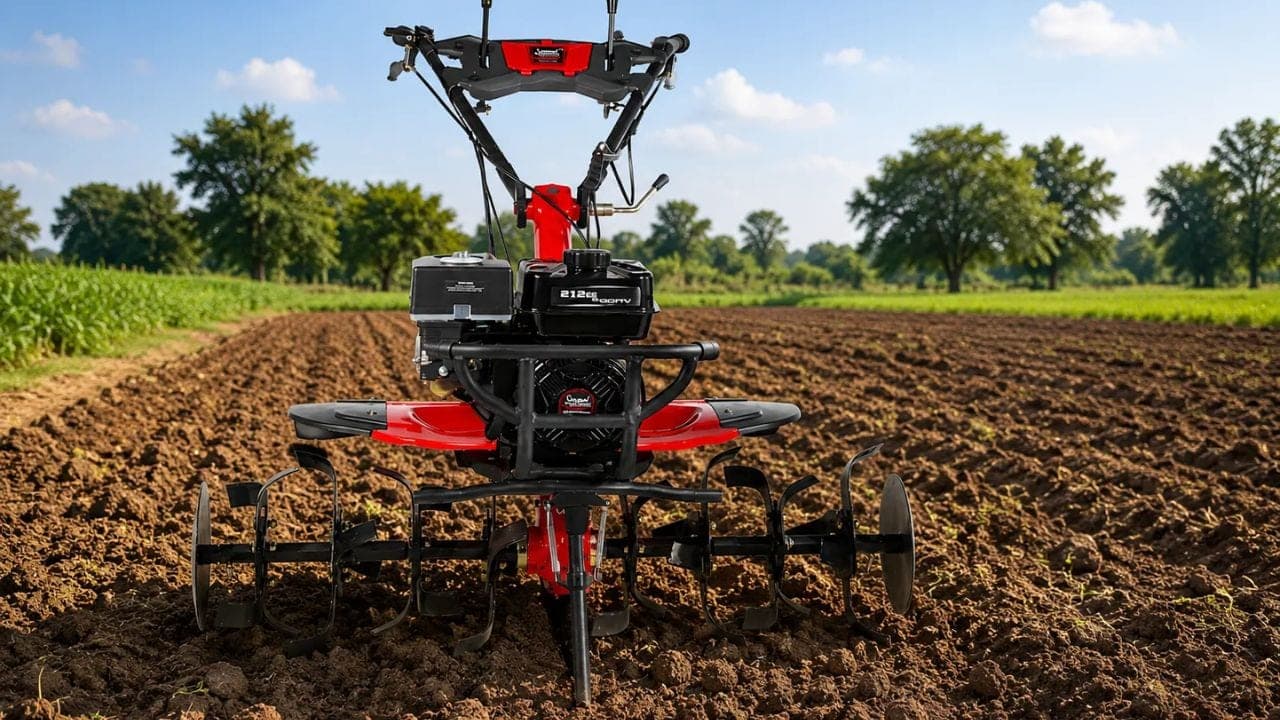
Size on working width and weight, then let horsepower follow. A typical 7 HP power weeder adjusts from roughly 45 to 102 cm wide, weighs about 90 kg and burns 550–650 ml of fuel an hour; a 9 HP cuts around 135 cm, weighs about 126 kg and burns around 700 ml. The wider machine is unusable if it cannot enter your rows at the weeding stage, and the extra 36 kg reduces how much ground one person covers on small irregular plots. The 9 HP earns its weight on hard compacted soil, dense established weeds, deeper work and larger regular plots — where a diesel engine with a heavy-duty gearbox is usually the better match.
The wrong question
Horsepower is the number on the sticker, not the number that decides
Almost every power weeder conversation starts with horsepower. It is on the sticker, it is in the model name, and it is the one figure a buyer can compare across brands without knowing anything else.
It is also close to the least useful thing to choose on.
Two figures decide whether a machine works on your land, and neither is horsepower. The first is working width — whether the machine physically fits between your crop rows. The second is weight — whether one person can wrestle it around a small plot for six hours without the day falling apart. Horsepower matters, but mostly as a consequence of those two: a wider, heavier machine needs a bigger engine to turn it.
Buy on horsepower alone and the common outcome is a machine that is too wide for the rows it was bought for, too heavy for the person who has to walk behind it, and burning more fuel than the job needs.
The comparison
What actually changes between 7 HP and 9 HP
Published specifications for representative models put the trade-off roughly here. Figures vary by make, so treat them as the shape of the difference rather than as a standard.
| 7 HP | 9 HP | |
|---|---|---|
| Working width | 45–102 cm, adjustable | around 135 cm |
| Tilling depth | 7.6–23 cm | 10–30 cm |
| Weight | about 90 kg | about 126 kg |
| Fuel burn | 550–650 ml/hour | around 700 ml/hour |
Read the weight row again. The 9 HP machine is around 40% heavier. That is the difference between the two that a farmer feels every single hour, and it is almost never the one discussed at the point of sale.
The width row is the other one that matters, and it is a hard physical limit rather than a preference. Depth and fuel differ too, but a machine that cannot enter the row is not a slower machine — it is an unusable one.
Width
Measure your rows before you look at a single brochure
A 9 HP machine cutting about 135 cm wide is excellent in an open field being prepared before sowing. Between growing rows it is often simply too wide.
This is why the same horsepower question has different answers for different crops. Closely spaced vegetables — tomato, brinjal, chilli — want a narrow machine with adjustable blades that can be set in tight. Widely spaced row crops like sugarcane and cotton give a bigger machine room to work. Orchards and plantation crops want depth and torque more than width.
The practical step costs nothing and almost nobody takes it: go and measure the gap between your rows at the stage you will actually be weeding, not at sowing. Weeding usually happens when the crop has grown into the row and the working gap is at its narrowest. Then subtract clearance for the wheels and for the operator not steering perfectly on uneven ground.
That number, not the horsepower, is the first filter. Anything wider than it is off your list regardless of what else it offers. A 7 HP machine adjustable down to 45 cm covers far more Indian cropping situations than a fixed wide one, which is why the adjustable range matters more than the maximum.
Weight
Thirty-six kilos is the difference between a tool and a wrestling match
Weight is the most underrated specification on the sheet. A power weeder is not driven; it is walked behind and steered by hand, and every headland turn means physically manoeuvring it.
On a large, regular, open plot, extra weight is close to free — the machine tracks straight and you turn a handful of times an hour. On small or irregular plots, which is most Indian holdings, you turn constantly, and the difference between 90 kg and 126 kg stops being a specification and becomes how tired the operator is by mid-afternoon. Field efficiency drops with fatigue, and as the running-cost arithmetic shows, coverage per hour is what actually sets your cost per acre.
Weight also decides who can use the machine. If it will be operated by more than one person in the household, or by anyone older or slighter than the person buying it, the heavier machine can quietly become a one-operator machine — which is a real constraint in a season where the weeding window is short.
There is a transport dimension too. A 90 kg machine can be manhandled onto a trolley between plots by two people. At 126 kg that becomes awkward, and if your land is in scattered parcels, moving the machine is part of the job.
The case for more
When 9 HP genuinely earns its weight
None of this makes the bigger machine wrong. There are conditions where 7 HP will disappoint and the extra engine pays for itself.
Hard or compacted soil. Where the ground resists, torque matters more than anything, and this is where a diesel engine with a heavy-duty gearbox is usually recommended over petrol. A machine that stalls or rides up over hard ground is not doing the work no matter what the sticker says.
Dense, established weeds. Larger machines are credited with clearing around 92% of weeds in a single pass. If you routinely go in late — and most people do, because labour and weather rarely cooperate — one effective pass can beat two marginal ones.
Deeper work. If the machine will double as light tillage rather than only inter-row weeding, the greater depth range is genuinely useful.
Bigger, regular plots. Where you are covering serious area in open ground, the wider cut converts directly into acres per hour, and the weight penalty largely disappears.
The pattern is straightforward: the bigger machine wins on hard ground and open area, and loses on narrow rows and small irregular plots.
The rule
Size to the tightest row and the longest day
Work through it in this order, and horsepower will be the last thing you decide rather than the first.
- Measure the narrowest gap you will need to drive through, at the growth stage you will be weeding. Everything wider is out.
- Ask who is operating it, for how long, and on what shape of plot. If the answer includes small irregular parcels or more than one operator, weight the decision toward the lighter machine.
- Judge your soil honestly. Hard, dry, compacted ground argues for torque and diesel; loose worked soil does not.
- Only now look at horsepower, and take the smallest engine that satisfies the first three.
The failure mode worth avoiding is buying up. Excess horsepower is not free insurance: it costs more to buy, burns more fuel every hour whether or not you need the power, and adds weight you carry on every turn for the life of the machine. A machine one size too big is a cost you pay daily for a capability you use rarely.
And if the honest answer is that the right machine is barely used a few days a season, the sizing question may be the wrong one entirely — the arithmetic on hiring rather than owning is in the running-cost piece.
Why it matters
This is a purchase most smallholders make once, on borrowed or hard-saved money, from a dealer whose easiest pitch is a bigger number. Overbuying is not a neutral mistake: the larger machine costs more upfront, burns more fuel every hour regardless of whether the power is used, and adds weight that has to be manhandled at every turn for years. On the small, irregular plots that describe most Indian holdings, that weight cuts the ground covered in a day — which raises cost per acre rather than lowering it. The specification that actually disqualifies a machine, working width against real row spacing, is the one nobody checks before buying.
Frequently asked
Should I buy a 7 HP or 9 HP power weeder?
Decide on working width and weight first, and let horsepower follow. A 7 HP machine typically adjusts from about 45 to 102 cm wide and weighs around 90 kg; a 9 HP is around 135 cm and 126 kg. If your rows are narrow at the weeding stage, or your plots are small and irregular, or more than one person will operate it, the lighter machine is usually right. The 9 HP earns its weight on hard compacted soil, dense established weeds, deeper work, and larger regular plots.
Is a higher HP power weeder always better?
No. Excess horsepower costs more to buy, burns more fuel every hour whether the power is needed or not, and adds weight that must be manoeuvred at every headland turn for the life of the machine. On small irregular plots that weight reduces how much ground gets covered in a day, which raises the cost per acre rather than lowering it. Buy the smallest engine that meets your width, weight and soil requirements.
What working width do I need for my crop?
Measure the gap between your rows at the growth stage when you will actually weed — not at sowing, since the working gap is narrowest once the crop has grown into the row — then subtract clearance for wheels and imperfect steering. Closely spaced vegetables such as tomato, brinjal and chilli need a narrow, adjustable machine. Widely spaced crops such as sugarcane and cotton allow a bigger one. Orchard and plantation work usually needs depth and torque more than width.
Petrol or diesel power weeder?
Diesel with a heavy-duty gearbox is generally recommended where soil is hard or compacted, because the job needs torque rather than speed and a machine that stalls or rides up over hard ground is not doing the work. Petrol machines are lighter, usually cheaper to buy and easier to start, which suits loose worked soil and lighter inter-row weeding. Match the engine to your soil's resistance rather than to a general preference.
Source
- STIHL India — How to choose the right power weeder for your farm
- ASPEE — Choosing a power weeder for farm size and crop type
- Greaves Engineering — Power weeders: prices, features and farming efficiency
- ICAR — AICRP on Farm Implements and Machinery: interculture equipment
The specifications quoted — 45–102 cm and about 90 kg for a 7 HP machine, around 135 cm and 126 kg for a 9 HP, fuel at 550–700 ml an hour, tilling depths of 7.6–23 cm and 10–30 cm — are published values for representative models sold in India and vary between makes and between variants of the same make. They are used here to describe the shape of the trade-off between the two sizes, not as a standard any given machine will meet; check the specification sheet for the model in front of you. The figure that larger machines clear around 92% of weeds in a single pass comes from manufacturer material rather than independent trial data and is reported as such. No prices appear in this article by design, because they date faster than anything else in the category. This piece does not recommend a brand and none of the sources cited paid for or supplied its inclusion.