Cotton
Gossypium spp. · Malvaceae (mallows)
India's most important fibre crop and the backbone of its vast textile industry — grown on the world's largest cotton area.
Production · Cotton
32.52M bales
1 bale = 170 kg — 2023–24 Final Estimates
Source: DA&FW Final Estimates 2023–24 (PIB)
2023–24
In the IndianAgri Data Atlas
India's cotton production, 2025-26 — with the state-by-state series behind it, every figure dated and sourced.
290 lakh bales (170 kg)
Top producing states
All cotton data, by state and year →Key figures
About cotton
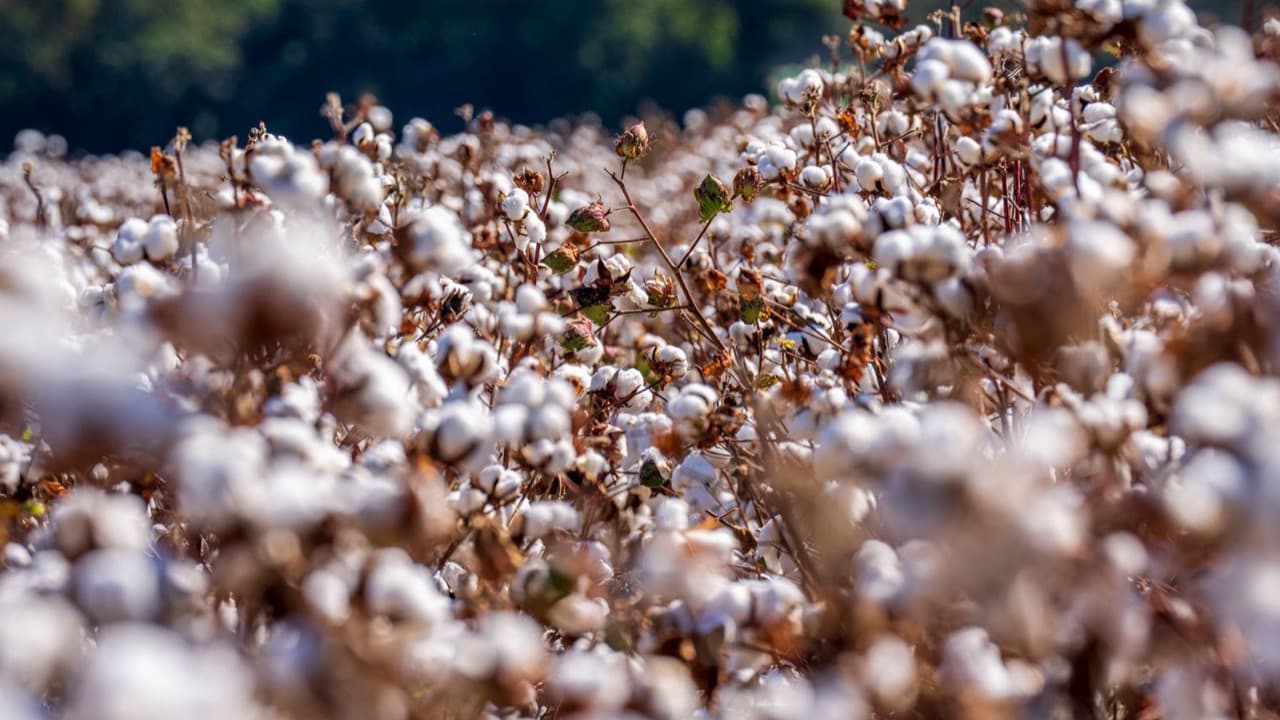
Cotton is India's most important fibre crop — the raw material for a textile-and-apparel industry that employs millions and anchors rural incomes across the west, centre, and south.
It is a kharif crop, sown with the pre-monsoon and monsoon rains and picked over a long autumn-to-winter window. India grows cotton on the largest area of any country, though much of it is rain-fed, so yields swing with the monsoon.
Since the mid-2000s, Bt (insect-resistant) hybrids have come to dominate India's cotton fields. The crop yields both lint for spinning and cottonseed, which is crushed for oil and used as cattle feed.
Where it’s grown
Leading producing states
- 1Gujarat9.05M bales
- 2Maharashtra8.04M bales
- 3Telangana5.08M bales
Gujarat, Maharashtra and Telangana together grow about two-thirds of India's cotton. Figures are DES/cotton crop estimates for 2023–24 (one bale = 170 kg).
How it’s grown
- Season
- Kharif
- Sowing
- April–June
- Picking
- October–February (long window)
- Climate
- Warm, frost-free; 21–30°C
- Water
- Moderate; a large share is rain-fed
Major varieties
Bt cotton hybrids
Insect-resistant hybrids that now cover the vast majority of India's cotton area.
Shankar-6
A widely grown, widely exported long-staple cotton from the west.
Suvin
India's finest extra-long-staple cotton (Tamil Nadu), comparable to Egyptian Giza.
DCH-32
A long-established, high-quality hybrid.
H-4
The world's first commercial cotton hybrid, developed in India by CICR.
Bt-cotton hybrids now dominate India's cotton area; the notable public varieties/hybrids shown here are from ICAR-CICR (not an area-ranked list). ICAR-CICR — cotton varieties.
Economics & trade
Cotton is priced through a Minimum Support Price with two grades — ₹8,267 per quintal for medium staple and ₹8,667 for long staple in 2026–27, each ₹557 above the previous season and the second-largest absolute rise of any kharif crop. The Cotton Corporation of India procures when market prices fall below the MSP.
What a quintal earns over cost. CACP puts the cost of growing medium-staple cotton at ₹5,511 per quintal (A2+FL — paid-out expenses plus imputed family labour). Every quintal sold at MSP therefore returns about ₹2,756 over that cost, a margin of exactly 50% — the statutory floor the 1.5× formula allows. Mind the units: India's average cotton yield is 436 kg of lint per hectare — about 1.8 quintals an acre — but MSP is paid per quintal of *kapas* (seed cotton), and lint is only about a third of kapas by weight. An average acre therefore carries roughly 5 quintals of kapas, worth on the order of ₹14,600 over cost at MSP. The kapas conversion is ours, not an official figure, and yields swing widely with rainfall and pink bollworm pressure.
India is among the world's largest cotton producers and a major exporter of cotton and cotton yarn; premium extra-long-staple varieties such as Suvin fetch a quality premium comparable to Egyptian cottons.
Uses
- Lint spun into yarn and woven for the textile and apparel industry — cotton's primary use.
- Cottonseed crushed for edible oil, with the residual cake used as protein-rich cattle feed.
- A major source of employment across farming, ginning, spinning, and textiles.
Notable facts
- India has the world's largest area planted to cotton.
- The vast majority of India's cotton is now Bt (insect-resistant) hybrid cotton.
- Suvin, grown in Tamil Nadu, is India's finest extra-long-staple cotton — comparable to Egyptian Giza.
- H-4 was the world's first commercial cotton hybrid, developed in India.
Frequently asked
- In which season is cotton grown in India?
- Cotton is a kharif crop — sown from April–June and picked over a long window from October to February.
- What is the MSP of cotton?
- The MSP for medium-staple cotton is ₹8,267 per quintal for 2026–27 and ₹8,667 for long-staple, approved by the CCEA on 13 May 2026. Both rose ₹557, the second-largest absolute increase of any kharif crop this season.
- What is the cotton yield per acre in India?
- India's average cotton yield is 436 kg of lint per hectare, about 1.8 quintals an acre. Note the unit: that is lint, while MSP is paid per quintal of kapas (seed cotton), and lint is roughly a third of kapas by weight — so an average acre carries around 5 quintals of kapas.
- What is the cost of cultivation of cotton per quintal?
- CACP puts the cost of producing medium-staple cotton at ₹5,511 per quintal for 2026–27, covering paid-out expenses plus the imputed value of family labour. Against the ₹8,267 MSP that leaves about ₹2,756 a quintal, a margin of exactly 50%.
- Which is the largest cotton-producing state in India?
- Gujarat is India's largest cotton producer (about 9 million bales in 2023–24), followed by Maharashtra and Telangana.
- How much cotton does India produce?
- India produced 32.52 million bales (of 170 kg each) in 2023–24 (Final Estimates) and is among the world's largest producers, with the largest cotton area.
- What is Bt cotton?
- Bt cotton is an insect-resistant hybrid cotton that now accounts for the vast majority of India's cotton area.
Latest cotton coverage
Updated automatically as new cotton coverage is published.
FACT Halts Ammonium Sulphate Output as Sulphur Crunch Bites; Imports Step In for Kharif 2026
23 July 2026
7 HP or 9 HP? Sizing a Power Weeder Without Overbuying
11 July 2026
Record Imports Drive India's Cotton Opening Stocks to All-Time High of 93.59 Lakh Bales for 2026-27
12 August 2026
Domestic Cotton Prices Surge on Global Cues, Tight Stocks, and Delayed New Crop
11 August 2026
Kharif Sowing Deficit Narrows to 2.9% as Surplus Rains Boost Acreage in Final Week of July
4 August 2026
Fertiliser Demand Rebounds in July as Kharif Sowing Picks Up Pace
2 August 2026
Cotton Imports Set for Record 60 Lakh Bales in 2025-26 as Mills Chase Duty-Free Window
30 July 2026
India's Cotton Sowing Crosses 100 Lakh Hectares as Monsoon Momentum Builds
29 July 2026
India's Cotton Output Drops 17% in Five Years as Raw Cotton Imports Surge Over 80%
24 July 2026
Price Surge Bigger Threat Than Monsoon Gaps for India's Soluble Fertiliser Sector: SFAI
12 July 2026
Drip Irrigation Cost Per Acre in India — and What the Subsidy Really Pays
16 August 2026
India Weighs Restricting Carbosulfan as Pesticide Crackdown Gathers Pace
9 August 2026
Tamil Nadu Agriculture Budget 2026-27: ₹58,374 Crore Allocated, Organic Farming and AI Push Take Centre Stage
7 August 2026
The DSR Map of India: Which States Are Leading and Which Are Lagging
2 August 2026
China's Yarn Hunger Drives India's Cotton Consumption to Record Highs
14 August 2026
US Eyes India as Fourth-Largest Cotton Market in 2026 Amid Area Decline and Monsoon Uncertainty
15 July 2026
Kharif Sowing Trails Last Year by 17.96 Lakh Hectares as Rice Area Falls 4.41%; Rainfall 11% Below Normal
11 August 2026
Gujarat's Kharif Sowing Crosses 50 Lakh Hectares Despite 33% Rainfall Deficit
29 July 2026